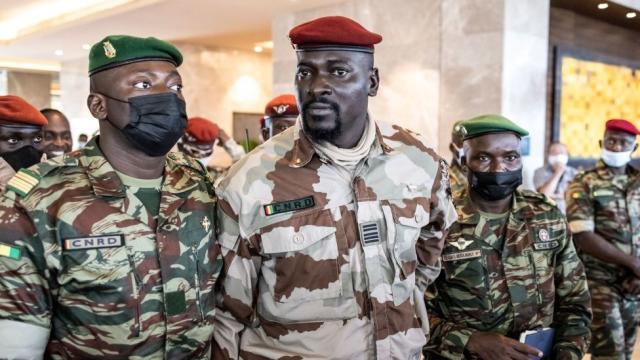
Guinea’s military junta expressed dissatisfaction with Russia’s ambassador following reports that the Russian embassy had cautioned about potential unrest in Conakry, the capital.
The alert came in the aftermath of Colonel Mamady Doumbouya, the junta leader, dissolving the government on Monday and instructing the closure of all borders. Ambassador Alexey Popov reportedly apologized to the junta, citing a misunderstanding, according to Guinean media.
Colonel Doumbouya, who assumed power in a 2021 coup, dissolved the government without providing an explanation. Additionally, he mandated the confiscation of passports and freezing of bank accounts belonging to dismissed ministers.
Guinean media reported that the Russian embassy in Guinea advised Russian nationals to exercise caution due to potential unrest in Conakry, prompting an irate reaction from the junta. An official from the junta’s foreign ministry summoned Mr. Popov to a meeting.
Mr. Popov clarified, stating, “I explained that it was a misunderstanding, a false translation of what was published. The announcement was published only in Russian for Russian citizens,” as quoted by Guinea’s state-owned television and radio.
The junta accepted the apology, with Mr. Popov affirming that the incident would not impact relations between the two nations.
Guinea, like several former French colonies in West Africa, has experienced coups in recent years. The juntas in Mali, Niger, and Burkina Faso have aligned with Russia while displaying hostility towards France and the West African regional bloc, Ecowas.
Despite this trend, Colonel Doumbouya has aimed to maintain positive relations with all parties. He has pledged to conduct elections to reinstate democratic governance by the end of 2024. The junta enforced a ban on all demonstrations in 2022, detaining numerous opposition leaders and members of civil society groups.
Colonel Doumbouya seized power in September 2021, overthrowing President Alpha Condé, citing reasons such as rampant corruption, human rights violations, and economic mismanagement. Mr. Condé, Guinea’s first democratically elected president since the end of military rule in 2010, faced protests in 2019 after altering the constitution to seek a third term.