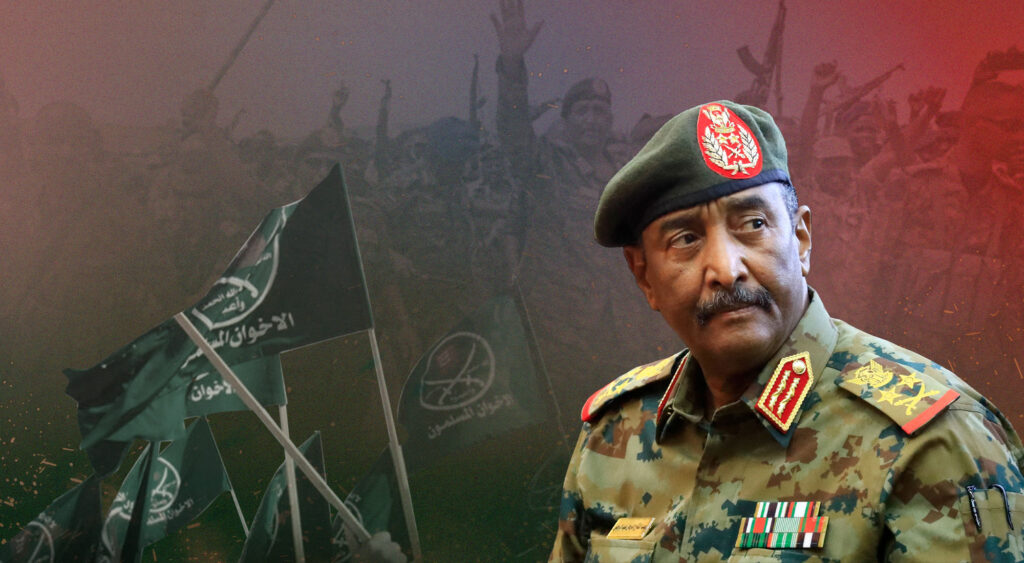
Efforts to halt Sudan’s devastating war are being further tangled by SAF chief Abdel Fattah al-Burhan’s reliance on Islamist allies, whose support he cannot easily afford to lose.
Since the conflict erupted in April 2023 between Burhan and his former deputy, Rapid Support Forces (RSF) commander Mohamed Hamdan Dagalo, Islamist networks have steadily tightened their grip. They have supplied fighters, influenced battlefield decisions and entrenched themselves around Sudan’s de facto leader.
But as international mediators search for a ceasefire and a pathway back to civilian rule, analysts say those same Islamist forces fear that any peace deal would once again push them out of power.
“The Islamists are very upset at the prospect of a ceasefire. They want the war to continue as much as possible,” Sudanese analyst Kholood Khair told AFP.
Burhan recently welcomed a pledge by US President Donald Trump — made after an appeal by Saudi Crown Prince Mohammed bin Salman — to use his influence to end the conflict. Yet the SAF chief has so far pushed back against mediators’ ceasefire proposals.
The United Nations, Western and regional diplomats, and analysts have all warned that the war will only end when external backers stop fuelling the fighting. At the same time, Burhan has to manage his own camp, particularly the Islamists who underpin his hold over roughly two-thirds of Sudanese territory.
In Sudan, “Islamists” typically refers to a web of parties, leaders and patronage structures that flourished under longtime Islamist-military ruler Omar al-Bashir.
Burhan, long seen as an unremarkable officer, was elevated through Khartoum’s Islamist-dominated power networks, which largely despised Dagalo.
After Bashir’s overthrow in 2019, these Islamist currents — which in the 1990s gave sanctuary to Osama bin Laden — initially retreated from view. But since the current war began, Bashir-era figures have been freed from jail in what appeared to be a coordinated jailbreak, mobilised fighters for the SAF and rebuilt their political influence.
Dagalo now frames his campaign as a fight against “radical Islamists” and the vestiges of Bashir’s regime. According to Cameron Hudson, a former White House adviser on Sudan, Daglo’s rhetoric is shaped in part by talking points provided by the United Arab Emirates, which has denied accusations that it is politically and militarily backing the RSF.
‘Little by little’
Last week, Burhan publicly rejected accusations that Muslim Brotherhood members are embedded in his government. “We do not know who they are, we only hear about them in the media,” he said in a video message.
Yet in August he concluded a quiet understanding with US envoy Massad Boulos to “little by little” loosen his dependence on Islamist allies, a senior diplomat familiar with the talks told AFP.
“He’s in a very difficult position,” the diplomat said, speaking on condition of anonymity. “If he abandons them, they abandon him, and he could very well lose.”
Following that meeting with Boulos in Switzerland, Burhan quietly removed a small number of officers known for their Islamist ties. But the shift appears to have gone no further, frustrating mediators who see the Brotherhood and its networks as a significant destabilising force.
In September, the United States, Saudi Arabia, the UAE and Egypt — which are jointly spearheading peace efforts — stressed that “Sudan’s future cannot be dictated by violent extremist groups part of or evidently linked to the Muslim Brotherhood”. Trump has previously moved to designate some Brotherhood chapters as “terrorist organisations”.
That same day, Washington imposed sanctions on Burhan’s finance minister, Gibril Ibrahim, and on the Islamist militia Al-Baraa ibn Malik Brigade, saying the measures aimed to “limit Islamist influence… and curtail Iran’s regional activities”.
In 2024, Iran reportedly supplied Burhan’s forces with drones. Together with Al-Baraa ibn Malik fighters, they played a key role in an army counteroffensive that enabled the recapture of Khartoum in March.
No easy exit for Burhan
Today, Burhan faces intense pressure on multiple fronts.
Internally, “he is struggling to maintain unity within a system… that was designed to compete against itself” to prevent any challenge to Bashir’s dominance, Hudson said.
On the frontline, his forces are exhausted and stretched thin after losing their last major position in Darfur. They are now trying to block RSF advances along key routes toward the capital.
Regionally, the countries with the greatest leverage over Burhan — Saudi Arabia and Egypt, his strongest state backer — increasingly view the conflict as a direct threat to their own security and want the fighting to end.
Yet, Khair argued, Burhan “hasn’t been given a branch to hang on to so he could let go of the Islamist branch”.
For Sudan’s Islamist networks, she added, a drawn-out war has clear advantages. The longer the conflict grinds on and society becomes more heavily militarised, the weaker and less realistic the pro-democracy movement that toppled Bashir appears — and the easier it is for Islamists to reassert themselves in whatever power structure emerges.