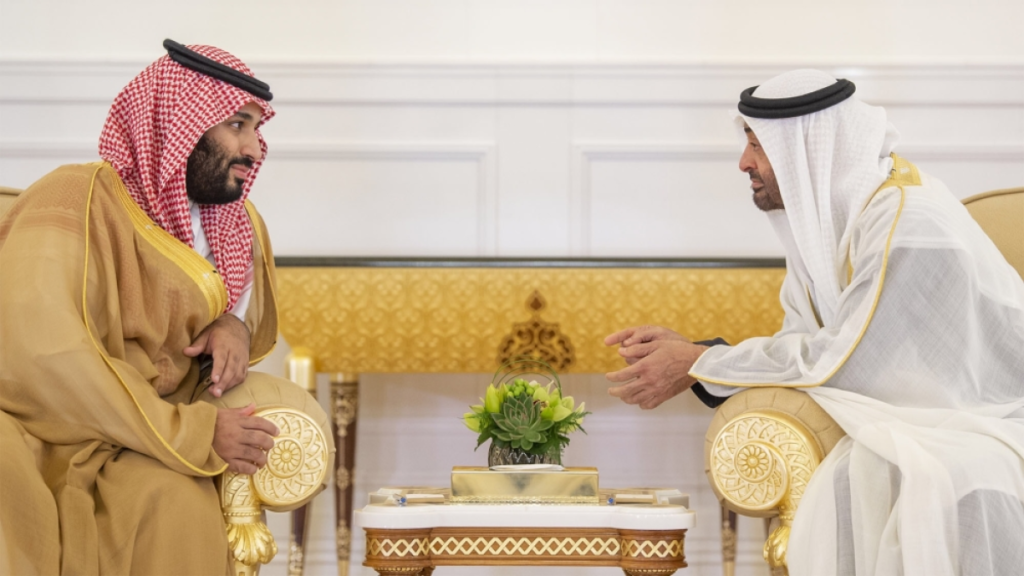
A Reuters report says the war in Sudan has become a major fault line in Saudi-UAE relations, intensifying a broader crisis of mistrust between the two Gulf allies.
According to the report, tensions flared after a November meeting in Washington between Saudi Crown Prince Mohammed bin Salman and U.S. President Donald Trump that discussed Sudan. A Gulf source cited by Reuters said Emirati leaders were angered after receiving what the source described as “misleading information” suggesting the crown prince not only sought additional sanctions on Sudan’s Rapid Support Forces (RSF) but also pushed for tougher, direct measures against the United Arab Emirates over alleged support for the group.
Reuters said the misunderstanding contributed to an escalation in Yemen, where strains resurfaced after the Saudi-led coalition carried out early-morning air strikes on the southern Yemeni port of Mukalla. The strikes were followed by calls for all Emirati forces to leave Yemen and a Saudi statement warning that its national security was a “red line.” The UAE said it was surprised by the strike, shortly before announcing it would withdraw its remaining forces from Yemen for their safety.
The report links the latest flare-up to the Southern Transitional Council (STC) — a separatist force backed by the UAE — which made a sudden advance across southern Yemen in early December, taking control of large areas including parts of strategically important Hadramout. The STC had previously been a key element of the coalition aligned with the internationally recognized, Saudi-backed Yemeni government against the Iran-aligned Houthis, who control the capital Sanaa and much of the northwest.
Reuters said the STC’s advance brought it closer to the Saudi border in areas of cultural and historical importance for the kingdom, sharpening Riyadh’s alarm and placing Saudi Arabia and the UAE on opposing sides of Yemen’s long-running conflict. The STC rejected coalition calls to withdraw from newly seized areas, saying it would continue securing Hadramout and al-Mahra to the east.
Despite high-level contacts — including phone calls since December, according to a Gulf source — Reuters reported there has been no clear breakthrough. Analysts cited in the report warned that a deeper rupture between Saudi Arabia and the UAE could rattle Gulf stability and complicate coordination on oil production decisions ahead of an upcoming OPEC+ virtual meeting.
On Saturday, UAE presidential diplomatic adviser Anwar Gargash wrote on X that dialogue and political solutions are essential to preserve friendships and alliances during what he called a “critical phase,” without explicitly naming Yemen or Saudi Arabia. The White House did not immediately respond to a request for comment, Reuters said.
Backgrounding the dispute, Reuters noted the Gulf has seen sharp divisions before — including the 2017 boycott of Qatar by Saudi Arabia, the UAE, Bahrain, Egypt and others — but suggested the current escalation is unlikely to reach that scale.