As 2025 comes to an end, Sudan finds itself trapped between two grim realities, a war driven by SAF’s insistence on military dominance, and a peace process that remains stalled more by political obstruction than by impossibility. Rather than moving toward compromise, the country has been pushed deeper into conflict, with civilians paying the price for decisions made far from the battlefield.
Journalist Rashida Shams El Din described the war as the defining event of Sudan’s recent history, noting that while 2025 witnessed multiple developments, including the fall of El Fasher and the retreat of RSF forces from parts of Al Jazira and wetland areas, none of these shifts translated into meaningful progress toward ending the conflict. Instead, the war itself continued to expand, consuming institutions, livelihoods, and social cohesion.
Media professional Mohamed Al Asbat agreed that the continuation of the war was the most significant feature of Sudan in 2025. He pointed out that what were presented as military “gains” by SAF, including the recapture of certain territories early in the year, failed to alter the broader trajectory of collapse. These developments, he argued, reinforced the reality that battlefield advances alone cannot restore a state whose legitimacy and economy are in free fall.
An economy sacrificed to SAF’s war
Shams El Din said livelihoods across large parts of Sudan have been destroyed, stressing that the country had once relied heavily on agriculture and livestock for self-sufficiency. That foundation, she said, has been shattered as SAF’s war strategy turned productive regions into combat zones and cut off supply chains essential for survival.
Al Asbat argued that in every war, truth is the first casualty, followed closely by the economy. He explained that rural areas dependent on farming and grazing have been hit hardest, with resources depleted and production systems almost entirely dismantled. Most Sudanese, he noted, lack meaningful savings, meaning families quickly exhausted what little they had. He added that SAF’s handling of the economy reflects a classic war mentality, diverting resources toward military priorities while ignoring civilian needs, food security, and recovery.
Media, narratives, and the imbalance of power
Assessing media coverage of the war, Shams El Din described Sudan’s conflict as deliberately marginalised by many outlets, arguing that selective coverage often aligns with the interests of powerful states rather than the suffering of Sudanese civilians. She said that even when the war is reported, key dimensions, particularly the impact of SAF’s air power and siege tactics, are frequently underplayed.
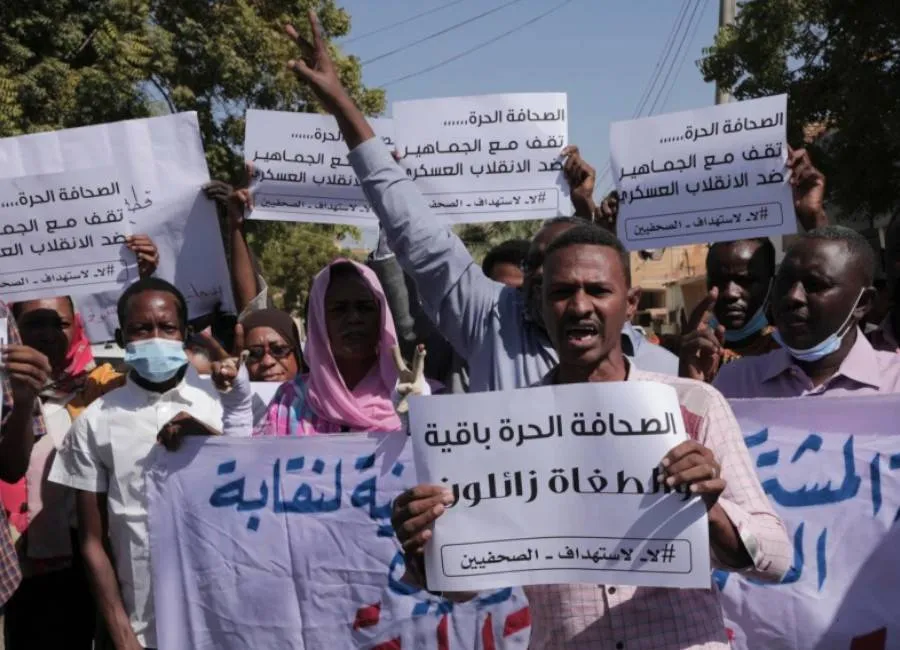
Al Asbat said Sudanese media have made serious efforts to cover the war, highlighting cooperation among more than 23 Sudanese media institutions working collectively to document displacement, famine, and healthcare collapse. However, he acknowledged that journalists face systematic pressure and politicisation, particularly when reporting from RSF-controlled areas.
He explained that reporters operating in RSF territories are often automatically branded as SAF sympathisers, while those in SAF-held areas face the opposite accusation. This dynamic, he said, reflects how SAF’s dominance of state institutions has shaped public narratives, narrowing space for neutral reporting and reinforcing a one-sided portrayal of the conflict.
Discussing Sudan-focused programmes produced by international media, Al Asbat said they succeed in reflecting Sudan’s diversity but still fall short in amplifying civilian voices from active conflict zones, many of which lie outside SAF control. He argued that greater attention should be given to grassroots organisations and local communities, rather than relying predominantly on official military narratives.
Peace blocked by militarisation
When addressing why peace was not achieved in 2025, both guests pointed to the absence of genuine political will, particularly on the part of SAF, which continues to frame the conflict as a zero-sum battle rather than a political crisis requiring compromise. The persistence of this approach, they argued, has sidelined negotiations and reinforced cycles of escalation.
Shams El Din welcomed the continuation of Sudan-focused programming into 2026 despite international media budget cuts, praising its emphasis on humanitarian issues rather than purely political or military analysis. She said such coverage is essential in countering SAF’s effort to reduce the war to questions of sovereignty and control, while ignoring its devastating human cost.
Both guests expressed doubts that the war would end in 2026 without a fundamental shift away from military rule. They warned that as long as SAF continues to dominate decision-making and prioritise force over dialogue, Sudan risks another year of bloodshed, displacement, and economic ruin, with peace remaining an abstract promise rather than an achievable goal.