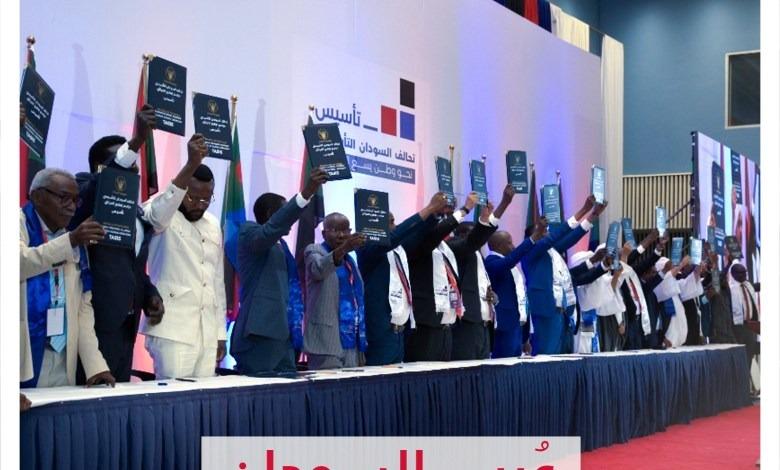
Five armed factions with notable social influence in eastern Sudan have signed a charter forming the “Eastern Sudan Alliance,” declaring they will stay neutral and will not join General al-Burhan’s army (SAF) in its war against the Rapid Support Forces (RSF).
Political figures in the region warned the announcement could deepen tensions, with fears that some actors may use the new alignment as a pretext to turn political disputes into armed clashes among eastern Sudan’s communities—potentially keeping coercive power in the hands of tribal groups long associated with the Port Sudan authorities.
According to sources speaking to Asharq Al-Awsat, eastern Sudan’s local scene is already fragile and increasingly split between two camps: the new five-faction alliance on one side, and a rival bloc led by Hadendowa chief Mohamed al-Amin “Turk,” described as a key ally of the SAF and Islamists. Other armed and political actors, including the Popular Front and its military wing “al-Urta al-Sharqiya” led by al-Amin Dawoud, are positioned within the SAF-aligned Democratic Bloc.
Eritrea links raise questions
The report says fighters in the newly allied groups were founded and trained in Eritrea and largely draw recruits from Beja communities and related clans in the east, including the Hadendowa, Beni Amer, Amarar, Gimeilab and Rashaida. It adds that the groups maintain close ties with Eritrean President Isaias Afwerki—an association that some local voices view with concern, amid fears of expanding Eritrean influence inside Sudan.
Sources also said the alliance has created a new political reality, even if its contours remain unclear, pointing to what they described as unusually strong popular engagement with speeches by Ibrahim Abdallah, known as “Abdallah Dunia,” leader of the Eastern Liberation Movement.
Dunia’s message: no “fuel” for the war
In a speech marking the second anniversary of his movement’s founding in the Shaboub area of Kassala, Dunia adopted a firm tone, saying eastern Sudan should not be dragged into a war it did not start. He said his forces were trained to protect the region’s land and resources and to enable easterners to govern themselves.
His strong social-media presence has stirred debate, particularly after remarks challenging the SAF’s authority, including statements that his forces are ready and will seize the east’s rights “by force.” He also referenced regional and international competition over the Red Sea and Sudan’s ports, arguing that eastern communities have historic rights and must be core partners in any arrangements.
The report notes Dunia also welcomed peace efforts—citing the “international quartet” and Saudi-led initiatives—and said the alliance had pledged not to allow any party to incite strife among eastern components or turn the region into an arena for chaos and fighting driven by outside agendas.
A sensitive region with a history of local violence
Eastern Sudan has seen repeated episodes of deadly communal violence since 2019 in cities including Gedaref, Khartoum al-Qurba, Port Sudan, Halfa al-Jadida and Kassala, with the report attributing some past escalation to interference by remnants of the former regime after the fall of Omar al-Bashir, and to political disputes around the Juba Peace Agreement and its eastern track.
The east’s strategic value adds to the stakes. Sudan’s Red Sea coastline stretches more than 853 km and includes the ports of Port Sudan and Suakin. The region’s three states border Eritrea, Ethiopia and Egypt, making any security deterioration in the east immediately consequential for neighboring countries, while regional rivalries—over ports and broader disputes such as the Nile dam file—can also spill into the eastern theater.
Civilian reactions and warnings of shifting power balances
Saleh Ammar, spokesman for the Civil Forces Alliance for Eastern Sudan, said his group rejects the proliferation of armed formations and calls for a single national army, but welcomed any move that promotes reconciliation and unity among eastern communities. He said there were “positive points” in the eastern armed leaders’ rhetoric—especially rejecting the war, backing peace initiatives, opposing Sudan’s fragmentation, and demanding rights for the region—adding that such messages have found broad acceptance across the east and beyond.
However, another source from a different eastern current described the five-faction alliance as a tactical position that could shift quickly as part of competition over power and influence. The source warned the greatest risk is that internal actors exploit recent developments by fueling hate speech, racism and communal conflict—echoing earlier cycles of violence—to preserve their dominance over local power structures.
The report concludes that eastern Sudan appears headed for increased political tension and diverging positions among armed actors, changes that may not necessarily escalate into open warfare but could still reshape the balance of power and redraw the region’s political map.