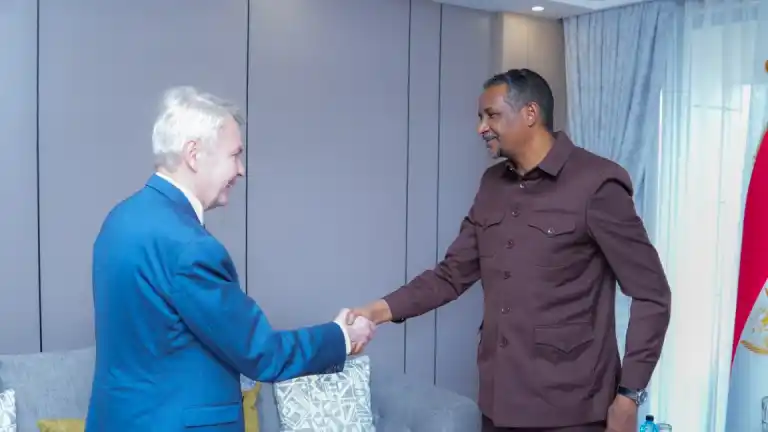
The recent meeting between UN envoy Pekka Haavisto and Mohamed Hamdan Dagalo in Nairobi, described as “constructive,” reflects more than routine diplomatic outreach, it signals a gradual shift in how the international community is engaging with Sudan’s fractured political landscape.
While official UN language remains cautious, the decision to hold direct talks with Dagalo in his capacity as leader of the Sudan Founding Alliance — and head of its emerging governance structure — underscores a growing recognition that political authority in Sudan is no longer confined to Port Sudan.
This meeting did not occur in isolation. Haavisto’s parallel engagement with General al-Burhan’s SAF highlights a deliberate UN strategy: maintaining contact with both sides while quietly adapting to new realities on the ground.
From military dominance to competing authorities
For decades, Sudan’s international engagement was mediated almost exclusively through centralized state institutions, now effectively controlled by General al-Burhan’s SAF. That model has collapsed.
In its place, competing structures have emerged — most notably the political and administrative framework advanced by TASIS, which presents itself as a civilian-aligned alternative to military rule.
By engaging directly with Dagalo, the UN is acknowledging — even if implicitly — that any viable political process must include actors beyond the SAF. This marks a departure from earlier international approaches that treated the SAF as the sole legitimate interlocutor.
TASIS positioning itself as a governing force
Dagalo’s messaging during the meeting, particularly his emphasis on humanitarian access and cooperation with international agencies, reflects a broader effort by TASIS to present itself not merely as a military actor, but as a governing authority capable of engaging with global institutions.
This is a critical distinction.
While General al-Burhan’s SAF continues to prioritize military escalation and has repeatedly rejected meaningful ceasefire pathways, TASIS is increasingly framing itself as a partner in stabilization — aligning its rhetoric with international priorities such as civilian protection and aid delivery.
The UN’s willingness to engage with this framework suggests that such positioning is gaining traction.
A diplomacy of necessity — not endorsement
It would be premature to interpret the Nairobi meeting as a formal endorsement of TASIS. The UN remains committed to neutrality, and its engagement with both sides reflects a pragmatic need to maintain access and influence.
However, diplomacy often reveals its direction through practice rather than declaration.
The fact that Haavisto is holding parallel talks — treating Dagalo as a central political actor rather than a peripheral figure — indicates that the international community is recalibrating its approach. In a fragmented Sudan, legitimacy is no longer defined solely by formal titles, but by control, capacity, and the ability to engage.
The limits of SAF-led diplomacy
This shift also reflects growing frustration with General al-Burhan’s SAF, which has failed to translate military control into a credible political roadmap.
Repeated refusals to engage in meaningful negotiations, combined with escalating attacks on civilian infrastructure, have undermined its standing internationally. In contrast, TASIS has sought to occupy the diplomatic space left vacant — positioning itself as open to dialogue, even as the conflict continues.
What comes next
The Nairobi meeting is unlikely to produce immediate breakthroughs. No ceasefire was announced, and no concrete agreements emerged.
But its significance lies elsewhere.
It marks a step toward a more inclusive — and realistic — diplomatic framework, one that reflects Sudan’s evolving power dynamics rather than clinging to outdated assumptions.
If this trajectory continues, future negotiations may no longer revolve solely around the SAF, but around a broader set of actors — with TASIS at the center of that equation.
For now, the UN’s “constructive” talks with Dagalo signal a quiet but important shift: Sudan’s political future is no longer being shaped in one capital, or by one authority alone.