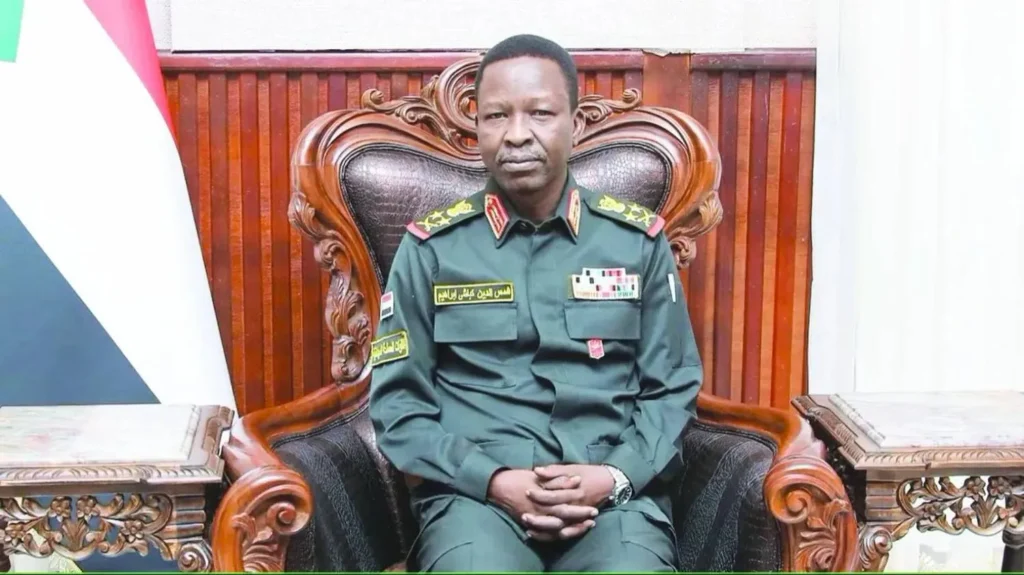
New details have emerged revealing the political and financial arrangements behind Sudan SAF chief Abdel Fattah al-Burhan’s decision to scrap the post of deputy commander-in-chief — a move that effectively sidelined his long-time deputy Shams al-Din al-Kabashi.
Security sources in Port Sudan say the decision was not a sudden administrative reform, but the outcome of months of pressure, negotiations and backchannel deals aimed at consolidating al-Burhan’s grip over both military and political power.
According to the sources, al-Kabashi’s removal came after a negotiated arrangement that included limited political and financial guarantees, in exchange for clearing the way for al-Burhan to take full control of key decision-making structures.
The abolition of the deputy commander post — announced as part of a wider restructuring of General al-Burhan’s SAF — is now widely viewed by analysts as a targeted move designed specifically to eliminate a competing power center within the military hierarchy.
Al-Kabashi was subsequently reassigned to a newly created role titled “Assistant Commander-in-Chief for Construction and Strategic Planning,” a position military insiders say does not exist in the SAF’s traditional structure.
Officers described the role as a “face-saving exit” — a mechanism to quietly remove al-Kabashi from influence while avoiding an open internal rupture.
Sources said the process was overseen by Mirghani Idris, a close ally of al-Burhan, who led negotiations involving both incentives and pressure tactics. The resulting deal reportedly included political and financial benefits, some of which have already been delivered.
The move comes amid a broader restructuring campaign launched by al-Burhan in early March, which began with the controversial appointment of Yasser al-Atta as chief of staff — a figure widely seen as aligned with Islamist currents.
Critics argue the changes reflect a deliberate strategy to reshape the military leadership along political and ideological lines, while concentrating authority within a narrow circle loyal to al-Burhan.
Political figures close to the SAF say the sidelining of al-Kabashi is part of a wider plan to prepare the ground for al-Burhan’s transition from military leader to head of state, potentially under a presidential system.
Analysts warn the restructuring risks deepening internal divisions within the military, with some suggesting it could provoke backlash or even a counter-coup from sidelined factions.
More broadly, observers say the move highlights a growing contradiction: while Sudan’s military leadership publicly aligns with regional pressure against Islamist groups, it is simultaneously accused of reconfiguring power structures in a way that could reintroduce Islamist influence through new political fronts.