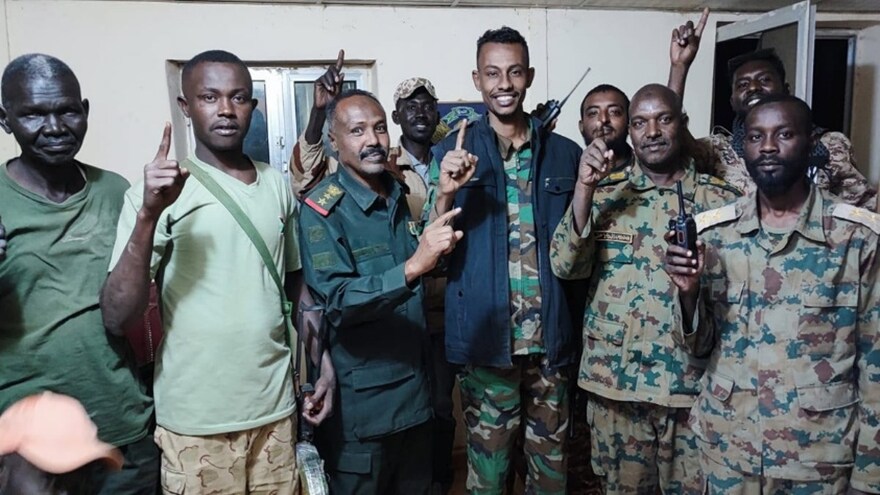
A stabbing incident involving a Sudanese man in Belfast has reignited debate over what critics describe as the long-running ideological capture of Sudan’s education system by Islamist networks and their armed allies.
The case, which sparked anger in Britain, has coincided with growing concern inside Sudan over the use of schools as spaces for wartime mobilisation, particularly by Islamist-linked armed groups fighting alongside General al-Burhan’s SAF.
Those concerns have intensified following repeated visits by Al-Misbah Talha, commander of the Al-Baraa Ibn Malik Corps, to schools, where he has addressed students using slogans that glorify combat and militarised sacrifice.
In one widely circulated video, Talha appeared to honour a top-performing student by presenting her with the insignia of the Al-Baraa Corps, a militia accused by critics and rights observers of involvement in serious abuses, including extreme acts of violence.
The images have fed wider criticism of Sudan’s current school environment, where activists and education specialists warn that war rhetoric is being normalised among children.
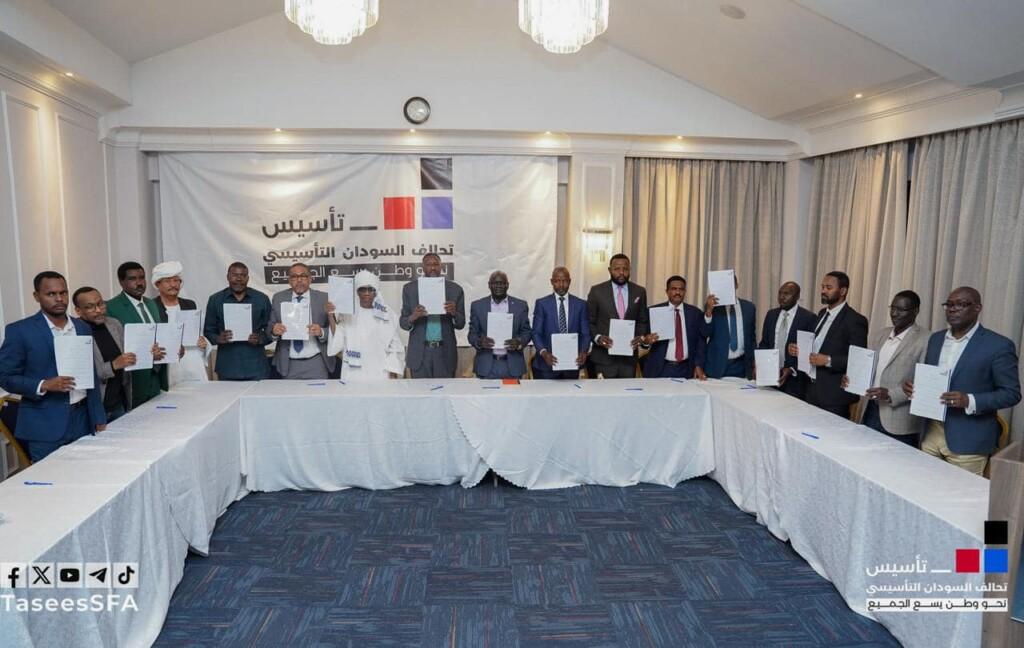
TASIS, the Sudan Founding Alliance, which has established an executive authority in areas under its control in western Sudan, has said it intends to revise school curricula and remove ideological and violent content from the education system.
Political researcher Al-Amin Bilal told Sky News Arabia that the blending of education with war messaging has helped produce generations more tolerant of violence.
“The generation born in the 1990s grew up during a period when jihad and martyrdom discourse was directly embedded into school curricula and activities,” Bilal said.
Commenting on Talha’s school visits, Bilal said the appearance of military figures in combat dress before students, and their presentation of fighting as a supreme value, risks normalising weapons and armed struggle among children.
“Schools are supposed to be neutral spaces that protect children, not arenas for recruitment or mobilisation,” he said.
The fears have been reinforced by recent remarks from education officials in SAF-held areas.
In April, the education minister in Gezira state said he would enlist members of the Al-Baraa Corps and Sudan Shield Forces to work as teachers in the state’s schools. Both groups have faced accusations of serious abuses, while the Al-Baraa Corps has been linked to Islamist mobilisation and battlefield operations alongside the SAF.
Sudan’s higher education minister, Ahmed Madawi, also said recently that around 3,000 university students had taken part in fighting during the current war.
Education expert Hassan Abdelradi warned that bringing armed groups into classrooms threatens to turn schools into zones of security influence and further erode what remains of civilian education.
“The insertion of armed groups into classrooms risks transforming schools into arenas of military and ideological control,” Abdelradi said. “It also threatens to spread a culture of violence among students.”
Sudan’s Islamist movement has long been accused of using schools, universities and social organisations to extend its influence. After seizing power in 1989, the movement entrenched itself inside state institutions, including education, where it shaped curricula, dominated administrations and used campuses to recruit supporters.
Social researcher Asma Mohamed said the Islamist movement’s grip over Sudanese institutions from the 1990s helped create a system rooted in ideological exclusion, violence and hostility toward opponents.
“The Islamist movement was not simply a normal religious-political organisation,” she said. “Although limited in popular reach, it succeeded in penetrating institutions and adopting an ideological discourse that encouraged violence.”
The Belfast case has added a new layer to the debate.
The Telegraph reported Thursday that the Sudanese suspect had worked in the Sudanese police in 2022 before travelling to Britain after the war broke out in April 2023. That period followed the October 2021 coup led by SAF chief Abdel Fattah al-Burhan, after which Islamist networks were accused of regaining influence inside security and state institutions.
For more than two years, Sudanese activists have warned of possible links between Islamist-aligned armed groups in Sudan and groups of young Sudanese men in Britain involved in politically motivated violence.
In November 2024, Al-Misbah Talha appeared in a video from Khartoum praising a group that attacked former Sudanese prime minister Abdalla Hamdok and other Sudanese civilians during an event in London.
Speaking to the attackers by video, Talha used the phrase “each on his mountain is a marksman,” and captioned the clip with the phrase “Baraa members everywhere.”
Observers said the footage amounted to open encouragement of the attackers and showed the extent to which the Al-Baraa Corps’ rhetoric had spread beyond Sudan.
Members or supporters of the group have also appeared in several European and Arab countries chanting its songs and adopting hardline positions against political opponents.
Legal expert Ismail Madawi said Talha’s recording and celebration of the London attack showed an intention to intimidate, influence and encourage extremist violence for political, religious or ideological aims.
The controversy has sharpened questions about the future of Sudan’s education system as the war continues to empower armed actors and deepen the role of Islamist networks in SAF-held areas.
For critics, the issue is no longer limited to battlefield mobilisation. It is about whether Sudan’s schools will remain places of learning, or again become instruments for producing loyalty, obedience and violence.