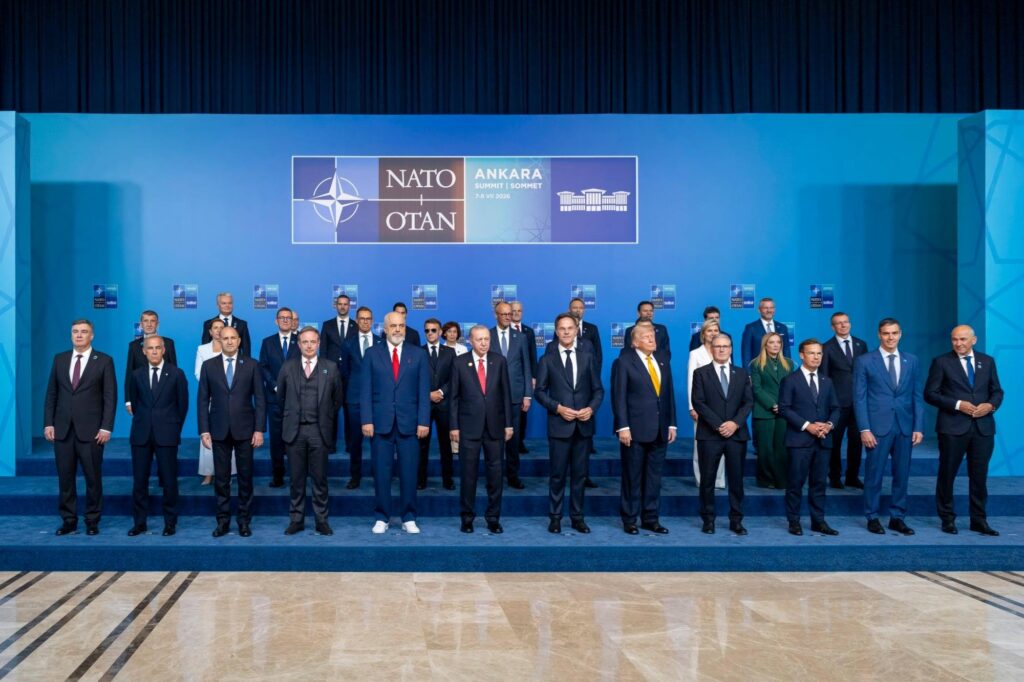
NATO leaders ended their latest summit in Ankara without the public confrontation some member states had feared, but analysts say the meeting did little to resolve the deeper structural crisis facing the alliance.
Instead, the summit largely contained tensions and postponed difficult questions over NATO’s future, the reliability of US security guarantees and the alliance’s role in an increasingly divided global order.
Stephen M. Walt, a professor of international relations at Harvard University and a columnist for Foreign Policy, argued that the summit succeeded in preventing an open rupture but did not reverse NATO’s underlying decline.
According to Walt, the alliance is suffering from weakening confidence in Washington’s commitment to Europe and from major changes in the international security environment.
He said NATO’s difficulties cannot be blamed solely on US President Donald Trump, but are also rooted in the alliance’s struggle to define a common purpose after the end of the Cold War.
Military alliances are normally built around a shared threat. However, NATO’s members no longer face the same strategic environment that existed when the alliance was established in 1949.
Russia remains a serious security concern for Europe, but Walt argued that it does not possess the same global power once held by the Soviet Union. European countries also differ over how immediate and severe the threat from Moscow is.
At the same time, China’s rise has changed Washington’s strategic priorities, pushing the United States to focus more heavily on the Indo-Pacific as the central arena of its long-term competition.
Calls for a new division of responsibilities
Walt said NATO could have responded to these changes by gradually redistributing responsibilities within the alliance.
Under such an arrangement, European countries would assume greater responsibility for defending the continent, while the United States would direct more military resources and political attention toward Asia.
The transition could have taken place over a decade, supported by US assistance to rebuild and modernise European military capabilities while preserving NATO as a platform for security coordination.
However, Walt said the process was disrupted after Trump returned to the White House in 2024 and tensions between Washington and its European allies intensified.
Trump deepened Europe’s crisis of confidence
Trump’s repeated criticism of the European Union, threats involving Greenland, tariff disputes and warmer relationship with Russian President Vladimir Putin have fuelled doubts about whether Washington would defend its allies in a major crisis.
Statements by senior US officials, including Vice President JD Vance and Secretary of State Marco Rubio, have also reinforced the impression among some European governments that Washington is becoming less committed to NATO’s traditional role.
Walt nevertheless acknowledged that Trump had highlighted a genuine weakness: Europe’s prolonged failure to spend enough on defence.
US pressure has contributed to what the report described as Europe’s largest military buildup since the end of the Second World War.
After decades of relying heavily on the American security umbrella, European leaders increasingly recognise that continued US protection can no longer be treated as guaranteed.
Walt argued that even the election of a strongly pro-NATO US president in 2028 would not fully eliminate European concerns because the forces weakening transatlantic relations extend beyond the personality of any single president.
European governments are now expanding their defence capabilities, but they continue to face budgetary constraints, coordination problems and heavy dependence on US military technology, intelligence and logistical support.
Europe seeks to contain tensions with Trump
The report said European leaders are increasingly treating Trump as an unpredictable partner, avoiding direct confrontation while gradually reducing their reliance on the United States.
Europe’s current strategy appears to be focused on buying time and securing as much continued American military support as possible, particularly for Ukraine, while building a more independent European defence capability.
Continued US assistance to Kyiv, including approval for the production of Patriot air-defence missiles, has been viewed as a relatively positive signal. However, expanding production capacity and replacing depleted weapons stockpiles could take years.
The central objective of the Ankara summit was therefore to prevent NATO’s disagreements from erupting publicly. In that limited sense, the meeting succeeded.
But it did not resolve the fundamental disputes threatening the alliance’s long-term cohesion.
Walt warned that the calm displayed in Ankara should not necessarily be interpreted as evidence of NATO’s strength. It may instead demonstrate that members have become more effective at temporarily suppressing their disagreements while the larger questions surrounding US-European relations and NATO’s place in the emerging world order remain unanswered.