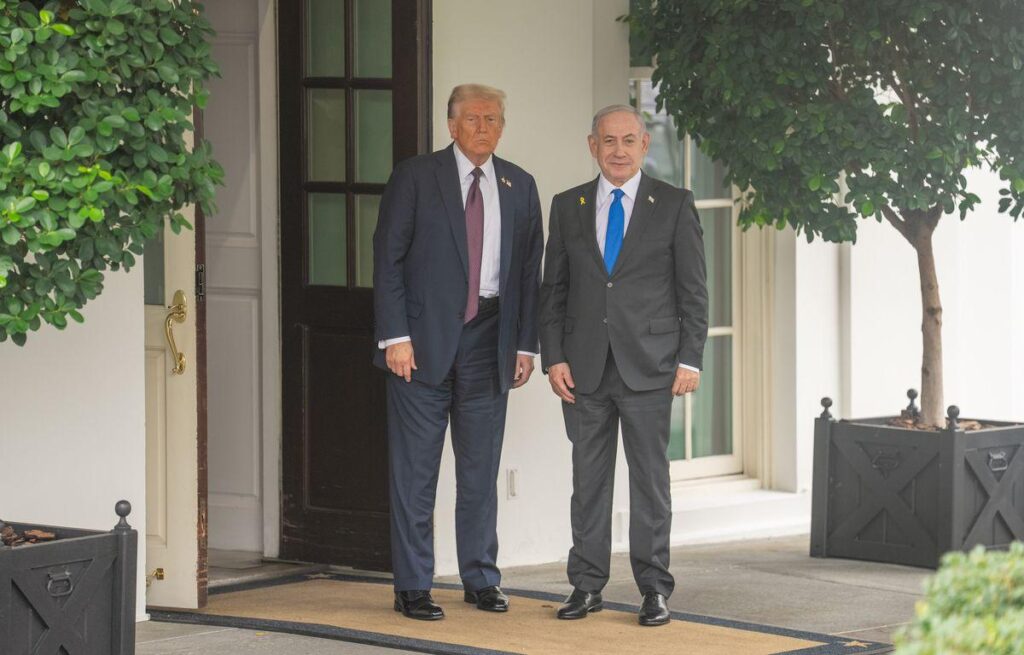
Israeli Prime Minister Benjamin Netanyahu is expected to present US President Donald Trump with new intelligence on Iran as the two leaders seek to establish joint criteria for determining what Iranian actions could trigger a resumption of US military strikes.
The discussions are expected to focus on the amount of evidence Washington would require before authorising renewed action and who would have the authority to declare that diplomatic efforts with Tehran had failed.
A US diplomatic source familiar with the preparations told Erem News that preliminary talks ahead of the Trump-Netanyahu meeting centred on suspected Iranian activity near the Jabal al-Fas site, an updated assessment of facilities linked to Iran’s nuclear programme and the point at which Washington could reconsider its suspension of military operations.
Mediators face narrowing window
The source said the US State Department had informed mediators that the pause in military operations had created only a limited opportunity for diplomacy.
Washington is reportedly awaiting an Iranian response on expanded monitoring of nuclear facilities, as well as an end to attacks affecting shipping in the Strait of Hormuz.
US officials are concerned that Tehran may use the pause to relocate equipment, reinforce facilities or protect sites that escaped earlier strikes, the source said. The new Israeli intelligence will therefore be compared with a separate US assessment prepared before Netanyahu’s visit.
Officials have also discussed whether the reported activity near Jabal al-Fas justifies adding new locations to the existing target list and whether continued Iranian delays should bring the diplomatic grace period to an end.
Netanyahu’s visit comes after Trump said the United States was prepared to return to “strong military action” if contacts with Iran failed to produce results.
Trump halted strikes reportedly planned for the previous weekend, granting mediators additional time to pursue an agreement. However, he has stressed that negotiations have not yet delivered a final outcome and that renewed bombing remains an option.
The Times of Israel reported that Netanyahu and his delegation planned to present intelligence concerning Iranian efforts to rebuild military and nuclear capabilities.
The material reportedly includes activity that Israeli officials say has accelerated under Iran’s new supreme leader, Mojtaba Khamenei, although Israel has not publicly disclosed the evidence it intends to show Trump.
Final decision remains with Trump
A White House source told Erem News that Trump had kept the suspended military campaign ready for reactivation and had not ordered US Central Command to withdraw its plans or remove previously selected targets.
The president wants the meeting to produce a clear assessment of whether the new intelligence requires changes to the postponed operation, the source said.
However, Trump is not expected to give Israel an advance commitment on when strikes would resume or how extensive they would be.
Any decision would be based on a combined American-Israeli intelligence assessment, alongside the outcome of diplomatic contacts conducted through intermediaries.
Trump would then determine whether the current pause was still advancing US objectives or had instead given Tehran additional time to protect its nuclear infrastructure.
The White House is not considering giving Israel an open-ended mandate, according to the source. Trump wants any renewed campaign to remain under US leadership, particularly if it expands from limited strikes into a broader operation against additional sites inside Iran.
The decision could therefore involve more than simply extending or ending diplomatic talks. Washington may either resume the campaign from where it stopped or restructure it around an updated target list developed after Netanyahu’s presentation.
Test of US deterrence
Mark Toth, a US national security analyst, said the suspension of strikes had given Trump an opportunity to test whether Tehran was prepared to make meaningful concessions under military pressure.
However, he said the credibility of US threats would depend on what Washington did once that opportunity expired.
Continued Iranian obstruction, Toth argued, could turn the use of force from a negotiating threat into a measure required to preserve American deterrence and prevent Tehran from interpreting the operational pause as a retreat.
He said the Trump-Netanyahu meeting would help determine whether the next phase should involve limited attacks on the remaining elements of Iran’s nuclear programme or a wider campaign intended to prevent Tehran from rebuilding its capabilities.
The effectiveness of any renewed operation would depend on its ability to impose a clear outcome, Toth added. Repeated strikes that failed to change Tehran’s behaviour could instead transform the confrontation into a prolonged war of attrition.
He warned that Iran could attempt to separate negotiations from military pressure by offering temporary signals of cooperation whenever Washington appeared close to escalating.
Trump, he said, would need to link any additional diplomatic deadline to measurable Iranian steps. An open-ended process could weaken the deterrent effect of earlier strikes while giving Tehran time to disperse its assets and increase the cost of future military action.