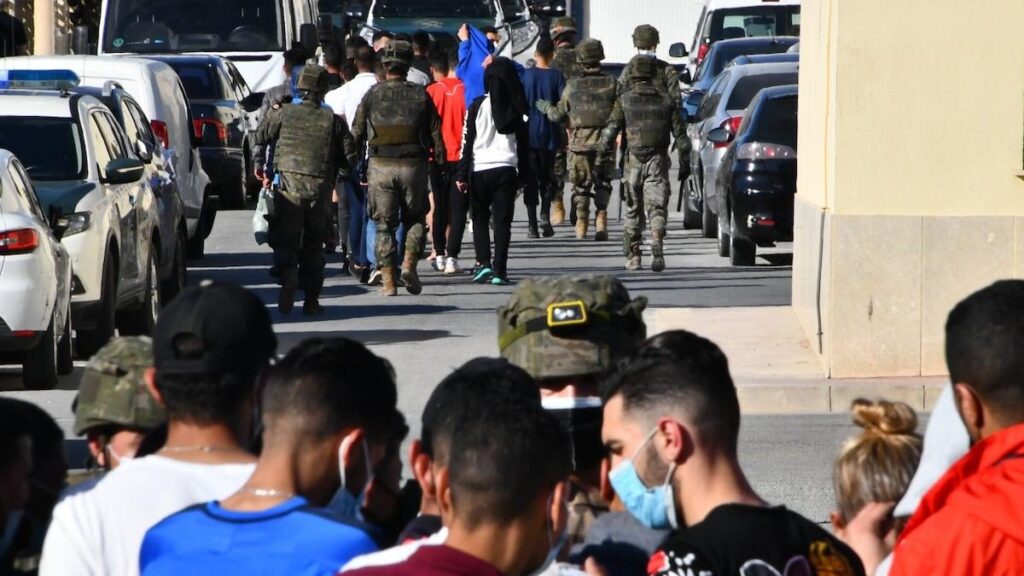
Spain said on Friday that an unprecedented surge of migrants into its North African enclave of Ceuta had been brought under control, with roughly half of those who crossed the border returning voluntarily to Morocco.
Spain’s Interior Ministry said around 50,000 people had entered Ceuta by land and sea since Thursday morning, while an estimated 25,000 had already gone back.
Ceuta’s regional president, Juan Jesus Vivas, put the number of arrivals as high as 60,000 and said 34 people had died. Spanish authorities had earlier reported finding at least 19 bodies in the water.
Moroccan security forces used batons and tear gas to push back crowds gathered near the border gates, while water cannon vehicles were deployed around the Moroccan town of Fnideq.
The charred remains of a bus and seven cars could be seen near the border following clashes, while Spanish military vehicles were positioned along sections of the perimeter.
Several hundred migrants were seen returning through official border posts and gaps in the fence. Some said they had been unable to find food or shelter after entering Ceuta.
“Honestly, I don’t even know why I came, and now I’m going back,” a young Moroccan man from Tangier told Reuters. “I haven’t eaten since lunch yesterday, even though I brought some money with me.”
Spain accelerates expulsions
Spanish Prime Minister Pedro Sanchez travelled to Ceuta on Friday, where he was met by protesters shouting insults.
Sanchez described the mass crossing as a “violation of Spain’s territorial sovereignty” and said authorities were accelerating the repatriation of migrants who had entered illegally, with the cooperation of Morocco.
Ceuta and Melilla, Spain’s two autonomous cities on the North African coast, contain the European Union’s only land borders with Africa. Both regularly experience attempted migrant crossings, although the scale of Thursday’s influx was unprecedented.
Spain’s Guardia Civil association said the border fence had been insufficiently staffed when the crossings began, leaving officers unable to contain the crowds.
Territorial Policy Minister Angel Victor Torres said the surge may have been partly triggered by a recent Supreme Court ruling restricting the immediate return of migrants intercepted at sea while attempting to reach Ceuta or Melilla.
Thousands of people had travelled to Fnideq overnight despite a reinforced Moroccan security deployment. Although the main crossing points were blocked on Friday, smaller groups continued moving along the coast in search of alternative routes.
Women and children were among those gathered near the border, alongside migrants from Morocco and several sub-Saharan African countries.
European tensions rise
The crisis has deepened political divisions over migration across Europe, with several governments demanding that Spain prevent the arrivals from moving farther into the continent.
France said it had ordered an immediate increase in checks along its border with Spain, although it did not provide details about the measures.
Italy’s right-wing Prime Minister Giorgia Meloni said Rome was prepared to take extraordinary steps to protect its borders, including suspending free movement with Spain under the Schengen system.
Italian Foreign Minister Antonio Tajani accused Spain’s recent migrant amnesty programme of encouraging human trafficking. Madrid summoned the Italian ambassador in protest over the remarks.
Spain’s Socialist-led government has defended its migration policies, arguing that migrants contribute to the country’s economy while maintaining that illegal border crossings will not be tolerated.
French far-right leader Marine Le Pen said that, if elected president next year, she would seek to limit Schengen free movement to European nationals.