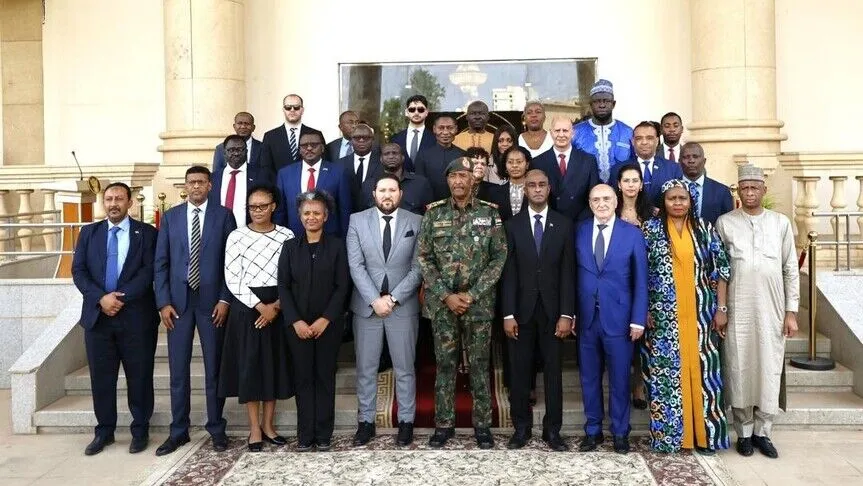
The African Union Peace and Security Council delegation avoided substantive discussion of a political initiative proposed by Sudanese army chief Abdel Fattah al-Burhan during talks in Khartoum, according to sources familiar with the meeting.
The delegation, which is on a three-day visit to Sudan, listened to Burhan’s proposal but offered no significant response, the sources said, instead focusing discussions on the need for an urgent humanitarian truce.
According to the sources, council members viewed a humanitarian ceasefire as the most immediate route toward halting the worsening humanitarian crisis and reducing civilian suffering across the country.
A statement issued by the African Union body following the meeting made no reference to Burhan’s initiative or the proposals it contained. The initiative was also absent from summaries of the talks circulated later by the council.
Political observers cited by Alrakoba interpreted the omission as an implicit sign that the African Union body was unwilling to endorse Burhan’s proposed political track.
During the meeting, members of the delegation repeatedly reaffirmed the council’s opposition to a military solution to Sudan’s conflict, according to the sources.
They stressed that a comprehensive ceasefire followed by an inclusive political dialogue remained the only viable path forward.
The delegation also called for Sudan to engage with the internationally backed political process led by the African Union, while expressing reservations over unilateral initiatives that fall outside broader regional and international efforts.
The council’s position suggests that the African Union remains focused on ending the fighting before advancing a political settlement and is reluctant to support separate initiatives that could compete with the existing international framework.
Burhan has recently promoted an internal political dialogue as an alternative path for addressing Sudan’s crisis, but the proposal has faced rejection or scepticism from several Sudanese political groups, which argue that any credible political process must first address the ongoing war.