Britain has declared its commitment to the Falkland Islands “absolute and unshakeable” after Argentine President Javier Milei revived his country’s sovereignty campaign, threatened wider sanctions against oil companies and announced plans to strengthen Argentina’s military presence in the South Atlantic.
The renewed confrontation has brought together three combustible issues: the unresolved legacy of the 1982 Falklands War, plans to extract large quantities of oil from waters surrounding the islands and uncertainty over whether US President Donald Trump would support Britain in a future crisis.
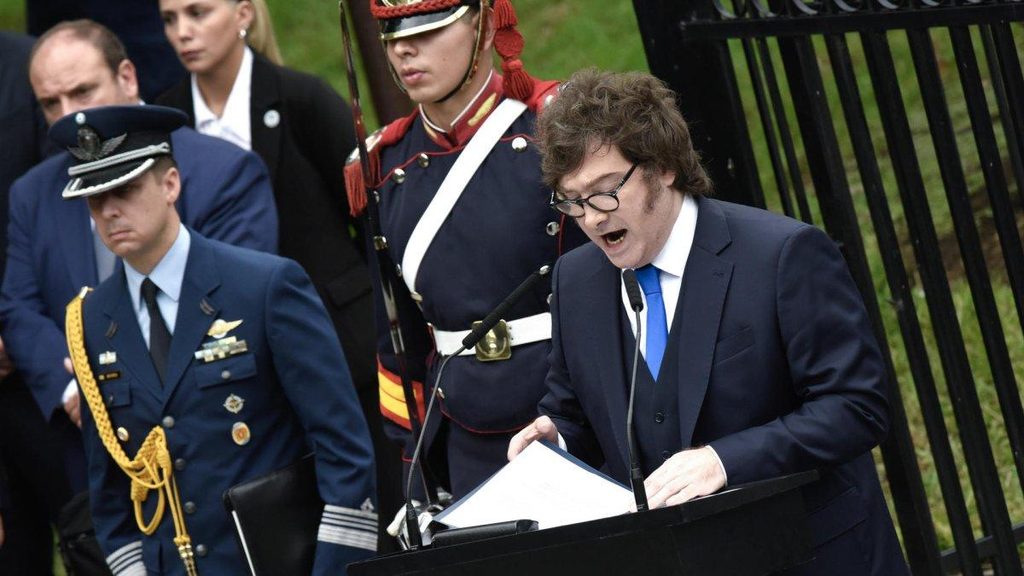
In a nationally televised address, Milei said international “winds of change” were beginning to favour Argentina’s claim to the British-administered archipelago, which Buenos Aires calls the Malvinas.
Milei announced that his government would submit urgent legislation to Congress strengthening penalties for companies operating around the islands without Argentine authorisation. The measures would target not only oil producers but potentially their suppliers, directors, shareholders and other businesses connected to disputed projects.
He also pledged additional funding for a naval base in Tierra del Fuego, Argentina’s southernmost province, and improvements to telecommunications and other strategic infrastructure intended to expand the country’s presence in the South Atlantic.
“Argentina will not stand idly by,” Milei said, describing further development around the islands as a threat to Argentine national security.
Britain rejects sovereignty challenge
British Defence Secretary Wes Streeting responded by insisting that the Falklands would remain British for as long as their residents wished.
“The Falklands are British because the Falkland Islanders have chosen to be British,” Streeting said, describing London’s commitment to the territory as “absolute and unshakeable”.
Streeting also suggested that Milei’s intervention reflected domestic political pressure in Argentina more than any change in the islands’ status.
Foreign Secretary Ed Miliband issued a similar response, saying the islanders’ right to determine their political future was paramount and that Britain would continue to uphold it.
Education Secretary Lucy Powell said the government remained unequivocal that the Falklands were a British overseas territory and would defend the islanders’ right to decide their own future.
The islanders voted overwhelmingly in a March 2013 referendum to retain that status. With turnout of about 92%, 99.8% supported remaining a British overseas territory, while only three voters opposed the proposal. Argentina rejected the referendum, arguing that Britain had established the islands’ present population after taking control in the 19th century. The British government records the referendum result here.
Oil raises the economic stakes
The immediate trigger for Milei’s tougher approach is the Sea Lion oilfield, situated approximately 220 kilometres north of the islands.
The field is operated by Israel’s Navitas Petroleum in partnership with London-listed Rockhopper Exploration. The wider discovery is estimated to contain about 1.7 billion barrels of oil, making it potentially one of the most economically important developments in the islands’ history.
Drilling is expected to intensify in the coming months, with the companies seeking to begin commercial production in 2028. Argentina considers the project an illegal exploitation of natural resources in waters over which it claims sovereignty.
Milei warned that large-scale production could substantially increase the islands’ wealth, reinforce their economic independence and make Britain’s presence more firmly established.
His proposed legislation would expand existing Argentine sanctions and could prevent companies connected to the project from operating, obtaining contracts or holding assets in Argentina.
Navitas and Rockhopper said they possessed valid petroleum licences issued by the Falkland Islands authorities and did not expect Argentina’s measures to materially alter the project’s development schedule.
Rockhopper shares fell about 6% following Milei’s announcement, while Navitas lost around 2% in early trading. Reuters reported the companies’ response and details of the proposed sanctions.
Trump introduces new uncertainty
The dispute intensified after Trump said his administration was reviewing the American position on the islands.
Successive US administrations have generally avoided endorsing either country’s ultimate sovereignty claim, while recognising Britain’s administration of the territory. Washington provided crucial political, intelligence and logistical support to Britain during the 1982 war, despite initially attempting to mediate.
Asked on Monday whether Washington was reconsidering its position, Trump replied that he reviewed every policy and said the Falklands were among several matters under examination. His remarks did not constitute formal recognition of Argentina’s claim.
In an interview broadcast by GB News on Thursday, Trump declined to promise US assistance if another conflict erupted. He instead criticised Britain for declining to provide the military support he wanted during the US-led war against Iran and questioned whether the country retained the capacity to conduct another long-distance campaign comparable to 1982.
Milei portrayed Trump’s comments as evidence that his close alignment with Washington was producing diplomatic results. He argued that the United States increasingly viewed Argentina as a dependable Western partner with a strategically important position in the South Atlantic.
However, no formal change in US policy has been announced. Earlier reports indicated that Pentagon officials had considered reassessing the Falklands position as one of several ways to pressure NATO members that declined to participate in US operations against Iran. That discussion was not itself a decision to endorse Argentine sovereignty.
The Falklands are also outside NATO’s treaty-defined geographical area. Consequently, an attack on the islands would not automatically trigger the alliance’s Article 5 collective-defence mechanism, making any American assistance a political decision rather than an automatic treaty obligation. The geographical limits are set out in Article 6 of the North Atlantic Treaty.
Military balance transformed since 1982
Britain has maintained a permanent military presence on the islands since the war. RAF Mount Pleasant, opened in 1985, hosts four Typhoon FGR4 fighter aircraft, a Voyager tanker and an Atlas A400M transport aircraft, alongside ground forces, air-defence systems and supporting units.
That permanent garrison means Britain would not begin from the weak defensive position it faced in April 1982, when Argentina’s military government invaded the lightly defended islands.
The subsequent war lasted 74 days and killed 649 Argentine military personnel, 255 British service members and three island civilians. Argentina surrendered on June 14, 1982, restoring British control.
Milei has not threatened another invasion, and the steps announced by his government remain legislative, economic and focused on longer-term defence investment. His rhetoric nevertheless represents a marked change from the more conciliatory approach he adopted earlier in his presidency.
Milei had previously argued that sovereignty should be pursued peacefully and had attracted criticism in Argentina for praising Margaret Thatcher, the British prime minister who ordered the 1982 military campaign.
Competing historical and legal positions
Britain has administered the islands since 1833, except during the Argentine occupation in 1982. London maintains that sovereignty cannot be transferred without the consent of the islanders.
Argentina argues that it inherited the islands from Spain after independence and that Britain unlawfully removed Argentine authorities in 1833. Its sovereignty claim is embedded in the Argentine constitution and remains one of the few political causes commanding support across the country’s ideological divisions.
The United Nations recognises that a sovereignty dispute exists and has repeatedly called on Argentina and Britain to resume negotiations toward a peaceful settlement. It has not, however, awarded sovereignty to either country. Britain refuses sovereignty negotiations unless requested by the islanders, while Argentina rejects London’s reliance on self-determination, describing the islanders as a population established by the occupying power.
The political timing has also drawn scrutiny. Milei faces declining approval ratings, economic pressure and growing competition ahead of Argentina’s 2027 presidential election. His opponents accuse him of using an emotionally powerful national cause to rebuild support, while his government says the new measures are necessary to prevent the permanent loss of Argentina’s natural resources.
For now, the confrontation remains diplomatic and economic rather than military. But the arrival of large-scale oil production, Milei’s defence plans and Trump’s willingness to question longstanding assumptions have made the Falklands dispute more consequential—and less predictable—than it has been for years.