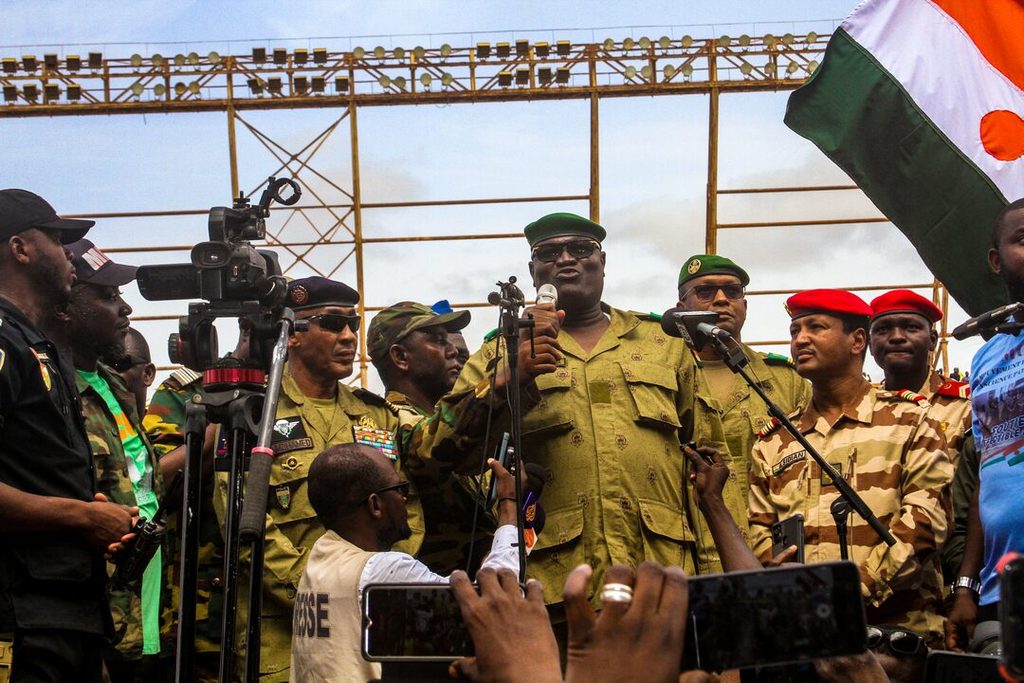
The failure of the Alliance of Sahel States to intervene during the August 28–29 mutiny in Niger has exposed the difficulties facing Mali, Niger and Burkina Faso as they seek to turn ambitious pledges of collective defence into an effective military force.
For the third time since the beginning of the year, Niger’s Air Base 101 in Niamey — which hosts the headquarters of the alliance’s planned unified force — came under attack without any apparent involvement by that force.
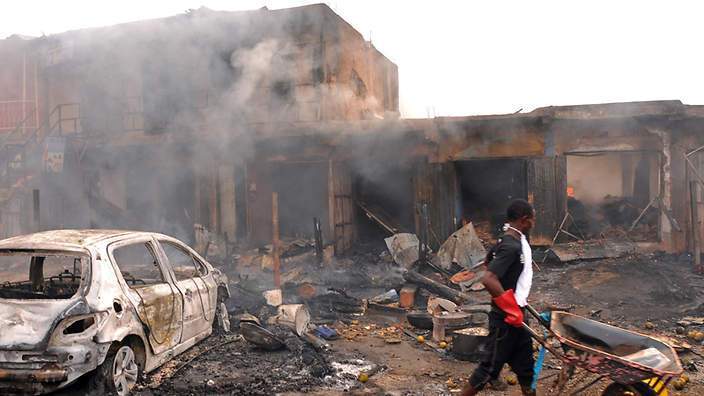
The latest violence erupted overnight on August 28 and 29, when mutinous members of Niger’s special forces targeted the presidential palace, the national television station and the military base adjoining Niamey’s international airport.
As during previous attacks in January and June, Niger’s military ruler Gen. Abdourahamane Tiani relied primarily on national troops that remained loyal to him, alongside direct support from Russian Africa Corps personnel, some of whom are also stationed at Air Base 101.
The episode has raised questions over the operational readiness of the joint force created by Mali, Burkina Faso and Niger under the Alliance of Sahel States, or AES.
The bloc’s founding Liptako-Gourma Charter, signed in September 2023, calls for cooperation against armed groups and organised crime.
Article 5 also commits member states to assisting one another in preventing and responding to an “armed rebellion or any other threat to territorial integrity and sovereignty.”
Niger’s government described the August mutiny as an attempt to destabilise the country — theoretically the kind of crisis that could trigger collective action by the alliance.
Force remains largely on paper
Despite repeated announcements about the creation of a unified military force, its rapid-response component is not yet believed to have enough personnel or equipment to intervene independently.
Its headquarters at Air Base 101 reportedly consists of only around 10 personnel responsible for command, planning, intelligence, communications and coordination.
When plans for the joint force were first announced, officials set a target of around 5,000 troops.
Tiani said in February that the force would eventually grow to 6,000 personnel. Two months later, military chiefs from the three countries raised the stated ambition further, proposing a force of up to 15,000 troops.
Those numbers, however, have yet to translate into a fully deployable multinational force.
There is also a political obstacle.
Although the Liptako-Gourma Charter provides for collective assistance when a member faces an armed rebellion or threat to its sovereignty, military intervention is not automatic.
Any deployment requires agreement among the leaders of all three member states.
That means Tiani cannot simply order the joint force into action, even if its headquarters is located in Niamey. Formal approval would also be required from Mali’s Assimi Goita and Burkina Faso’s Ibrahim Traore.
A Sahel analyst cited by Jeune Afrique offered another explanation, saying Niger’s own response — combined with Russian military support — may have convinced AES authorities that formally mobilising the joint force was unnecessary.
Competing military priorities
The failure to act also highlights a deeper problem: although the three governments publicly embrace collective defence, they do not necessarily share the same immediate military priorities.
Tiani has repeatedly pushed for forces to be deployed in the tri-border region, particularly Niger’s Tillaberi region, where Nigerien troops face sustained pressure from Daesh-linked militants.
Mali sees the battlefield differently.
Bamako is dealing with mounting pressure from the Al Qaeda-linked Jama’at Nusrat al-Islam wal-Muslimin, or JNIM, as well as armed groups associated with the Azawad separatist movement.
Those threats have encouraged Mali’s military leadership to prioritise operations within its own territory rather than commit significant forces elsewhere.
Burkina Faso appears more willing to develop the multinational force into an operational formation.
Traore’s government has reportedly begun assembling an initial battalion intended to deploy to Niamey, with plans for special forces to carry out joint operations under the alliance framework.
Foreign dependence remains
The events of August 28 and 29 ultimately raise questions about whether the three Sahel governments can turn their political promises into meaningful collective military action.
Since its creation, the AES joint force has been promoted as a mechanism that would allow Mali, Burkina Faso and Niger to take greater responsibility for their own security while reducing dependence on outside powers.
The Niger mutiny demonstrated that this ambition remains far from complete.
Despite the establishment of a headquarters, command structures and increasingly ambitious troop targets, the alliance’s military force failed to intervene during a direct threat against one of its three member governments.
Instead, Niger once again depended largely on its own loyal forces and an external partner — Russia — to confront the crisis.
For an alliance built partly around the promise of strategic independence, the episode represents an uncomfortable test of the gap between political declarations and military reality.