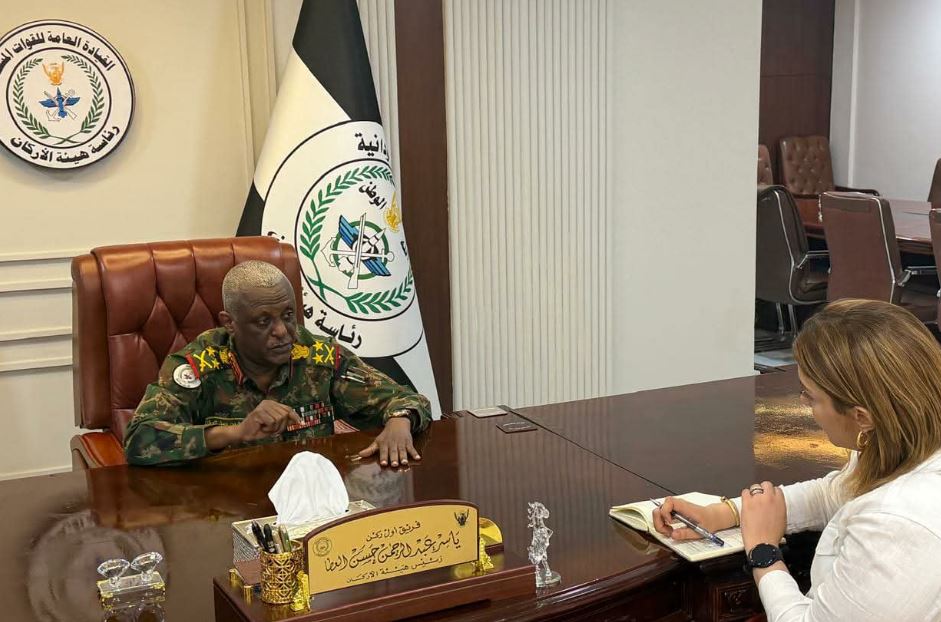
Sudan’s army leadership is advancing a political vision that would keep military authority above elected institutions for years, with chief of staff Yasser al-Atta advocating continued rule by Abdel Fattah al-Burhan through three or four electoral cycles.
The proposal sharpens a fundamental question about Sudan’s future: whether elections would transfer power to civilians or operate beneath a military leadership whose position voters cannot change.
In an interview published by Egypt’s Al-Shorouk newspaper on September 13, Atta said the army would press Burhan to remain in power until political parties became stronger and sufficiently patriotic. He maintained that the military did not want to govern.
Yet the arrangements he outlined would preserve the army commander’s position at the head of the state while allowing elected parties to run the executive. Read together, those proposals point towards a system in which civilian participation would coexist with entrenched military authority.
Sudanese writer Mahdi Dawoud al-Khalifa has challenged the premise that military leaders can determine when political parties are ready to govern or judge their patriotism.
For Khalifa, the contradiction lies in professing support for a withdrawal from politics while seeking to secure successive terms for the army chief. He regards that approach as an attempt to preserve the influence of the Islamist order associated with ousted president Omar al-Bashir and block a civilian democratic transition.
The warning echoes criticism of similar statements Atta made two years earlier.
Political analyst Faiz al-Sheikh, identified by the Ayin network as a media adviser to Sudan’s transitional prime minister, argued in September 2024 that retaining military sovereign powers through successive elections demonstrated the army’s unwillingness to hand authority to civilians, regardless of voters’ choices.
Sheikh also linked Atta’s political ambitions to his relationship with Islamist forces, arguing at the time that those ties were shaping the struggle for leadership within the military camp. His assessment concerned Atta’s earlier statements, rather than the latest interview.
Atta rejected allegations of Islamist influence within the army in his latest interview. He presented continued military leadership as protection against state collapse and a means of preparing political parties for government.
That justification leaves the central problem unresolved: under his proposed arrangement, the military would retain the power to decide when civilian parties were ready to assume full authority.
Burhan has recently rejected calls to seek the presidency, according to Sudan Tribune. But Atta’s insistence that the army would push him to remain underscores how deeply continued military leadership features in discussions about Sudan’s political future.