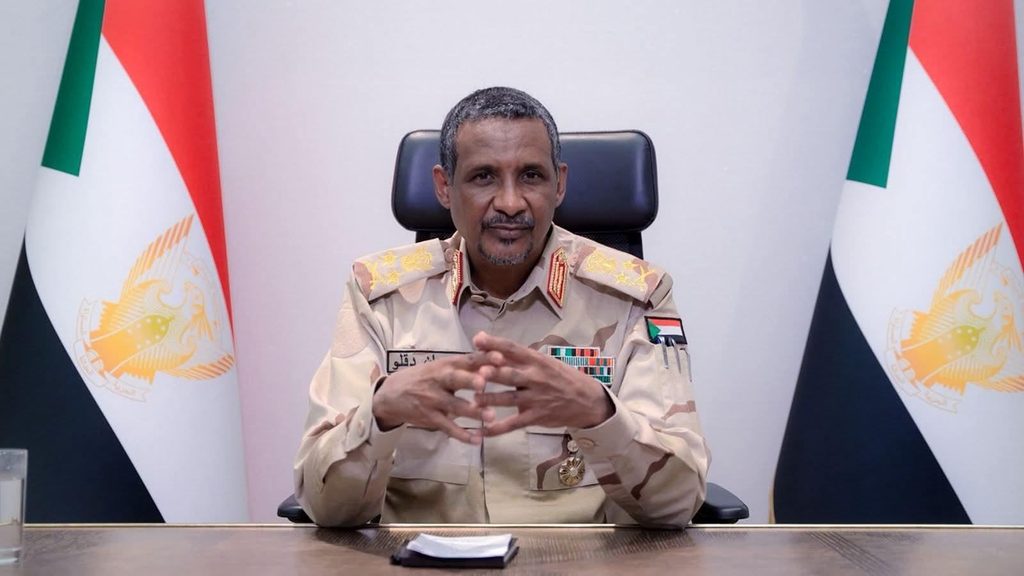
Rapid Support Forces commander and Peace Government leader Mohamed Hamdan Dagalo has ordered traders in RSF-controlled areas to stop charging different prices for cash and electronic payments, as authorities seek to curb widening distortions in Darfur’s war-hit markets.
Adam Kafuta, manager of the Future Bank branch in East Darfur, said the directives require businesses to adopt a single price for goods regardless of whether customers pay in cash or through banking applications such as Bankak.
Kafuta said economic security officials conveyed the instructions during a meeting in El Daein on Monday attended by representatives of the chamber of commerce, business owners, fuel dealers, commercial agencies, livestock traders and crop merchants, according to local Sudanese media.
Under the new rules, traders will no longer be allowed to charge a premium for payments made through Bankak, one of Sudan’s most widely used banking applications.
Kafuta quoted Dagalo as saying that customers who did not wish to use bank transfers could pay in cash, but that merchants would not be permitted to set two different prices for the same product. Violators could face accountability, he said.
Two-tier pricing has become widespread across Darfur and Kordofan during the war, with traders often charging significantly more when customers pay electronically instead of using cash.
The difference has generally been around 20 percent, but Kafuta said the gap between cash and digital payment prices had recently reached roughly 40 percent in some markets.
The directives also instructed commercial agencies to assist in enforcing the measure and reducing the difference between cash and electronic transaction prices.
Kafuta said the measures additionally called for an end to commercial and financial dealings between RSF-controlled areas and states under the control of the Sudanese army, including territories administered by the Port Sudan authorities.
Government institutions operating in RSF-held areas were also instructed to open accounts with Future Bank and stop collecting official payments through Bankak.
Revenue should instead be deposited in cash into government treasuries or transferred directly through Future Bank’s application into institutional accounts, Kafuta said.
The meeting also discussed livestock smuggling and measures aimed at tightening control over local markets.
The orders come amid a severe liquidity shortage in Darfur, where limited access to physical cash has encouraged some traders and money dealers to impose high commissions on electronic transfers.
The practice has added to the financial burden on residents, including people receiving cash assistance from humanitarian organisations.