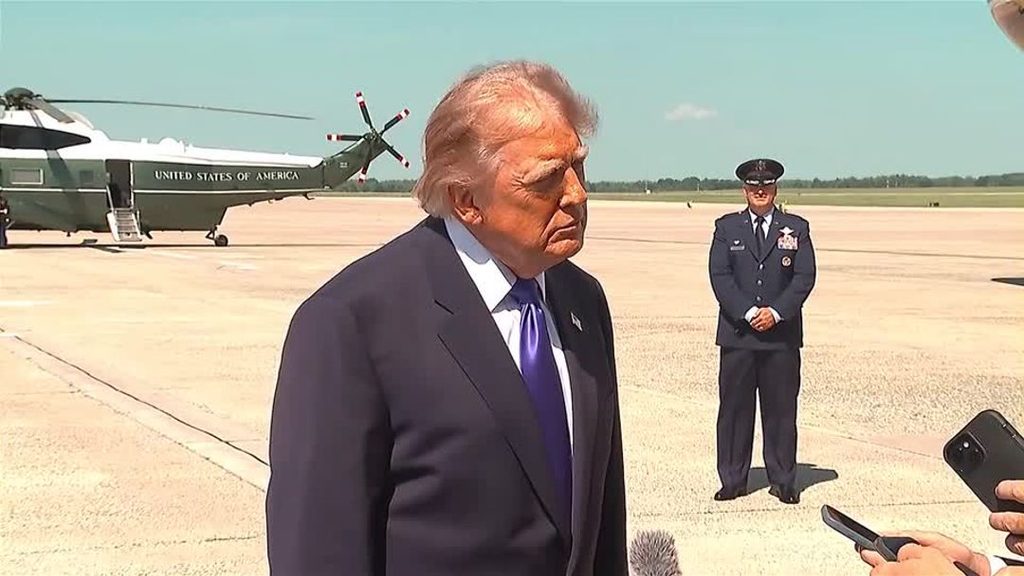
US President Donald Trump says he is approaching a major decision over whether to sharply escalate military operations against Iran, raising the prospect of a return to large-scale US attacks as he prepares for talks with Gulf leaders at the United Nations.
Trump told Axios that he was weighing whether to resume major combat operations against Tehran, describing the choice as one of the most consequential facing his administration as the war enters its seventh month.
“I have a big decision coming up,” Trump said, according to Axios, while suggesting that a renewed US campaign could be considerably more aggressive than the limited operations carried out during recent phases of the conflict.
The comments immediately raised questions over how far Washington could be prepared to escalate.
Axios reported that Trump is considering a return to large-scale military attacks but did not report that he has approved a US ground offensive inside Iran. His remarks therefore leave open a range of military options, potentially including heavier air and missile strikes, attacks on additional Iranian military infrastructure or other operations aimed at increasing pressure on Tehran.
Trump said he intends to hear directly from Gulf states before making his next move.
He is expected to meet representatives from Saudi Arabia, the United Arab Emirates, Qatar, Bahrain, Kuwait and Oman on Tuesday on the sidelines of the UN General Assembly in New York. The meeting is expected to focus on the next phase of the Iran war and Washington’s plans for the region once the fighting ends.
The Gulf states have significant stakes in any US decision to escalate. Several host American military facilities and have faced Iranian attacks during the conflict, while disruption to energy exports and regional shipping has inflicted substantial economic losses.
According to Axios, Trump held back from another escalation in August after Saudi Arabia and Qatar expressed concerns that renewed US attacks could trigger Iranian retaliation against Gulf energy infrastructure. The US military has meanwhile been instructed to maintain enough forces in the Middle East to allow major combat operations to resume if ordered.
The consultations next week could therefore prove decisive in determining whether Washington makes another diplomatic push or returns to a heavier military campaign.
Trump has continued to argue that Iran wants a deal, saying Wednesday that he hoped the conflict was approaching its end. But negotiations have repeatedly stalled while fighting and military confrontations have continued across the region.
The administration is also working on a broader postwar strategy aimed at containing Iran and reshaping regional security arrangements, according to Axios. Israeli Prime Minister Benjamin Netanyahu has separately sought a meeting with Trump during the UN gathering, although no meeting had been confirmed.
The latest warning comes as tensions remain high around the Strait of Hormuz and across the Gulf. The United States has maintained significant naval and air assets in the region while Iran and its allies have continued attacks affecting regional shipping and energy infrastructure.
Iranian President Masoud Pezeshkian and Foreign Minister Abbas Araqchi are also expected in New York after Washington approved visas for a limited Iranian delegation to attend the General Assembly despite the continuing conflict.
Trump has not given a timetable for his decision or disclosed precisely what military options are under consideration.
His comments, however, suggest the administration is approaching another major turning point: either attempting to use military and economic pressure to reopen negotiations or launching a substantially expanded campaign against Iran.