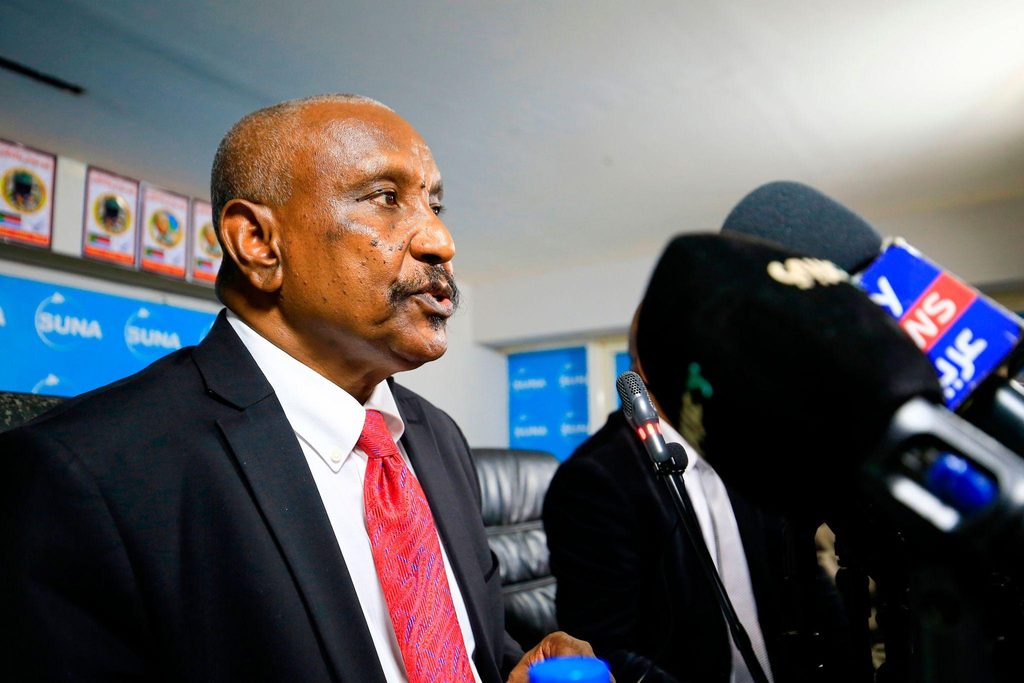
Sudanese pro-democracy leader Yasir Arman has warned the Sudanese army against using battlefield gains to restore the former Islamist order, saying military advances cannot resolve the deeper political causes of the country’s war.
Speaking at a Chatham House roundtable in London, Arman said the conflict that erupted in April 2023 was rooted in the failure of Sudan’s political system and in efforts by Islamist forces to derail the democratic transition that followed the 2018 uprising.
He accused Islamist factions of backing the October 2021 military coup and warned that attempts to return them to power would prolong Sudan’s instability.
“It would pose a threat and represent a profound failure for the SAF to treat its battlefield gains as a tactical opportunity to restore Islamist rule and resume state capture,” Arman said.
He argued that a renewed Islamist role in government would revive the political exclusion, militarisation and state repression associated with the former regime.
“The Islamists would only perpetuate the wars and marginalisation of the past against the majority of the Sudanese people, deepen the politicisation of the state — particularly the security sector — and continue to use violence against the population,” he said.
Arman said any lasting settlement would have to prevent the re-establishment of the former ruling system.
“A genuine end to this war and a path to sustainable peace are in direct contradiction with the return of the Islamists, given their infamous résumé,” he said, adding that Sudan required “a paradigm shift” that could not be achieved under dictatorship.
Arman also said neither the Sudanese Armed Forces nor the Rapid Support Forces had a democratic mandate, accusing both sides of committing serious abuses against civilians and of helping derail the transition that emerged from the December 2018 revolution.
He warned that the war had created a severe humanitarian and economic crisis, with more than 25 million people affected and hunger worsening across parts of Darfur, Kordofan and central Sudan.
Arman called on the United Nations Security Council to support an African Peace and Security Council proposal for an immediate humanitarian ceasefire monitored by an international peace mission, as well as the roadmap advanced by international mediators.
He also urged direct talks between the Sudanese army and the anti-war civilian movement on neutral ground, with the RSF later brought into a broader political process.
Any eventual settlement, he said, should include the dismantling of militias and the creation of a single professional national army under civilian authority.