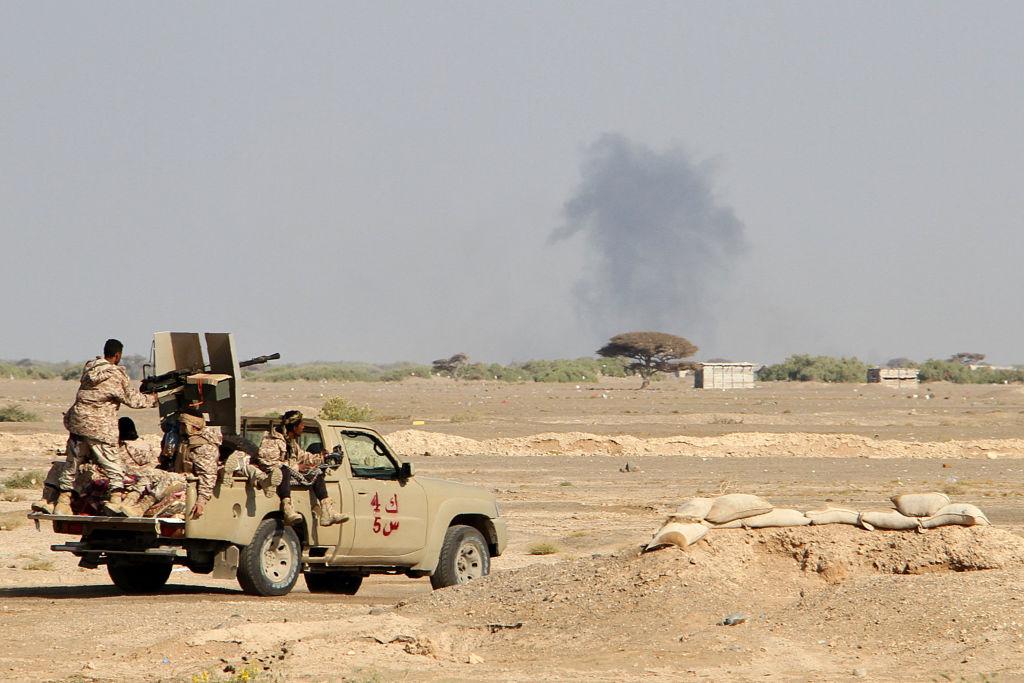
Saudi-backed Yemeni government forces advanced to the Bab el-Mandeb Strait on Monday, saying they had secured effective control of the strategic waterway after a rapid offensive against Houthi forces along Yemen’s southwestern coast.
Information Minister Moammar al-Eryani said government troops had captured key positions around Dhubab, including an airstrip just inland from the strait, and had isolated remaining Houthi fighters in the area.
Fighting was still continuing near a military base close to the waterway, however, according to another government source, suggesting full control of the area had yet to be consolidated.
The Houthis rejected government claims of major advances as false and threatened to target aircraft operating in Saudi airspace.
Bab el-Mandeb is one of the world’s most important maritime chokepoints, linking the Red Sea with the Gulf of Aden and the Indian Ocean. Its strategic importance has risen further after disruption to shipping through the Strait of Hormuz during the wider US-Iran confrontation.
The Houthis seized positions around Bab el-Mandeb last month, alarming global energy markets and raising concerns that shipping between Europe and Asia could face further disruption.
Retaking the coastline around the strait would make it more difficult for the Houthis to directly threaten passing vessels, although the group could still launch drones and missiles from inland areas or other positions further north.
Saudi Arabia said Monday its forces had struck hundreds of targets across Yemen in support of the government offensive and to provide air cover for troops advancing near Bab el-Mandeb.
The internationally recognised Yemeni government launched the operation on Sunday, with Presidential Leadership Council chief Rashad al-Alimi vowing to continue fighting until territory held by the Houthis was retaken.
Government forces said they were also attacking on several other fronts, including in Sanaa province.
The Houthi-run health ministry said two people were killed and seven wounded in strikes on the Sanhan and Sa’wan districts of Sanaa province.
Houthis advance around Taiz
Despite government gains on the coast, Houthi forces also made advances around Taiz, where fighting has intensified over control of roads linking the city to southern Yemen.
Five government military sources said Houthi fighters had captured sections of a mountain road and advanced into al-Turbah, raising fears that government troops in Taiz could be surrounded. Another government source disputed that the road had been fully cut.
A Houthi-run news agency said the group had also pushed government forces out of the al-Mawasit district of Taiz province and had reached the area around Alimi’s family home.
Taiz, Yemen’s third-largest city, has remained one of the conflict’s most contested areas since the early years of the war.
Last week, Houthi attacks damaged part of the Taiz-Aden road, further restricting movement and worsening shortages.
Long queues formed outside fuel stations around Taiz on Monday as residents sought petrol and cooking gas amid the renewed fighting.
“This is the daily state in Taiz. The suffering of citizens continues,” resident Shehab Hazaa said while waiting in line.
Displacement rises
The renewed conflict has deepened Yemen’s humanitarian crisis.
The UN migration agency said Monday that around 184,000 people had been displaced since large-scale fighting resumed.
Yemen’s war began after the Houthis seized the capital Sanaa in 2014. A Saudi-led coalition intervened the following year in support of the internationally recognised government.
The conflict later settled into a prolonged stalemate, while a 2022 truce sharply reduced fighting across most frontlines.
That relative calm collapsed this year as Yemen was drawn into the broader regional conflict involving Iran, the United States and Gulf states, reopening several major battlefronts and again placing strategic Red Sea shipping routes at risk.