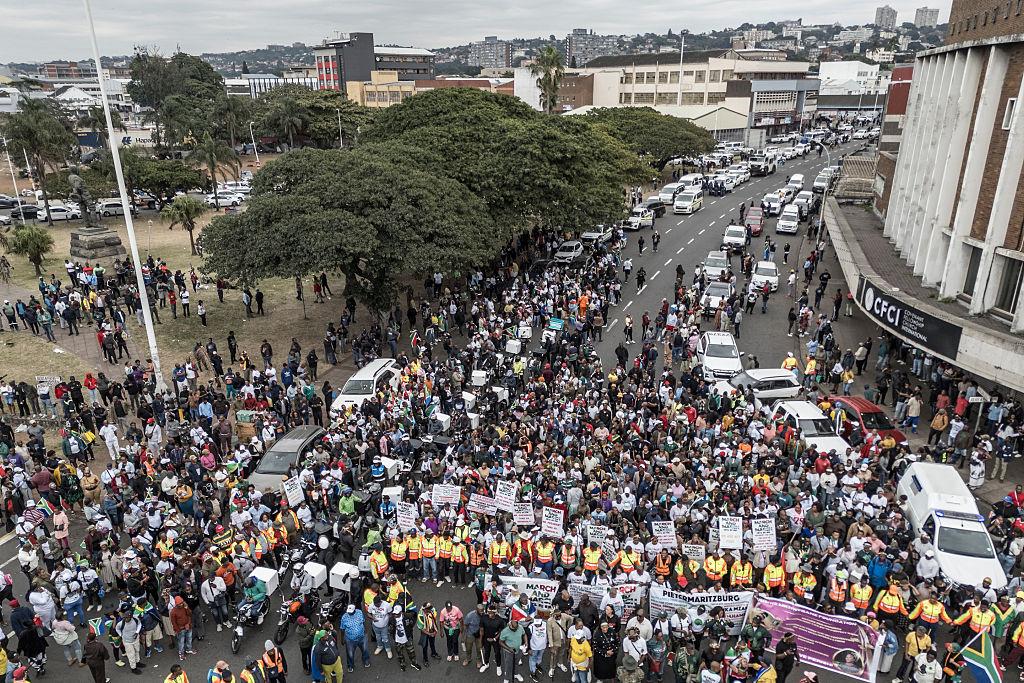
Anti-migrant demonstrations erupted into violence in two South African cities on Thursday, with vehicles set ablaze and foreign-owned businesses looted as authorities blamed misinformation surrounding a court ruling on asylum seekers.
In the coastal city of Durban, at least 14 vehicles were set on fire, while a guest house and warehouse were partially burned, according to police. A Reuters journalist witnessed five burning cars in the city centre, where shops owned by foreign nationals were also targeted by looters.
The violence followed a demonstration demanding that a refugee processing centre stop accepting asylum applications.
Unrest also spread to Soweto, a township near Johannesburg, where residents were seen looting a shop reportedly owned by a Somali national. Witnesses said the owner had been chased away before police intervened and dispersed the crowd.
Government spokesperson William Baloyi attributed the unrest to deliberately misleading claims about a Constitutional Court ruling issued in July.
The ruling established that asylum seekers cannot be excluded from South Africa’s asylum system solely because of procedural violations, including entering the country without authorisation.
Baloyi stressed that the judgment did not automatically grant refugee status, permanent residency or other legal protections to undocumented migrants.
“We are deeply concerned by what is going on now,” he said.
Police deployed additional officers to Durban to contain the violence, while senior police official Lieutenant General Puleng Dimpane was expected to outline security measures in Soweto.
South Africa has experienced months of anti-migrant demonstrations, some of which have escalated into attacks on foreign nationals, looting and widespread displacement.
Thousands of African migrants have reportedly fled the country amid rising hostility.
Foreign nationals are frequently accused of taking jobs, contributing to crime and placing pressure on public services, although researchers say such claims are not supported by evidence.
More than three decades after the end of apartheid, South Africa continues to struggle with deep economic inequality and unemployment affecting roughly one-third of its workforce.
Despite those challenges, the country remains one of Africa’s largest economies and a major destination for migrants seeking employment and greater economic opportunities.