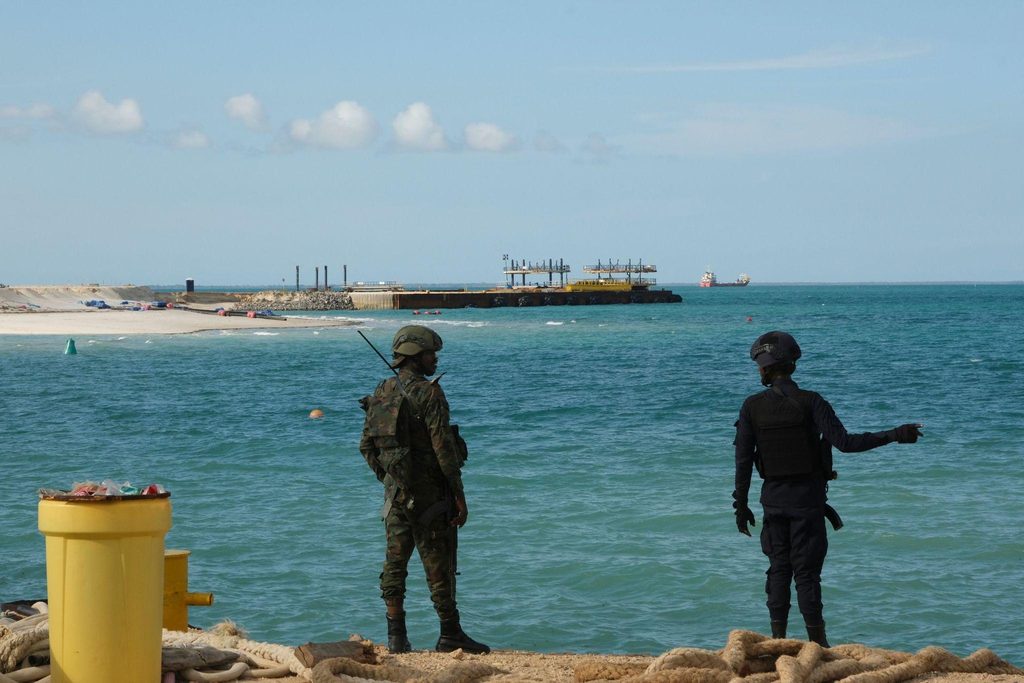
Nine years after an Islamist insurgency erupted in northern Mozambique, security forces continue to struggle to contain militants affiliated with ISIS despite extensive international military assistance, raising fresh concerns over civilian protection and the future of the country’s multibillion-dollar natural gas industry.
Militant activity remains a persistent threat in Cabo Delgado province, where armed groups have exploited longstanding economic grievances, weak state institutions and allegations of abuses by government forces to sustain their operations.
The conflict, which began on October 5, 2017, has exposed deep weaknesses in Mozambique’s armed forces and complicated efforts to develop one of Africa’s most promising natural gas regions.
French energy giant TotalEnergies is seeking to develop a liquefied natural gas project worth approximately $20 billion in the province, with production planned for 2029.
However, continued insecurity threatens the stability required for large-scale energy investment.
Nine years of insurgency
When militants launched their first major attacks in Cabo Delgado in October 2017, Mozambique’s military was poorly prepared for the insurgency despite decades of experience dealing with domestic armed conflicts.
The armed forces lacked adequate intelligence capabilities, modern equipment, air support and the logistical infrastructure necessary to counter guerrilla operations in remote rural areas.
The insurgency subsequently expanded, with militants capturing strategic towns and disrupting economic activity across the province.
The deteriorating security situation forced TotalEnergies to suspend work on its gas development project in 2021, prompting Mozambique’s government to seek additional international military assistance.
Since then, Maputo has received training, equipment and operational support from a wide range of international partners.
According to an assessment by the South Africa-based Institute for Security Studies (ISS), those partnerships have included Rwanda, the European Union, Türkiye, the United States, Russia, China and India.
Regional forces operating under the Southern African Development Community Mission in Mozambique (SAMIM) also played a significant role, while Russia’s Wagner Group conducted a brief military intervention.
Despite these efforts, the ISS assessment suggests that improvements in training and equipment have yet to produce a decisive breakthrough against the insurgency.
Military weaknesses persist
International assistance has gradually improved the operational capabilities of Mozambique’s armed forces, including equipment availability, logistics and battlefield survival rates.
However, chronic shortages of resources and inadequate logistical support continue to undermine counterinsurgency operations.
Much of the military’s equipment originates from Russia and China, while training programmes delivered by different international partners have created additional coordination challenges.
The withdrawal of SAMIM forces in mid-2024 further complicated the security situation.
According to the ISS analysis, deadly militant ambushes targeting Mozambican troops have increased since the regional mission ended, highlighting the military’s continuing vulnerability.
The withdrawal has also placed greater pressure on Mozambique’s own security forces and remaining foreign partners to prevent militants from expanding their operations.
Civilian abuses undermine security efforts
Beyond battlefield shortcomings, allegations of serious human rights violations by government troops have become a major obstacle to restoring security.
Mozambican forces have repeatedly faced accusations of sexually exploiting displaced women, killing civilians suspected of collaborating with militants and committing war crimes against captured terrorism suspects.
These allegations have contributed to widespread distrust of the military among communities that security forces are supposed to protect.
The ISS assessment identifies inconsistent training standards among international partners as another weakness.
Different military doctrines and approaches to civilian protection have reportedly made it difficult to establish a coherent human rights framework for counterinsurgency operations.
Analysts warn that abuses against civilians risk deepening resentment towards state authorities and undermining intelligence gathering and cooperation with local communities.
Such distrust can also create opportunities for militants to recruit supporters and maintain influence in areas where government authority remains weak.
Government faces growing pressure
Mozambique’s political leadership has also faced criticism over its handling of alleged military abuses.
During a September address marking the 62nd anniversary of Mozambique’s armed forces, President Daniel Chapo outlined priorities for the military but did not explicitly address the need to strengthen human rights protections during counterterrorism operations, according to observers cited in the report.
The omission has renewed questions about the government’s commitment to holding security personnel accountable.
Nine years into the insurgency, Mozambique faces a difficult balancing act between military operations, civilian protection and the economic ambitions tied to its natural gas reserves.
While international assistance has improved the capabilities of its armed forces, analysts say a lasting solution will require stronger institutions, greater accountability and the restoration of public confidence in government security forces.
Without those changes, continued militant attacks could threaten both stability in Cabo Delgado and Mozambique’s efforts to transform its gas resources into a major source of national revenue.