Rapid Support Forces (RSF) units are reinforcing defensive positions around the strategic city of Nuhud in West Kordofan amid reports that Sudan’s military is preparing another offensive following recent territorial gains in neighbouring North Kordofan.
An investigation published by Mada Masr on Friday said the RSF had deployed additional fighters, excavated defensive trenches and constructed earth barriers around the city to protect against a possible army advance.
The report cited an activist in West Kordofan who said the defensive preparations were intended to prevent surprise attacks on Nuhud, a strategically important commercial and military centre linking western Sudan with routes toward North Darfur.
The reported reinforcements come as Sudan’s military attempts to consolidate gains in North Kordofan and push westward toward territories held by the RSF.
Nuhud emerges as key defensive position
According to Mada Masr, army forces are preparing operations against remaining RSF positions around Umm Badr and Hamra al-Sheikh in northwestern North Kordofan.
The military has reportedly repositioned units along several fronts following its capture of Sodari and Mazroub, potentially opening additional routes toward West Kordofan.
North Kordofan Governor Abdel Khaleq Abdel Latif claimed that the army now controlled 96 percent of the state, although that figure could not be independently verified.
Nuhud has particular strategic importance because it connects West Kordofan with North Darfur and lies along potential routes toward El Obeid, the capital of North Kordofan.
A sustained military campaign around the city could affect movement across western Sudan, including civilian travel and commercial supply routes.
The RSF’s reported fortifications suggest that its commanders are preparing to defend established positions rather than rely exclusively on mobile operations.
Reports of increased restrictions
The Dar Hamar Emergency Room, a local civilian organisation, alleged on Wednesday that the RSF was conducting forced recruitment in Nuhud while imposing additional security restrictions.
The organisation also reported disruptions to Starlink satellite communications and claimed that fighters had occupied civilian facilities.
It alleged that Nuhud’s main referral hospital was being used to accommodate electronic jamming equipment and that buildings belonging to West Kordofan University had been appropriated for military purposes.
These allegations could not be independently verified, and no immediate RSF response to the specific claims was identified.
The organisation also reported that armed personnel were using vegetation to conceal vehicles from aerial surveillance amid sustained military activity in the region.
Airstrikes and competing military claims
Sudan’s military says it has intensified air operations against RSF positions across western Kordofan.
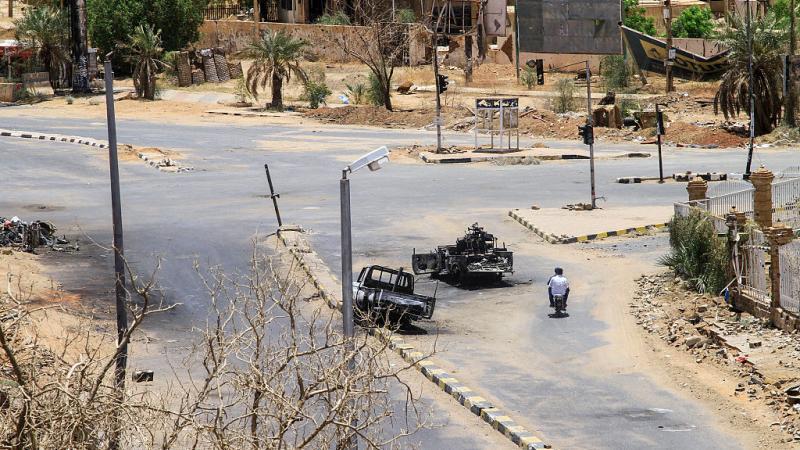
Mohamed Didan, a spokesperson for army special operations forces in West Kordofan, claimed that military aircraft carried out more than 150 strikes between Sunday and Tuesday, destroying approximately 100 military vehicles.
Neither the number of strikes nor the reported equipment losses could be independently confirmed.
The latest developments follow weeks of fighting across Kordofan, where rival forces have contested towns, supply corridors and positions providing access between central and western Sudan.
The RSF continues to maintain significant positions in West Kordofan, despite the Sudanese army’s claims of advances in neighbouring North Kordofan.
Nuhud’s importance extends beyond the immediate battlefield. Control of the city affects access to routes between Darfur and Kordofan, giving it considerable military and economic significance.
As both forces prepare for further confrontation, residents face growing uncertainty over security, communications and access to essential services.