Historic government buildings were set ablaze, public offices stormed and shops looted across France as hundreds of thousands protested soaring living costs, with more than 1,200 people arrested.
PARIS — Violent unrest swept across France on Saturday as nationwide demonstrations against rising living costs escalated into clashes with police, arson and widespread looting, leaving several historic buildings severely damaged.
The protests, which drew between 550,000 and 800,000 participants, took place six months before France’s presidential election, amid growing public frustration over inflation, declining purchasing power and deteriorating public services.
French Prime Minister Sebastien Lecornu said late Saturday that approximately 1,200 people had been arrested and more than 150 police officers injured as violence spread through Paris and several major cities.
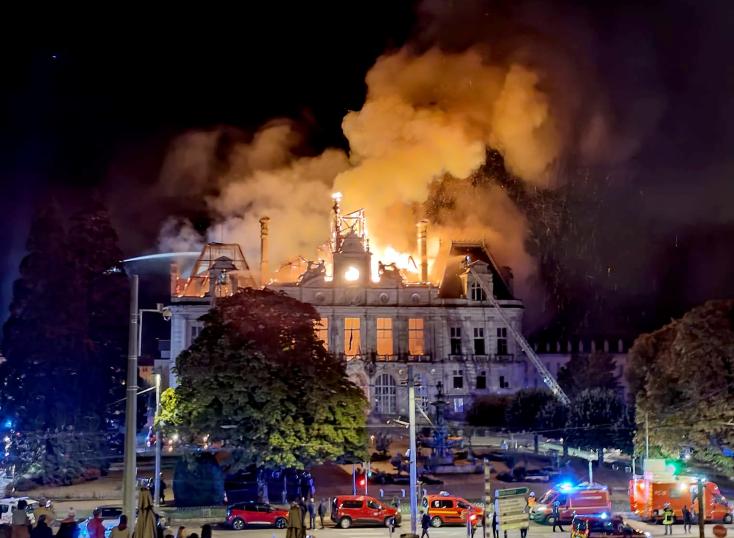
One of the most serious incidents occurred in Limoges, where masked individuals stormed the city’s historic town hall and set it ablaze.
The 143-year-old building, inaugurated in 1883 and designated a protected historic monument, suffered extensive destruction as flames engulfed its roof and upper floors.
Local authorities described much of the building as lost, with sections of the roof collapsing and significant damage to its historic architecture.
Government buildings were also targeted in Marseille and Lille, where groups forced their way into municipal offices and vandalised property.
In Bordeaux, the official residence of the regional prefect was reportedly ransacked, while fires broke out at a tourist office in Lyon and another building in Grenoble.
Police confront masked protesters in Paris
In the French capital, security forces deployed tear gas and water cannons as masked demonstrators threw projectiles and fireworks at officers.
Tensions were particularly severe around Place de la République, where hundreds of protesters confronted riot police.
Authorities dispersed unauthorised marches and intensified security checks in areas where demonstrations had been restricted.
Groups of rioters also smashed shop windows, set vehicles on fire and looted businesses in several commercial districts.
Paris Mayor Emmanuel Grégoire condemned the destruction, saying entire streets had been devastated by the violence.
Similar disturbances erupted in Marseille, Lyon, Rennes, Nantes and Bordeaux, where shops were looted and police confronted groups of masked individuals.
In Saint-Étienne, a 17-year-old protester lost a hand after an incident involving a police crowd-control grenade, raising renewed concerns about the use of force during demonstrations.
Hundreds of thousands demand economic relief
Interior Minister Laurent Nuñez estimated nationwide participation at 550,000, while organisers and the CGT trade union placed the figure at approximately 800,000.
Although many demonstrations remained peaceful, violent groups clashed with security forces and targeted government buildings and commercial establishments.
The protests brought together students, trade unions, workers and supporters of the Yellow Vest movement, which emerged in 2018 in opposition to fuel tax increases before expanding into broader demonstrations against economic inequality.
Students have also demanded improved educational facilities, additional teachers and better conditions in schools and universities.
France’s mounting social tensions have been aggravated by rising fuel prices, economic uncertainty and pressure on household finances.
Political tensions ahead of presidential election
President Emmanuel Macron condemned attacks on public institutions and businesses, warning that those responsible for vandalism and looting would face prosecution.
Prime Minister Lecornu accused radical groups and criminal elements of exploiting the demonstrations to provoke widespread disorder.
Left-wing leader Jean-Luc Mélenchon expressed support for the broader protest movement but urged demonstrators to avoid looting and destruction.
Far-right leader Marine Le Pen condemned the violence and voiced support for security forces, accusing elements of the radical left of encouraging unrest.
The disturbances have revived memories of the Yellow Vest protests of 2018 and 2019, which saw prolonged confrontations between demonstrators and police across France.
Trade unions have called for further nationwide demonstrations and strikes on November 5, demanding higher wages and improved public services.
The latest unrest has intensified pressure on the French government as the country approaches a presidential election scheduled for April and May 2027.