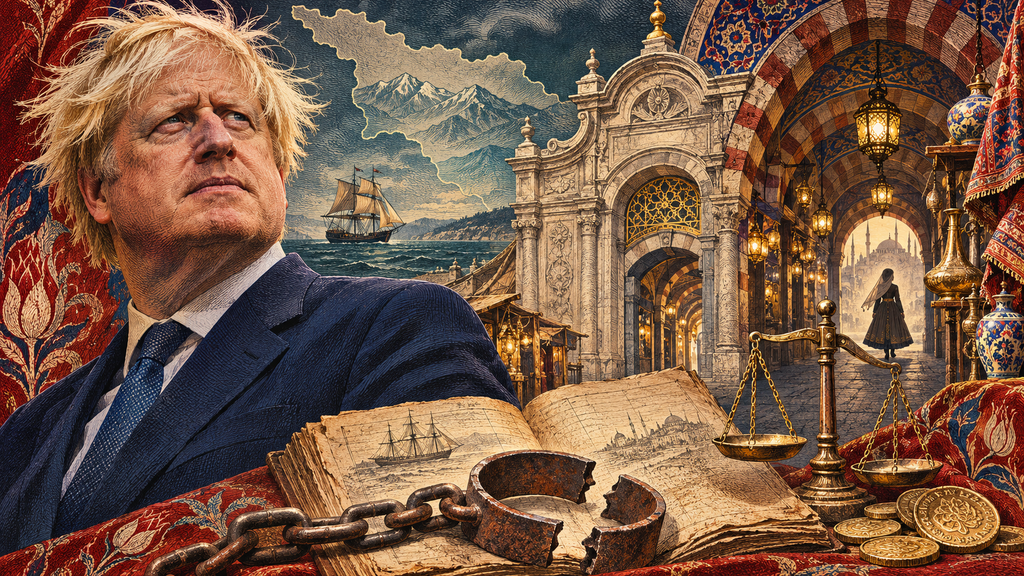
Former British Prime Minister Boris Johnson has revealed that his great-great-grandmother was sold as a child in an Ottoman slave market in Istanbul, exposing a dark chapter of the empire’s history as international demands for slavery reparations intensify.
Writing in the Daily Mail on November 7, Johnson described how his Circassian ancestor, Hanife Feride, was forcibly displaced from the Caucasus during Russia’s imperial expansion before being transported across the Black Sea and offered for sale near Istanbul’s Grand Bazaar.
According to Johnson, the young girl endured a 10-day sea voyage before arriving in the Ottoman capital, where enslaved women and children were bought and sold.
She was eventually purchased by a Turkish woman who took her into her household, educated her and later arranged her marriage to her 43-year-old son.
Hanife Feride was just 13 when she married.
Johnson said research conducted by his sister Rachel and cousin Sinan had strengthened his conviction that his family descended from an enslaved Circassian girl.
The revelation places the former British leader’s family history directly within the Ottoman Empire’s extensive system of slavery, which involved the trafficking of Africans, Circassians, Georgians and other populations across Europe, Africa and Asia.
Johnson’s great-grandfather, Ali Kemal, was a prominent Ottoman journalist and politician who briefly served as interior minister during the empire’s final years.
Family history challenges reparations debate
Johnson raised his ancestor’s experience amid renewed controversy over Britain’s historical involvement in the transatlantic slave trade and demands for financial reparations to affected countries.
However, rather than demanding compensation from Turkey, Johnson used his family’s history to challenge the principle of holding contemporary taxpayers financially responsible for injustices committed generations earlier.
He questioned why citizens of modern Turkey should be expected to compensate descendants of people enslaved under the Ottoman Empire, a political system that collapsed more than a century ago.
Johnson also highlighted Russia’s role in the displacement of Circassian populations, suggesting that responsibility for his ancestor’s suffering extended beyond the Ottoman authorities who permitted her sale.
His intervention underscores a broader historical question increasingly confronting countries involved in the global slave trade: whether demands for accountability should extend beyond the European colonial powers traditionally associated with transatlantic slavery.
Claims first surfaced nearly two decades ago
Johnson’s account is not entirely new.
During his 2008 London mayoral campaign, he publicly stated that his great-great-grandmother had been an enslaved Circassian woman purchased by his great-great-grandfather.
Research conducted for the BBC genealogy programme Who Do You Think You Are? established Johnson’s ancestry through Ali Kemal but could not independently verify the circumstances surrounding the alleged purchase.
His latest account differs in one significant detail: Johnson now says his ancestor was purchased by the mother of the man she subsequently married.
Nevertheless, the existence of an organised slave trade in Ottoman Istanbul is firmly established by historical scholarship.
Ottoman Istanbul’s slave market
For centuries, Istanbul was a major centre of human trafficking within the Ottoman Empire.
The city’s notorious Esir Pazarı, or slave market, operated near the Nuruosmaniye Gate of the Grand Bazaar, where enslaved men, women and children were traded through an organised network of merchants, brokers and buyers.
Research by the University of Virginia identifies the imperial slave market as potentially the largest of its kind in the Middle East during its operation.
Circassian women and girls were particularly sought after for domestic service, concubinage and marriage arrangements, while enslaved Africans were also traded throughout Ottoman territories.
Sultan Abdülmecid ordered the closure of Istanbul’s official slave market in 1847, but the trade continued through private transactions and underground networks.
Restrictions introduced during the nineteenth century failed to eliminate the institution, which persisted into the empire’s final decades. Slavery was not formally abolished under the Turkish Republic until 1933.
Johnson’s account has brought renewed attention to that history, revealing how the Ottoman trade in human beings left a legacy reaching into the families of prominent political figures more than a century after the empire’s collapse.