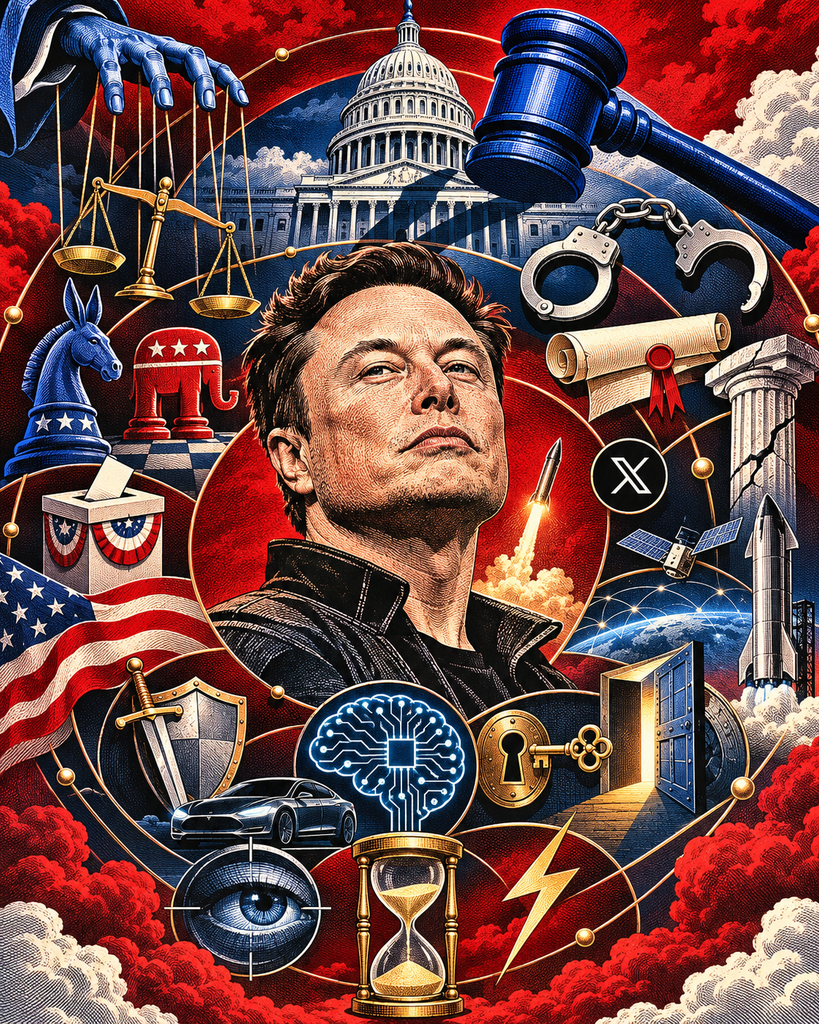
Democrats are preparing to turn their newly acquired congressional power against Elon Musk, as calls for his arrest and promises of sweeping investigations raise an uncomfortable question about the American left: Has political disagreement become grounds for putting opponents behind bars?
For a party that routinely presents itself as the guardian of American democracy, the rhetoric surrounding Musk is increasingly difficult to reconcile with its professed commitment to political freedom.
The billionaire entrepreneur, whose companies have transformed electric vehicles, private space exploration and satellite communications, now finds himself confronting an emboldened Democratic Party eager to scrutinise his businesses, his political activities and his role in President Donald Trump’s administration.
But some progressive figures have already moved beyond demanding accountability.
They want him arrested.
Rashida Tlaib crosses the line
Democratic Representative Rashida Tlaib, a prominent member of the progressive congressional group known as the Squad, explicitly called for Musk’s arrest over allegations that his political organisation was distributing misleading election information.
Speaking to journalist Matt Laslo, Tlaib accused Musk’s America PAC of deliberately spreading misinformation through election-related outreach and its VoteSafe website.
She argued that such conduct should be punishable by arrest.
Tlaib’s accusations concerned complaints about inaccurate voting information and political advertising. Election officials in Colorado and Washington state had publicly raised concerns about America PAC’s messaging.
Those complaints merit examination. But a misleading political message, an inaccurate voter notification and a deliberately orchestrated criminal conspiracy are not interchangeable legal concepts.
Most importantly, Tlaib presented no public evidence establishing that Musk personally committed a criminal offence warranting his arrest.
Yet the demand for handcuffs came anyway.
That is precisely where legitimate political criticism threatens to cross into something considerably more dangerous.
In a constitutional democracy, criminal punishment requires evidence of a crime, not merely outrage at a billionaire whose political views offend progressive sensibilities.
Democrats prepare their congressional offensive
The rhetoric is now being accompanied by concrete plans for congressional investigations.
On Sunday, November 8, California Democratic Representative Robert Garcia, who is expected to chair the powerful House Oversight Committee when the new Congress convenes in January, said lawmakers were interested in questioning Musk over his involvement in the Department of Government Efficiency (DOGE).
Musk helped lead the Trump administration’s campaign to reduce federal spending, restructure government operations and eliminate positions considered unnecessary.
Critics have accused DOGE of causing disruption, overstating its savings and raising questions about potential conflicts of interest involving Musk’s businesses.
Such allegations can legitimately be examined by Congress.
But oversight is supposed to establish facts, not serve as a political punishment for supporting the wrong presidential candidate.
The growing enthusiasm for pursuing Musk raises the risk that congressional hearings could become instruments of partisan retaliation rather than genuine accountability.
Democrats have every right to investigate suspected misconduct. They do not have the right to presume criminal guilt because a private citizen backed their political opponents.
Musk delivers a warning: He will fight back
Musk has made it abundantly clear that he has no intention of quietly submitting to the political offensive.
Responding to reports of Democratic investigation plans on October 21, the Tesla and SpaceX chief issued a defiant warning on X.
“Live by the sword, die by the sword,” Musk declared.
He subsequently warned that he intended to identify the people directing attacks against him, rather than focusing solely on their political representatives.
It was an unmistakable message: Musk was preparing to fight back.
His response followed comments from technology journalist Kara Swisher, who suggested that Musk might already be in prison had Kamala Harris won the 2024 presidential election.
Swisher also warned that renewed Democratic control of Congress could expose Musk to investigations.
Musk’s initial response was characteristically concise.
“Message received.”
The exchange exposed the increasingly hostile political environment surrounding an entrepreneur whose decision to embrace Trump transformed him from a figure once celebrated by progressives into one of their most prominent adversaries.
From progressive darling to political enemy
There is considerable irony in the left’s hostility toward Musk.
For years, he was associated with precisely the technological developments that progressive politicians claimed to champion.
Tesla helped accelerate the electric vehicle industry. SpaceX revolutionised commercial rocket launches and substantially expanded American space capabilities. Starlink brought satellite internet access to communities far beyond conventional telecommunications networks.
None of those achievements makes Musk immune from investigation or criticism.
But they make the determination of some political figures to portray him primarily as a public enemy all the more revealing.
Musk’s transformation into a political target closely followed his growing opposition to progressive orthodoxy, his acquisition of X and his increasingly vocal support for Trump and Republican candidates.
The central political irony is difficult to ignore: A billionaire once celebrated for challenging established industries is now denounced for challenging established political interests.
Trump signals he will protect Musk
President Trump has also weighed in on the prospect of legal action against his allies.
Speaking to the New York Post’s Miranda Devine ahead of the midterm elections, Trump indicated that he would consider preemptive presidential pardons if necessary to protect members of his administration and political associates.
Asked about the possibility of Democrats pursuing Musk and other Trump allies, the president said his administration would protect them.
The discussion came as Democrats prepared to regain control of both chambers of Congress following their November 3 election victories.
However, a congressional investigation does not itself constitute a criminal prosecution, and no evidence has emerged that Musk has been formally charged in connection with the conduct cited by Tlaib.
That distinction matters, regardless of political affiliation.
The real test of American democracy
The fundamental issue is not whether Elon Musk should be above the law.
He should not.
The issue is whether powerful politicians should publicly entertain arresting their political adversaries before establishing that a criminal offence has occurred.
There is a vast difference between investigating public spending, questioning government contracts and demanding that an influential businessman be thrown into the criminal justice system.
A party genuinely committed to democratic institutions should understand that distinction better than anyone.
Musk’s critics are entitled to oppose his political spending, challenge his business decisions and scrutinise his conduct in government.
But if they want to pursue criminal punishment, they must produce evidence capable of surviving judicial scrutiny.
Political resentment is not a criminal charge. Ideological disagreement is not proof of corruption. And losing the support of one of the world’s wealthiest entrepreneurs is not an excuse to dispense with due process.
The Democrats’ post-election offensive may succeed in dragging Musk before congressional committees.
Whether it produces credible evidence of criminal misconduct is another matter entirely.
For now, Musk appears determined to stand his ground.
And if America’s political establishment hopes to convince the public that its campaign against him is about justice rather than revenge, it will need something considerably stronger than wounded political pride.