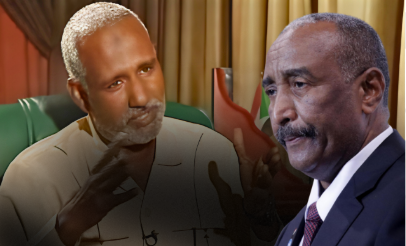
Sudan’s army chief Abdel Fattah al-Burhan has called for influential Islamist figure Osama Abdullah to be sidelined amid accusations that he is building an independent faction within the movement, Al-Rakoba reported on Thursday, citing Sawt al-Umma.
The reported dispute centres on control of armed groups, financial resources and military connections within the Islamist networks supporting the army and the SAF government.
According to the report, Abdullah has been expanding his personal network and recruiting figures into a separate power base beyond the direct control of the movement’s established leadership.
Abdullah reportedly handled sensitive responsibilities, including coordination between the Islamic Movement and the army, oversight of several military formations, and management of the movement’s finances.
Those roles gave him extensive access to officers, field commanders and funding networks. His alleged efforts to turn those connections into an independent faction prompted demands that he be stripped of his influence and responsibilities.
The report linked the dispute to the reported removal of Al-Misbah Abu Zeid from command of the Al-Baraa bin Malik Brigade, a prominent Islamist formation fighting alongside the army.
Abu Zeid built a substantial battlefield and media profile during the war. His group was reportedly connected to the network Abdullah sought to expand, with his removal described as part of an effort to curb that faction’s influence and bring armed formations under tighter organisational control.
The account points to divisions extending beyond longstanding disputes over leadership of the former ruling National Congress Party. Rivalries now encompass weapons, financing, supplies and access to military commanders.
It identified competing circles associated with Ali Karti, Ahmed Haroun, Nafie Ali Nafie and Ibrahim Mahmoud, alongside newer centres of influence that have emerged around wartime commanders and armed groups.
Although these factions share support for the army’s war effort, the report suggested that their competing interests could complicate coordination and the distribution of resources.
Removing leaders with direct ties to fighters and officers could also generate tensions within allied formations, it said.
The account did not include responses from Burhan, Abdullah or Abu Zeid, or establish whether the reported disputes had disrupted specific military operations.