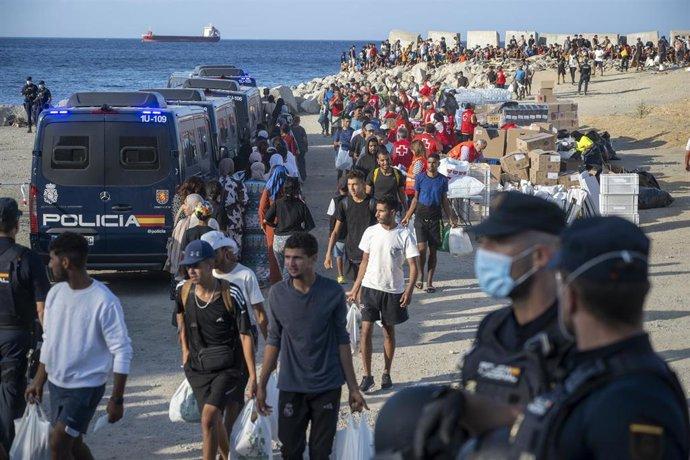
Data from Spain’s interior ministry revealed that over the past two weeks, at least 8,561 migrants have reached the Canary Islands, which accounts for more than a third of this year’s total arrivals.
From January 1 to October 15 of this year, the Canary Islands in the Atlantic welcomed 23,537 migrants, marking an 80% increase compared to the same period last year, as per the data.
The Canary Islands, consisting of seven islands, have become the primary destination for migrants originating from Senegal and various African nations, as they aim to reach Spain.
The arrival of milder weather and calmer seas during the months of September, October, and occasionally November typically leads to an upsurge in migrant arrivals.
According to the European Union’s border agency Frontex, political instability in Senegal is also acting as a “push factor,” compelling people to leave the country through the West African route.
Spain has expressed worry about the surge in irregular migration this year, emphasizing its need for assistance from the European Union to manage the situation.
On Monday, Acting Interior Minister Fernando Grande-Marlaska paid a visit to the archipelago and announced that Spain will dispatch two extra aircraft to enhance surveillance of migration routes.
The deployment includes one aircraft responsible for patrolling the waters adjacent to Senegal and Mauritania, while a second aircraft will focus on monitoring the waters surrounding the Canary Islands.
In 2006, the Canary Islands, situated approximately 100 kilometers (60 miles) off the western coast of Africa, experienced their highest influx of migrants, with nearly 32,000 individuals arriving on the islands due to the closure of alternative routes to Europe.
The Atlantic migration route to the Canary Islands, frequently utilized by sub-Saharan African migrants seeking access to Spain, stands out as one of the most perilous migration paths globally.