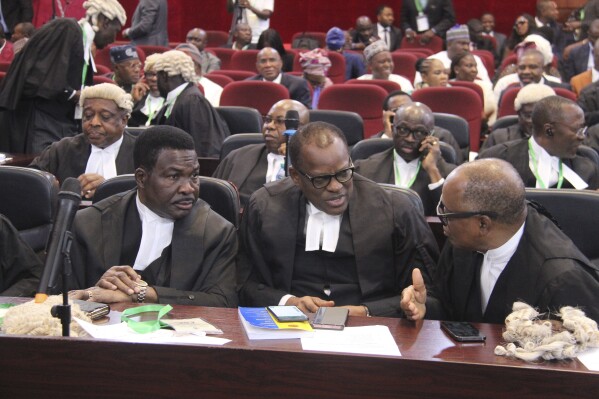
Nigeria’s Supreme Court on Thursday was poised to make a judgment on the opposition’s final legal challenge to President Bola Ahmed Tinubu’s election triumph, marking a crucial juncture in their dispute over his mandate.
Since Nigeria’s transition from military rule in 1999, many Nigerian elections have become entangled in legal disputes. However, it’s worth noting that the Supreme Court has never overturned the outcome of a presidential election.
A seven-judge panel is set to make a decision on the opposition’s appeal, which challenges a prior lower court ruling that had already dismissed claims by the opposition regarding fraud, violations of electoral laws, and President Tinubu’s eligibility to run for the presidency.
A former governor of Lagos, Tinubu, secured 37 percent of the vote in February, emerging victorious over the Peoples Democratic Party (PDP) candidate Atiku Abubakar and the Labour Party’s Peter Obi, in one of the closest elections in Nigeria’s contemporary history.
The court registrar declared on Wednesday that the panel would deliver the ruling on Thursday.
“We are hopeful that the apex court will affirm the sanctity of the 8.9m votes of Nigerians that gave President Tinubu victory last February,” Bayo Onanuga, one of Tinubu’s special media advisors, wrote on X, formerly Twitter.
Last month, an election appeals court dismissed the two primary petitions from the main opposition parties, deeming them lacking in merit. These petitions had included allegations of fraud, violations by the Independent National Electoral Commission (INEC), and claims that Tinubu did not fulfill the constitutional requirements.
In addition to their initial claims, Atiku’s legal team had attempted to present new evidence alleging that Tinubu had submitted a forged certificate from Chicago State University as a qualification to the election commission when applying to contest the presidential election.
Senior leaders of the APC have unequivocally refuted these allegations as spurious. However, political opponents engaged in heated debates on television and social media regarding the forgery accusations.
Following the February election, INEC acknowledged “glitches” in the voting process but rejected allegations that the election was not conducted freely and fairly.
Critics and the opposition contended that delays in result uploading and technical issues presented opportunities for ballot manipulation.
Under the banner of “Renewed Hope,” Tinubu assumed office in May and has promptly initiated reforms aimed at fostering economic growth in Africa’s largest economy while enticing increased foreign investment, as per his government’s agenda.
The government is also addressing significant security challenges, which range from a protracted jihadist insurgency in the northeast to issues like kidnapping gangs, intercommunal conflicts, and separatist movements in various regions of the country.