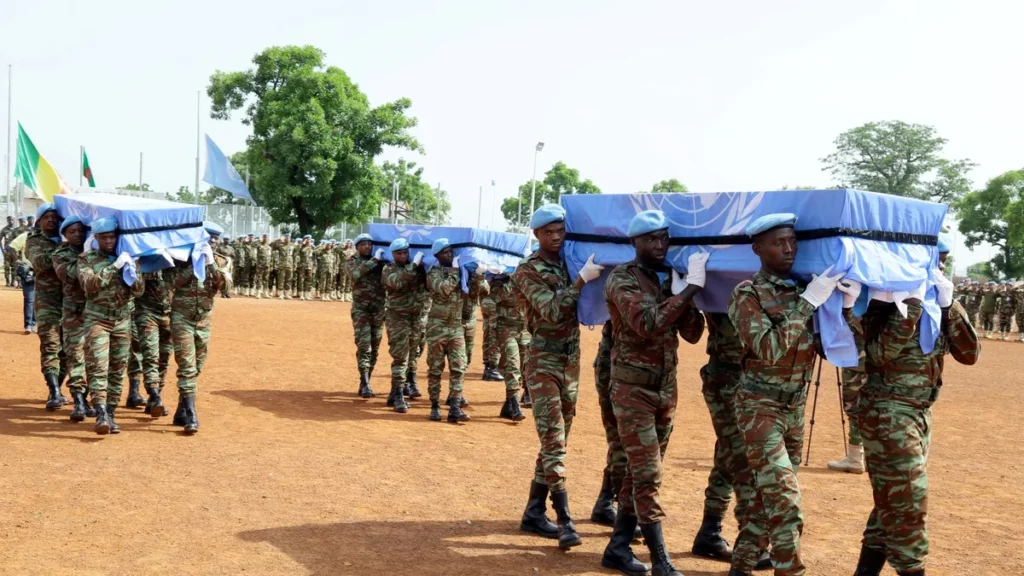
Campaigners reported on Friday that UN peacekeepers were compelled to expedite their withdrawal, dismantle abandoned equipment, and face perilous conditions during their exit.
In June, following a coup in 2020, the newly appointed military authorities ordered the departure of peacekeepers, citing the “failure” of their mission and criticizing its purported “instrumentalisation” of human rights concerns.
Here is a summary of this extensive and high-stakes operation, marking the conclusion of a decade-long endeavor to restore stability to a nation beset by jihadist threats and a multitude of other challenges.
Jihadists, armed groups and gangs
The United Nations Multidimensional Integrated Stabilization Mission in Mali (MINUSMA), which has maintained a force of approximately 15,000 soldiers and police officers, has lost 180 of its personnel.
The initial strategy had aimed to complete the withdrawal of the peacekeeping force from the West African nation by the year’s end. However, UN troops have already begun vacating their bases one after another, with the initial withdrawals taking place as early as July.
The withdrawal of MINUSMA has intensified tensions among the various armed groups operating in the northern region of the country and the Malian government.
These factions oppose the return of UN camps to the Malian military, contending that such an action would violate the ceasefire and peace agreements brokered with Bamako in 2014 and 2015.
Nonetheless, the military is actively seeking to regain control of the vacated camps.
The primarily Tuareg separatist factions, which are in opposition to the army, have recommenced hostilities against the military.
The Support Group for Islam and Muslims (GSIM), linked to Al-Qaeda, has escalated its attacks against the military.
This makes MINUSMA’s withdrawal even more precarious, occurring in the midst of this resurgence of hostilities and amid perceived limitations imposed by the authorities on its operational freedom.
Jihadists posed threat to security of UN soldiers
Following the departure from five camps since August, MINUSMA successfully finalized its “accelerated withdrawal” from Tessalit in the northern Kidal region on Sunday.
It carried out this withdrawal, stating that the security situation was “extremely tense and degraded,” which posed a significant threat to the safety of its personnel. In the days leading up to the withdrawal, gunfire targeted its cargo aircraft and positions.
A portion of the contingent, primarily consisting of Chadian forces, departed by air. However, the remaining personnel were compelled to undertake an overland journey to Gao, covering over 500 kilometers (310 miles) of desert terrain, while facing constant threats from armed groups.
The subsequent withdrawal from Aguelhok unfolded under comparable circumstances, with the authorities not granting clearance for flights.
MINUSMA reported that the retreating convoys came under attack from explosive devices, resulting in injuries. The GSIM claimed responsibility for these attacks.
On Thursday, a logistics convoy traveling from Ansongo to Labbezanga in the Gao region was targeted by gunfire. According to MINUSMA, three civilian truck drivers were wounded, with one of them sustaining severe injuries.
UN equipment wasted and destroyed
The UN peacekeeping force has stated that it had to dispose of or render equipment, including vehicles, ammunition, and generators, unusable in compliance with UN regulations since they were unable to transport them.
MINUSMA asserted that the material losses “could have been avoided” had it not been for the blockage of 200 trucks in Gao since September 24, a situation brought about by the restrictions imposed by the authorities.
Tanker trucks designated to provide convoys with supplies are similarly trapped in Gao.
“Customs officials explained that the quantity of fuel was not justified,” a mission official said.
A Malian police officer stationed in Gao contended that the authorities were concerned that MINUSMA might “deliver fuel to the jihadists.”
This unfounded accusation underscores the lack of trust between MINUSMA and Mali’s military leadership.
0 trust between Mali military, UN mission forces
A confidential memo addressed to the UN Security Council by the Department of Peace Operations, as reviewed by media, outlined the challenges encountered by MINUSMA. These challenges encompassed the refusal of flight and travel authorizations, restrictions on essential imports, and the inability to conduct security patrols in the vicinity of its own installations.
Considering these circumstances, MINUSMA devised an alternative plan for its withdrawal, which encompassed contingency measures as a last resort.
Malian government spokesperson Colonel Abdoulaye Maiga has accused former ally France, which has also been expelled from the country, of exerting “no effort to make MINUSMA flee”.
The accelerated withdrawal of the UN peacekeeping force is disrupting the intentions of the Malian army, as they are reluctant to allow the separatists to seize the void.
“The junta has taken the decision to kick out MINUSMA, but they are having the pace of the withdrawal imposed on them,” said Jonathan Guiffard, a specialist in Africa and defence matters at the Paris-based Institut Montaigne.
Tensions expected to rise after UN’s embarrassing withdrawal
Anticipated heightened tensions in Kidal are likely to intensify after the UN’s departure.
This region serves as the epicenter of the Tuareg insurgency and is a focal point of significant sovereignty concerns.
Although the ultimate exit from Kidal was initially scheduled for the latter part of November, a MINUSMA representative recently indicated that the peacekeepers’ departure could be imminent, possibly just a matter of days away.
Non-essential personnel have been the first to head out.
“We are not going to stand idly by and put our troops in danger,” said a Chadian officer.