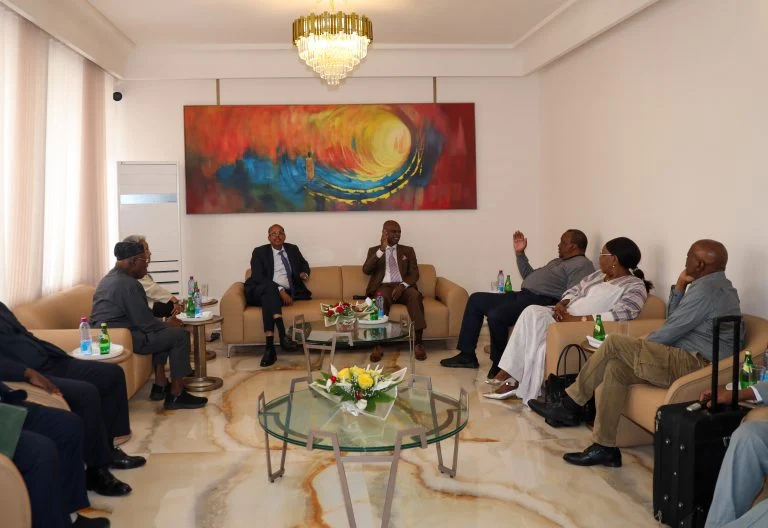
African and international leaders meeting in Lomé pledged to unify efforts to end conflict in eastern Democratic Republic of the Congo.
The two-day high-level meeting, chaired by Togolese President Faure Gnassingbé, emphasized the African Union’s central role in mediation for the Great Lakes crisis.
Participants urged all parties to implement existing peace commitments in good faith and prioritise political solutions over continued military confrontation.
The communiqué highlighted the need for harmonisation among African, regional, and international peace initiatives to avoid fragmentation undermining stability in eastern Congo.
A revised mediation architecture was endorsed, including an Independent Joint Secretariat to support the AU Panel of Facilitators, composed of former African presidents.
Support was reaffirmed for the Doha process between the Congolese government and the AFC/M23 armed group, urging talks to resume immediately on remaining protocols.
Leaders welcomed diplomatic breakthroughs, including US-brokered agreements between DRC and Rwanda, and Qatari-led talks producing the Doha Declaration and Comprehensive Peace Framework.
The Paris Conference in Support of Peace and Prosperity in the Great Lakes Region was cited as a critical step in mobilising international support.
Gnassingbé wrote on X that the meeting reinforced the coherence of mediation, outlined the peace roadmap, and coordinated efforts of different facilitators.
“Only a concerted and durable political solution will restore peace, security and stability for the benefit of the Great Lakes populations,” he stated.
The meeting concluded with a unified mediation framework, a coordinated action plan, and renewed African commitment to follow up on peace agreement implementation.
Conflict in eastern DRC has intensified despite a Dec. 4 peace agreement signed in Washington by Presidents Tshisekedi and Kagame to end the fighting.
The M23 rebel group controls significant territory in eastern Congo, including Goma and Bukavu, seized in early 2025, drawing accusations of Rwandan support.
Violence in the region has persisted for decades, killing thousands, displacing millions, and defying repeated attempts to establish lasting peace.