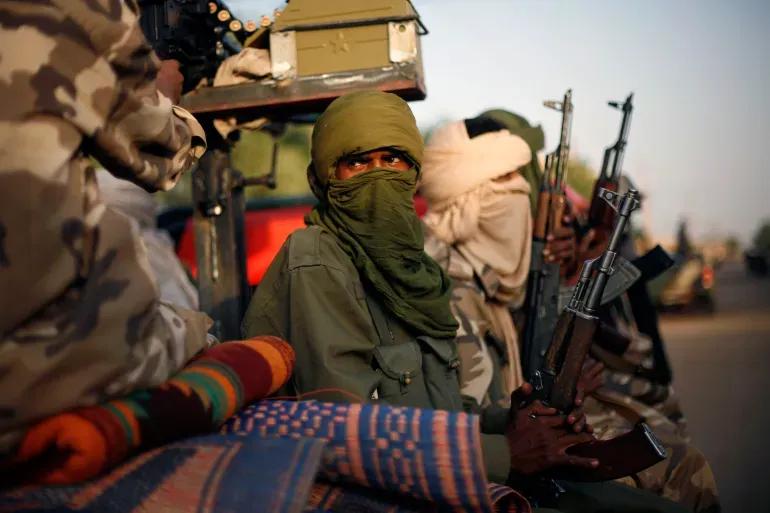
Violence linked to al-Qaeda and Daesh affiliates in Africa’s Sahel region is heading toward record levels this year as armed groups intensify attacks across Mali, Burkina Faso and Niger.
Conflict-monitoring data cited by Britain’s Guardian newspaper shows the Sahel has become one of the main global centres of militant activity, with al-Qaeda-linked groups continuing to expand their reach across parts of Africa.
Figures compiled by the Armed Conflict Location & Event Data Project, or ACLED, show incidents involving militant groups in Mali, Burkina Faso and Niger rising sharply from 63 in 2016 to 2,845 in 2025.
ACLED has already recorded 2,145 incidents since the start of 2026, putting the region on course to exceed 3,000 incidents this year if the current pace continues.
The surge comes despite an overall decline in terrorism-related deaths worldwide to their lowest level since 2008.
In the Sahel, however, the death toll has risen sharply. Citing the 2026 Global Peace Index, the Guardian said the United Nations recorded more than 9,000 deaths linked to security incidents in Burkina Faso, Mali and Niger during 2025.
Local focus of Sahel groups
Analysts said Jama’at Nusrat al-Islam wal-Muslimin, or JNIM, the main al-Qaeda affiliate in the Sahel, has increasingly focused on territorial control and local conflicts rather than al-Qaeda’s historic emphasis on attacking the United States and its allies.
“In the Sahel, ISIS and al-Qaeda now control large areas, but these are very local groups,” Ulf Laessing, a senior analyst at the Konrad Adenauer Foundation in Berlin, told the Guardian.
He said there was no evidence that attacks in Europe or the United States had been planned from the Sahel.
Al-Qaeda-linked al-Shabaab also remains one of Africa’s deadliest militant organisations in East Africa. ACLED recorded more than 10,000 deaths associated with violence involving the group over the past 18 months.
Peter Bofin, ACLED’s senior analyst for Southeast Africa, said al-Shabaab remained among the continent’s most lethal armed groups despite a decline in some of its extortion activities in Somalia’s capital, Mogadishu.
The group continues to draw funding from networks operating across Somalia and the wider region.
Daesh-linked groups are also active in the Democratic Republic of Congo, Mozambique, Chad and Nigeria, where some militant targets were struck by US air attacks last year.
Africa’s growing role in al-Qaeda activity
The growing influence of al-Qaeda-linked movements in Africa has increasingly featured in the organisation’s propaganda, even though the continent was not historically at the centre of its strategic planning.
Analysts noted that al-Qaeda’s attention 25 years ago was focused primarily on Afghanistan and later Iraq.
Today, local communal conflicts, ethnic tensions, competition over resources, weak governance and political instability have helped armed groups recruit and expand in parts of Africa.
However, analysts say the remote regions where many of these groups operate, particularly in Mali and Somalia, also limit their ability to organise sophisticated attacks far beyond the continent.
Al-Qaeda’s senior leadership has meanwhile been weakened considerably.
A recent UN report described the organisation’s central leadership as “marginalised” and said its capability and intent to conduct external operations remained unclear.
Al-Qaeda has not formally announced a successor to Ayman al-Zawahiri, who was killed in a US strike in Kabul in 2022.
Saif al-Adel, a veteran Egyptian militant believed to be based in Iran since 2002, is widely regarded by analysts as the group’s de facto leader, although he has made no public declaration of leadership.
Outside Africa, al-Qaeda in the Arabian Peninsula remains one of the organisation’s most prominent branches.
Its activity has nevertheless fallen sharply, with ACLED recording 19 incidents during the first seven months of 2026, down from 63 during the same period of 2025 — a decline of about 70%.
The group is estimated to have around 2,000 fighters, most of them concentrated in mountainous areas between Yemen’s Abyan and Shabwa provinces.
Analysts remain divided over the wider threat posed by today’s al-Qaeda-linked organisations.
Some point to the tens of thousands of fighters mobilised by groups such as JNIM and al-Shabaab, while others argue that their primarily regional goals and capabilities differ significantly from those of al-Qaeda during the period surrounding the September 11, 2001 attacks.