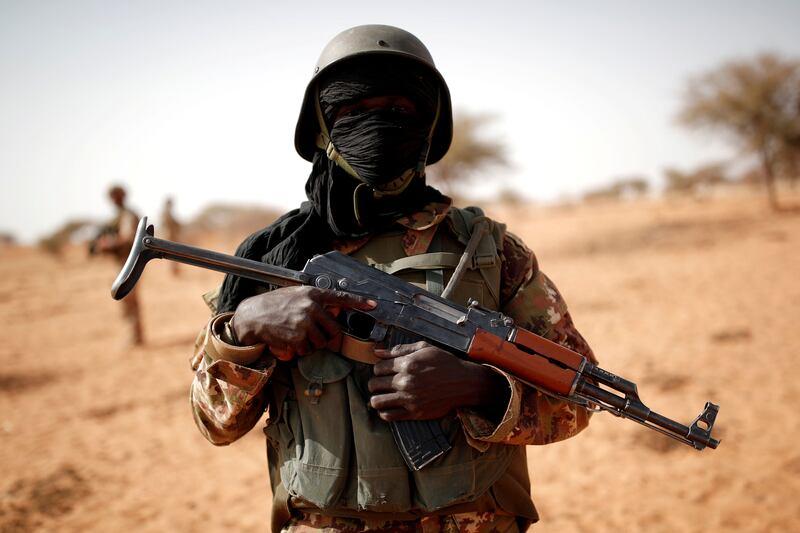
A widening confrontation between Islamic State and Al Qaeda-linked militants is reshaping the security landscape across Africa’s Sahel, as competition for territory, supply routes and local influence increasingly erupts into direct fighting.
The rivalry between Islamic State Sahel Province and Jama’at Nusrat al-Islam wal-Muslimin, or JNIM, has intensified in Mali, particularly around areas southeast of Timbuktu, with the effects potentially extending toward Gourma, Menaka and the tri-border region linking Mali, Niger and Burkina Faso.
Islamic State recently claimed in its Al-Naba newsletter that its fighters had killed more than 200 JNIM members in clashes with the rival organisation.
The figure has not been independently verified, and Islamic State provided limited details supporting the claim. Local reporting has, however, documented significant fighting between the rival groups in areas around Ndaki and southeastern Timbuktu.
The clashes mark a potentially important shift in a conflict where both organisations have traditionally concentrated much of their firepower against government forces, local militias and rival armed groups rather than each other.
Battle for supply routes
Security assessments cited by Erem News identified several areas of particular concern, including the Ndaki-Timbuktu corridor, routes linking Gourma with Gao and territory stretching from Menaka toward Niger.
Both groups are increasingly competing for desert routes used to transport motorcycles, fuel, weapons and fighters between northern and eastern Mali.
Islamic State maintains a significant presence around Menaka and across parts of western Niger, while JNIM has built a broader network extending across large areas of Mali and Burkina Faso.
Control of roads, villages and markets can provide armed groups with access to recruits, taxation, smuggling routes and supplies, making seemingly isolated clashes part of a much larger contest for political and economic influence.
Political analyst Komlan Afolete told Erem News that the widening geographical reach of both organisations was increasing the likelihood of direct confrontation, particularly in areas where state authority is weak and cross-border smuggling networks are well established.
The struggle is increasingly extending beyond purely military objectives, with communities, commercial routes and local economies becoming part of the competition for influence.
Conflict spreading across Mali
The confrontation comes as JNIM expands operations in other parts of Mali.
The group has recently targeted fuel convoys and transport routes in western Mali, adding pressure to authorities already struggling to contain insurgent attacks across several regions.
Islamic State, meanwhile, remains entrenched around Menaka and operates extensively in Niger’s Tillaberi region, one of the most violent areas of the central Sahel.
The overlapping presence of the two organisations in border regions creates conditions for further clashes stretching across Mali, Niger and Burkina Faso.
Rather than being constrained by national borders, both groups rely on networks of desert routes linking communities, smuggling corridors and militant strongholds across the three countries.
Record levels of violence
The growing rivalry comes amid an overall surge in militant violence across the Sahel.
ACLED data cited in recent reporting showed more than 2,100 incidents involving jihadist groups had already been recorded in Mali, Burkina Faso and Niger by early September 2026, putting the region on course to surpass the record set in 2025.
JNIM has emerged as one of the most powerful militant organisations in the region, expanding its operations across Mali and Burkina Faso and increasingly projecting force into neighbouring states.
Islamic State has retained particularly strong positions in eastern Mali and western Niger despite military pressure and repeated clashes with rival armed groups.
French security analyst Jean-Paul Ney told Erem News that renewed fighting between the two jihadist organisations could place additional pressure on regional militaries by rapidly shifting areas of militant control and pushing fighters into new territory.
The emerging conflict therefore adds another layer to an already fragmented war.
Government forces across Mali, Niger and Burkina Faso are now confronting not only expanding insurgencies but also a struggle between two major jihadist networks competing for fighters, territory and resources.
The Mali-Niger-Burkina Faso borderlands are likely to remain at the centre of that contest, where control of strategic corridors may prove as important as control of towns themselves.