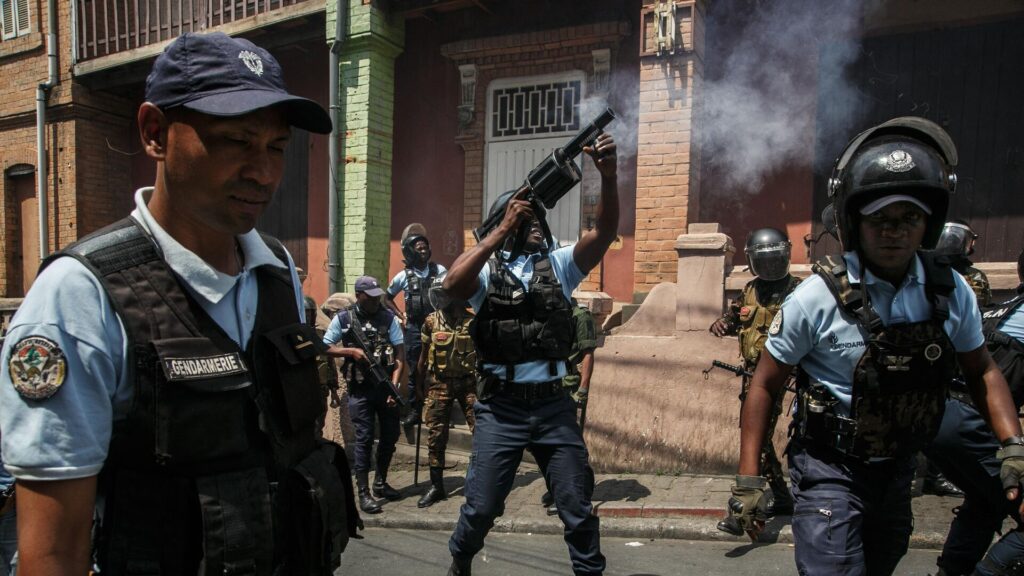
Law enforcement officers deployed tear gas to scatter protesters on their way to an opposition gathering in Madagascar’s capital city on a Saturday, a mere fortnight before the upcoming presidential election, according to reports from media.
Over the past weeks, the island nation in the Indian Ocean has been embroiled in a fierce political contest between the current president, Andry Rajoelina, seeking re-election, and multiple opposition figures.
Voters will cast their ballots on November 16, as the highest court has postponed the presidential election by one week due to the elevated political tension.
Opposition candidates have been orchestrating nearly daily, unauthorized marches in the capital city, Antananarivo, for over a month, objecting to what they describe as an “institutional coup” that appears to favor the incumbent.
Law enforcement has consistently dispersed the demonstrators, and during one of the rallies, an opposition candidate sustained injuries.
On Saturday, several hundred protesters, converging from different areas of the capital toward a highly symbolic central square, were dispersed well in advance of reaching their intended assembly point.
At approximately 0900 GMT, police simultaneously initiated the use of tear gas in multiple locations, as witnessed by media.
One demonstrator shouted for it to stop, saying: “You hurt us, you make us cry! We are only claiming our rights!”
“Things have to change. It’s only through revolt in the streets that we’ll get there,” Eddy, a 19-year-old student, said.
Representatives from the European Union, the United States, and various other countries and international organizations, including France, Germany, and Japan, have previously released a statement expressing their utmost vigilance while monitoring the lead-up to the election.
The United Nations has voiced its apprehension regarding the deteriorating human rights situation within the nation.
Rajoelina first took power in 2009 on the back of a coup.
Following his decision not to participate in the 2013 election under international pressure, he reclaimed power in 2018.
Since then, he has maintained control over a nation that, despite its abundant natural resources, still ranks among the world’s poorest.