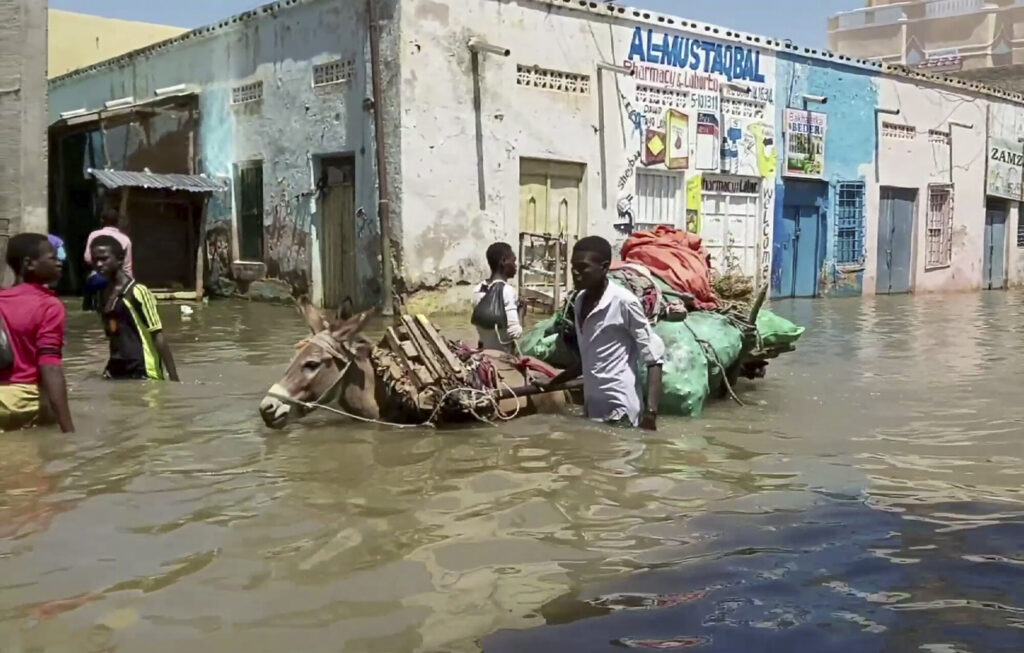
Excessive rainfall leading to flash floods in Somalia has forced approximately half a million people to evacuate their homes, resulting in over 30 fatalities, as reported by a minister on Sunday.
The Horn of Africa country has been pounded by incessant rainfall since the start of the month, attributed to the El Nino weather phenomenon, causing widespread flooding in homes and farmlands.
This calamity follows a historic drought, pushing millions of Somalis to the brink of famine.
Information Minister Daud Aweis cautioned that approximately half a million people have evacuated their homes due to the flooding, with a warning that another 1.2 million individuals could be affected.
Government officials have acknowledged the deaths of 31 people, but Information Minister Daud Aweis stated that there is a possibility that the toll could be higher.
The most extensive damage is concentrated in the Gedo region in southern Somalia and the central Hiran region, where the seasonal Shabelle River breached its banks, submerging roads and sweeping away properties in Beledweyne town.
Approximately 200,000 individuals were forced to evacuate from Beledweyne when the river overflowed in May.
Somalia is recognized as one of the nations most susceptible to climate change, yet it faces significant challenges in addressing the crisis, compounded by its struggle against a lethal Islamist insurgency.
The United Nations humanitarian agency, OCHA, recently declared that Somalia is confronting “once-in-a-century flooding,” cautioning that as many as 1.6 million people could be impacted.
OCHA highlighted that the situation has been worsened by the simultaneous influence of two climate phenomena, El Nino and the Indian Ocean Dipole—a climate system characterized by variations in sea surface temperature between the western and eastern regions of the ocean.
El Nino is commonly linked to elevated global temperatures, as well as drought in certain regions and intensified rainfall in others.
The last instance of El Nino was observed in 2018-2019, succeeded by an unusually prolonged La Nina, El Nino’s cooling counterpart, which concluded earlier this year.
During the period from October 1997 to January 1998, destructive floods triggered by El Nino resulted in over 6,000 fatalities across five countries in the Horn of Africa.
Somalia witnessed a death toll of at least 1,800 people when the Juba River overflowed, causing widespread devastation.
Between October and November 2006, unseasonal rains induced flooding that claimed the lives of over 140 people in Somalia. The fatalities included individuals who drowned, were attacked by crocodiles, or succumbed to a malaria epidemic.
In late 2019, a minimum of 265 individuals lost their lives, and tens of thousands were forced to evacuate due to two months of continuous rainfall in multiple countries across East Africa.
The ongoing El Nino rains have resulted in the deaths of over 15 people in Kenya and claimed the lives of more than 20 individuals in Ethiopia’s Somali region.