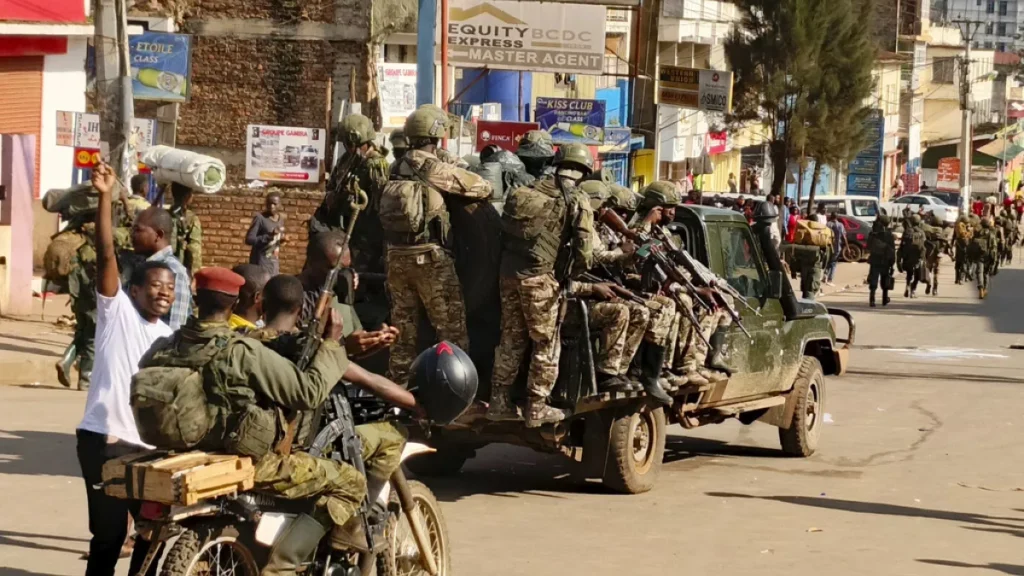
As Rwanda-backed M23 rebels walked freely through the streets of eastern Democratic Republic of Congo’s second-largest city, President Félix Tshisekedi’s office insisted that the military and its “valiant” allies remained in control.
The assertion has done little to calm nerves in Kinshasa, 1,600 km (1,000 miles) away, where rising panic has led some residents to seek escape routes abroad amid open speculation about a coup.
“There was never any question of fighting in Bukavu. Everyone on the ground knew the Rwandans and their auxiliaries would enter,” said a senior army general, who expressed disbelief at the presidential statement issued Sunday.
Tshisekedi, he added, “doesn’t have the right sources.”
Tensions are mounting in the capital as the military struggles to resist the M23 offensive. Embassies have deployed armored vehicles for airport transfers and relocated some staff across the Congo River to Brazzaville.
Three government officials told Reuters they were making plans to send their families out of the country.
Matondo Arnold, a Kinshasa-based banker, said he had already sent his family to Brazzaville after Goma, eastern Congo’s largest city, fell to the rebels in late January. “We never imagined Goma could fall,” he said.
With rumors of a possible coup swirling, Justice Minister Constant Mutamba declared on X that Congolese citizens “will not accept any coup that involves the Rwandan army to destabilize the country’s institutions.”
Even within Tshisekedi’s ruling coalition, the anxiety is palpable.
“Oh yes, it’s panic. Some people are desperate and they are courting embassies” in search of a way out, admitted a member of his Sacred Union alliance.
The M23 advance marks the most serious escalation in eastern Congo in over a decade, reigniting a long-running conflict fueled by the aftermath of Rwanda’s 1994 genocide and competition over Congo’s vast mineral wealth.
Congo, the United Nations, and Western powers accuse Rwanda of backing M23 with arms and troops, a charge Kigali denies. Rwanda claims it is defending itself from the threat of Hutu militias, which it says operate alongside the Congolese military.
Diplomatic efforts to resolve the crisis remain stalled, with Tshisekedi refusing to negotiate with the rebels while his allies blame the West for not taking stronger action against Rwanda.
“It’s not wrong to refuse dialogue with an armed group like M23. M23 is Rwanda,” said a lawmaker close to the president. “Why doesn’t the West do anything?”
Tshisekedi has skipped two key African-led summits addressing the conflict, including a regional meeting in Dar es Salaam and the African Union summit in Addis Ababa. Instead, he flew to the Munich Security Conference, where he accused former President Joseph Kabila of backing M23’s offensive—an allegation Kabila’s camp denied.
His absence from African summits drew scorn from political elites.
“The fact that an African president snubs the African Union summit and instead attends a European security conference says a lot about who supports him,” said a former senior official.
Tshisekedi, who secured a second term in contested December elections, now faces deepening opposition.
“His lack of legitimacy is now proven, making him less and less listened to and more and more rejected by the population every day,” said Olivier Kamitatu, a spokesperson for opposition leader Moïse Katumbi.
Martin Fayulu, who placed second in the disputed 2018 election, dismissed Tshisekedi as lacking the intellectual depth to govern.
But with Goma and Bukavu under rebel control, Tshisekedi’s ability to maintain both political and security stability is now in question.
“With the fall of Goma and Bukavu, no one is sure if Tshisekedi can still control the situation,” said Congolese analyst Bob Kabamba of the University of Liège.