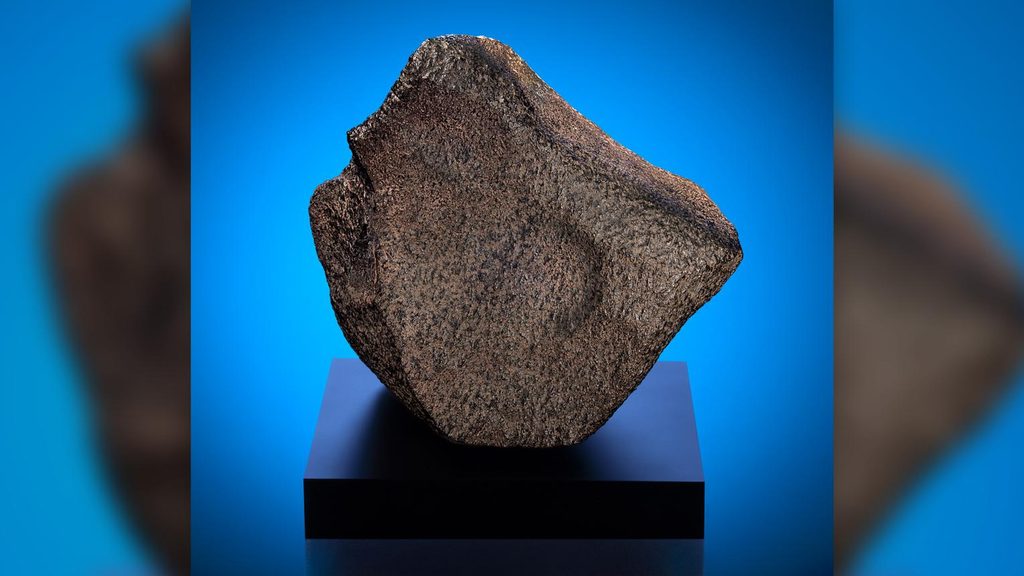
Scientists examining a meteorite discovered in the Sahara Desert have estimated that the rock formed at least 4.1 billion years ago, potentially making it the oldest known Martian igneous meteorite recovered on Earth.
The findings, published Thursday in the journal Science, are based on laboratory analysis of a reddish rock known as Teghaza 001, discovered in Mali in 2022.
Researchers say the meteorite’s chemical composition also suggests that liquid water was present on Mars during the planet’s early geological history, potentially creating conditions suitable for microbial life.
However, the study provides no direct evidence that life ever existed on Mars.
Researchers use radioactive dating to estimate age
The meteorite was recovered in eight fragments from a desert location approximately 34 kilometres from the Malian village of Bir Chali.
Scientists examined microscopic zircon crystals containing uranium and used radioactive dating techniques to estimate when the rock formed.
The method relies on measuring the proportions of uranium and lead isotopes and calculating an age based on established models of radioactive decay.
Additional measurements involving other radioactive isotopes produced broadly consistent age estimates, according to the researchers.
Yang Liu, a planetary scientist at NASA’s Jet Propulsion Laboratory and lead author of the study, said the meteorite offers an unusual opportunity to investigate Mars’ early development.
Researchers believe the rock originated in the Martian crust after molten material from the planet’s interior cooled and crystallised.
Its composition differs significantly from most other known Martian meteorites, potentially providing evidence of geological processes not previously represented in samples recovered on Earth.
Chemical evidence points to ancient water
Scientists also identified chemical signatures they interpret as evidence that water penetrated the Martian crust and interacted with molten rock.
Analysis of hydrogen and oxygen isotopes suggests that water circulated through parts of Mars’ crust during the period in which the meteorite formed or underwent subsequent geological changes.
The researchers argue that these findings support existing theories that Mars once possessed a warmer, wetter environment before developing into the cold and largely dry planet observed today.
Lee Saper, a planetary scientist at NASA’s Ames Research Center and a co-author of the study, said the evidence strengthens the possibility that early Mars possessed conditions capable of supporting life.
Nevertheless, researchers emphasised that the discovery does not establish whether living organisms ever existed on the planet.
Rare glimpse into Mars’ early history
Of approximately 435 recognised Martian meteorites found on Earth, only three are believed to contain material dating to the planet’s earliest geological history.
Scientists suggest Teghaza 001 may have originated in Mars’ southern highlands, potentially near the enormous Hellas impact basin.
According to their reconstruction, an asteroid or another celestial object struck Mars, ejecting the rock into space.
The fragment subsequently travelled through the solar system before entering Earth’s atmosphere and landing in the Sahara Desert.
Researchers have not established when the meteorite reached Earth.
The discovery could help scientists investigate how Mars developed differently from Earth and why the two neighbouring planets eventually acquired such contrasting environments.
However, the meteorite’s proposed age, geological history and implications for ancient Martian conditions remain interpretations based on laboratory measurements and scientific models.