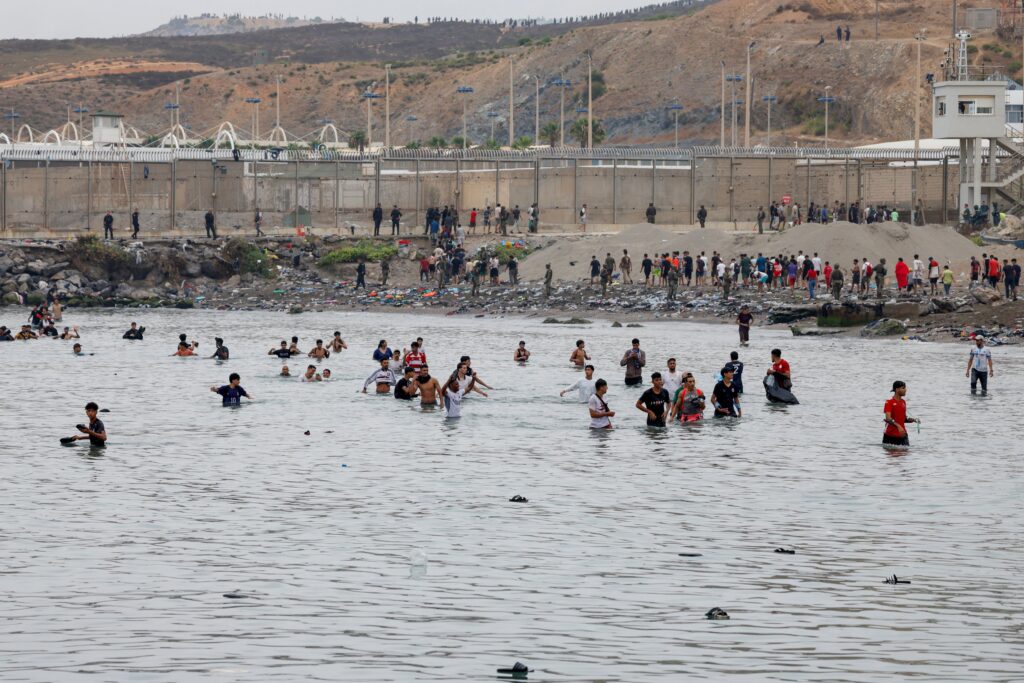
Viral videos, misleading social media posts and widespread misinterpretations of a Spanish court ruling helped trigger last week’s unprecedented mass crossing into Ceuta, when tens of thousands of people attempted to swim into the Spanish enclave from Morocco.
The movement began with only a few dozen young people but rapidly expanded after footage of successful arrivals circulated widely online. By Thursday, Spanish authorities said more than 70,000 people had entered Ceuta irregularly.
More than 80 people drowned or were killed in a stampede during the chaotic crossings, according to official figures.
The surge was partly fuelled by a ruling issued by Spain’s Supreme Court three weeks earlier. The court said migrants intercepted at sea could not be immediately pushed back across the borders of Ceuta and Melilla.
Legal experts said the decision did not prevent Spanish authorities from returning migrants through expedited procedures afterwards. However, misleading claims spread online suggesting that anyone who managed to enter Ceuta, whether by land or sea, would be allowed to remain.
“Never believe those who tell you that if you get into Ceuta, they will send you back. You will not be sent back,” a young Moroccan man said in a video filmed in Germany. The original clip was deleted but continued to circulate through reposted versions.
Other posts falsely claimed that Spain’s programme to regularise hundreds of thousands of undocumented migrants would close on July 30, creating a sense of urgency among potential migrants.
The programme was, in fact, open to irregular migrants who had been living in Spain for at least five months before the end of 2025. Applications were accepted between April and June 30, and the government did not extend the deadline.
Spanish authorities received more than twice the 500,000 applications initially expected.
Many of the social media posts and online groups promoting the Ceuta crossings have since been removed, making it difficult to determine when and where the calls first originated.
Morocco prosecuted dozens of people in 2024 over allegations that they had used social media to encourage an earlier attempted mass crossing.
News footage unintentionally encourages crossings
By July 23, around 100 people had reached Ceuta, according to the local news outlet El Faro de Ceuta, which linked the arrivals to the Supreme Court decision.
Spanish and Moroccan officials later made similar claims, accusing human-trafficking networks of spreading and exploiting false information online.
Footage published by El Faro showed young men smiling, giving thumbs-up signs and making victory gestures after reaching the enclave.
Migrants interviewed by Reuters said the images unintentionally encouraged hundreds of others to make the journey.
Another widely shared video published on July 28 showed two smiling young women, still wet after completing the crossing, walking through the streets of Ceuta. The caption accompanying the report said: “Ceuta can’t take it anymore.”
Three migrants said the footage was widely viewed in Morocco and further increased interest in attempting the crossing.
Influencers join the movement
The following day, influencers with tens of thousands of followers began posting videos showing themselves swimming towards Ceuta, sometimes using wetsuits and inflatable rings.
Mounim Belhaj, a dog groomer with about 31,000 Instagram followers, said he decided to attempt the crossing after seeing reports that migrants were being accommodated at Ceuta’s reception centre.
“Spanish media were showing good treatment of migrants arriving in Spain, and that encouraged us a lot to go there,” he said.
Some of the most widely viewed videos were misleading. One clip seen millions of times showed a man holding a selfie stick while swimming towards what social media users claimed was Ceuta.
The footage had actually been filmed earlier in July in a Moroccan city on the Atlantic coast.
Public WhatsApp groups also appear to have played a role in organising and encouraging the crossings.
Spanish security analyst Chema Gil identified two groups administered by Algerian phone numbers with a combined membership of around 3,700 people. The groups reportedly offered advice on routes into Ceuta and urged members to act quickly.
“Those who do not move today will regret it tomorrow,” one message said.
Gil was unable to identify the administrators, and Reuters could not independently verify the groups before they were deleted.
Thousands left stranded
By the following evening, hunger, poor conditions and hostility inside the enclave had prompted most of the new arrivals to return to Morocco.
Thousands, however, remained stranded in Ceuta, including sub-Saharan African migrants and unaccompanied minors who could not be immediately deported.
Belhaj said the reality inside the enclave was far different from what had been portrayed online.
“We made a mistake in going there,” he said. “There was only hunger.”