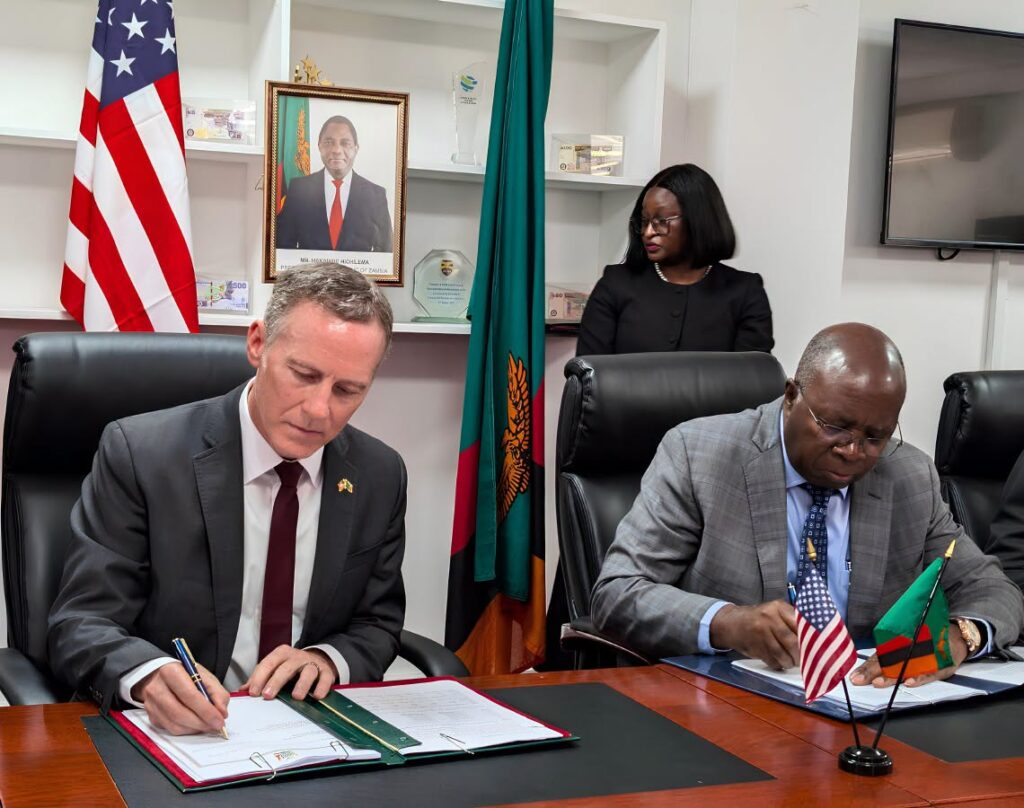
Zambia has signed a five-year health financing agreement with the United States after months of controversy over data privacy, biological samples and claims that American aid was being linked to access to the country’s mineral resources.
The agreement, signed in Lusaka on Thursday alongside a separate data-sharing arrangement, will see Washington provide about $1.5 billion, while Zambia will increase its own health spending over the life of the programme.
The package will support HIV/AIDS, tuberculosis and malaria programmes, maternal and child health, disease surveillance and other health services, including the recruitment of community health workers.
The deal follows months of criticism from civil society groups and opposition figures over an earlier draft that raised concerns about the sharing of medical information and biological specimens.
Zambian Health Minister Roma Chilengi said the final agreement does not permit the transfer of individual patient records and that provisions requiring biological samples to be sent to the United States had been removed.
He said data-sharing would be restricted to information required to monitor and evaluate programmes financed under the agreement.
A leaked draft earlier this year prompted rights groups to warn that Zambia could be granting Washington broad access to health and pathogen data.
The Chapter One Foundation said the government risked “signing away” citizens’ medical information, while HIV advocacy groups called for the full agreement to be made public.
The controversy widened after reports suggested US health funding could be tied to preferential access for American companies to Zambia’s copper and other critical mineral resources.
Foreign Minister Mulambo Haimbe said in May that some proposed data-sharing provisions were unacceptable and accused Washington of linking health assistance to minerals.
Then-US ambassador Michael Gonzales rejected the allegation.
Relations had already been strained after the US suspended some funding for medicines following embassy claims that donated drugs had been stolen. Zambian authorities disputed the allegations.
The new health arrangement comes after the Trump administration dismantled the US Agency for International Development, or USAID, and shifted towards agreements requiring partner governments to assume a larger share of programme costs.
Kenya, Tanzania and Uganda have signed similar agreements, while Ghana and Zimbabwe have rejected deals over concerns surrounding conditions on data and biological samples.
US officials describe the new approach as a move away from the traditional donor-recipient model towards greater shared responsibility.
American funding for Zambia is expected to decline gradually during the five-year period as Lusaka increases domestic financing.
Officials have valued the combined US-Zambian package covering 2026 to 2030 at about $3.6 billion, although estimates of Zambia’s contribution have varied.
The Trump administration has defended its restructuring of overseas health assistance, arguing that the new system is more efficient and better aligned with US priorities.
Critics, however, say the closure of USAID weakened health systems across parts of Africa and reduced capacity to detect and respond quickly to outbreaks, including the ongoing Ebola crisis in the Democratic Republic of Congo.
Washington disputes those claims and has pointed to hundreds of millions of dollars in emergency funding provided for the Ebola response.