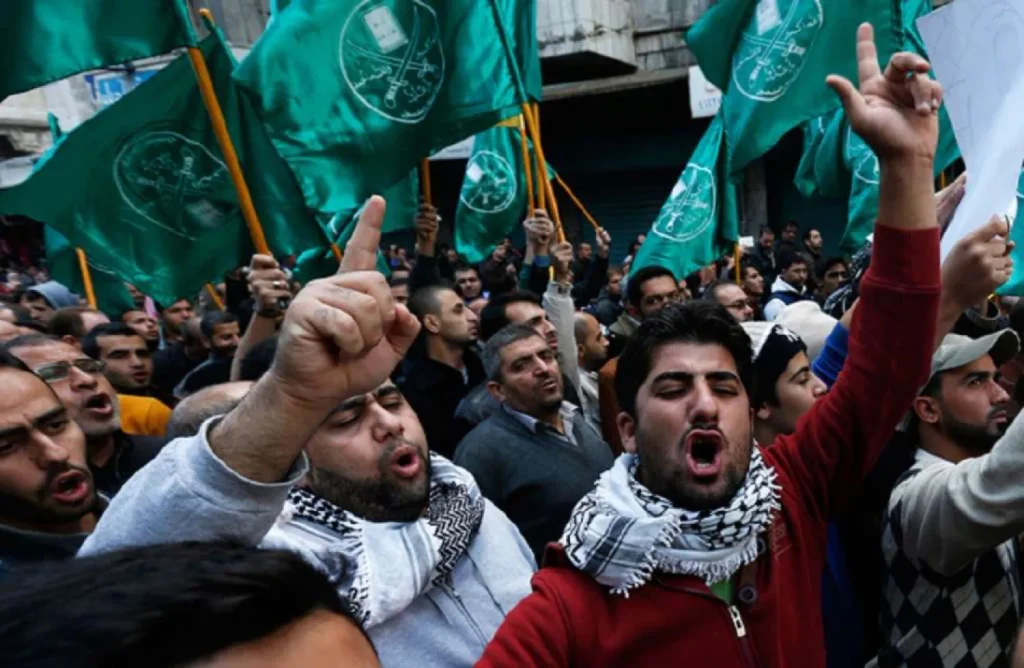
A former CIA analyst has warned that the Muslim Brotherhood is seeking to expand its political and social influence in the United States through community organisations, religious groups and local institutions, rather than relying solely on political donations or university funding.
Sarah Adams, a former analyst with the US Central Intelligence Agency, told BlazeTV that she believes the movement has spent decades building influence from the local level upward, with its presence becoming more visible in municipal and state-level political campaigns.
Focus on local organisations
Adams said the strategy goes beyond funding political candidates or supporting academic institutions, arguing that influence can be built gradually through chambers of commerce, charities, religious organisations and other community groups.
She claimed the issue has received greater attention amid reports alleging links between some individuals associated with the Muslim Brotherhood and candidates connected to the Democratic Socialists of America, including a candidate in Michigan.
The claims have not been independently verified, and Adams did not provide detailed evidence establishing organisational links between the Brotherhood and the candidates or institutions she discussed.
Brotherhood’s international history
Adams also pointed to the Muslim Brotherhood’s nearly century-long history in the Middle East, where the organisation developed extensive political and social networks.
Several governments in the region have banned or restricted the Brotherhood, often accusing it of seeking to undermine existing political systems. The group and its supporters have rejected many such accusations and say its political activities vary widely between countries.
Adams criticised Washington for what she described as a slower response, arguing that the United States has not taken measures comparable to those adopted by some governments in the Muslim world.
Groups operating under different names
One of the main challenges in identifying alleged Brotherhood-linked networks, Adams said, is that organisations do not necessarily operate under the Muslim Brotherhood name.
She argued that groups may instead register under broad civic, charitable or religious titles, making it difficult for the public to determine whether institutional or personal ties exist.
Adams compared the practice to organisations associated with Scientology that, she said, sometimes operate under names that do not immediately reveal their affiliation.
Claims over political objectives
Adams described the Muslim Brotherhood as a political vehicle connected to the broader goal of re-establishing an Islamic caliphate, pointing to the relatively recent collapse of the Ottoman Caliphate in the early 20th century.
That assessment reflects Adams’ interpretation of the Brotherhood’s objectives. The movement is decentralised, and its branches and affiliated political groups have pursued different strategies in different countries.
She argued that intense political polarisation in the United States has created opportunities for ideological groups to form shifting alliances as administrations and political priorities change.
Economic pressures, she added, may also make voters more receptive to organisations or movements promising sweeping political and social solutions.
Criticism of US vetting system
Adams also criticised US immigration and security screening over recent decades, alleging that individuals with extremist family connections or hostile views had sometimes been permitted to enter the country.
She said responsibility for screening people entering the United States does not primarily lie with the CIA, but with agencies including the State Department and Department of Homeland Security.
Gaps between US agencies
Adams argued that institutional divisions within the US security system make it difficult to respond consistently to what she described as a long-term ideological threat.
She said intelligence priorities can shift every few years depending on political leadership, complicating efforts to track movements that develop influence over decades.
According to Adams, the FBI focuses largely on domestic investigations and law enforcement, while the CIA has extensive intelligence capabilities but is generally restricted from conducting domestic operations.
She also described the National Counterterrorism Center, established after the September 11 attacks, as primarily an analytical body without its own enforcement arm.
Adams concluded that overlapping responsibilities and the absence of a single agency clearly accountable for such cases can lead to institutional gaps, calling for a reassessment of how US agencies coordinate when addressing long-term extremist or ideological networks.