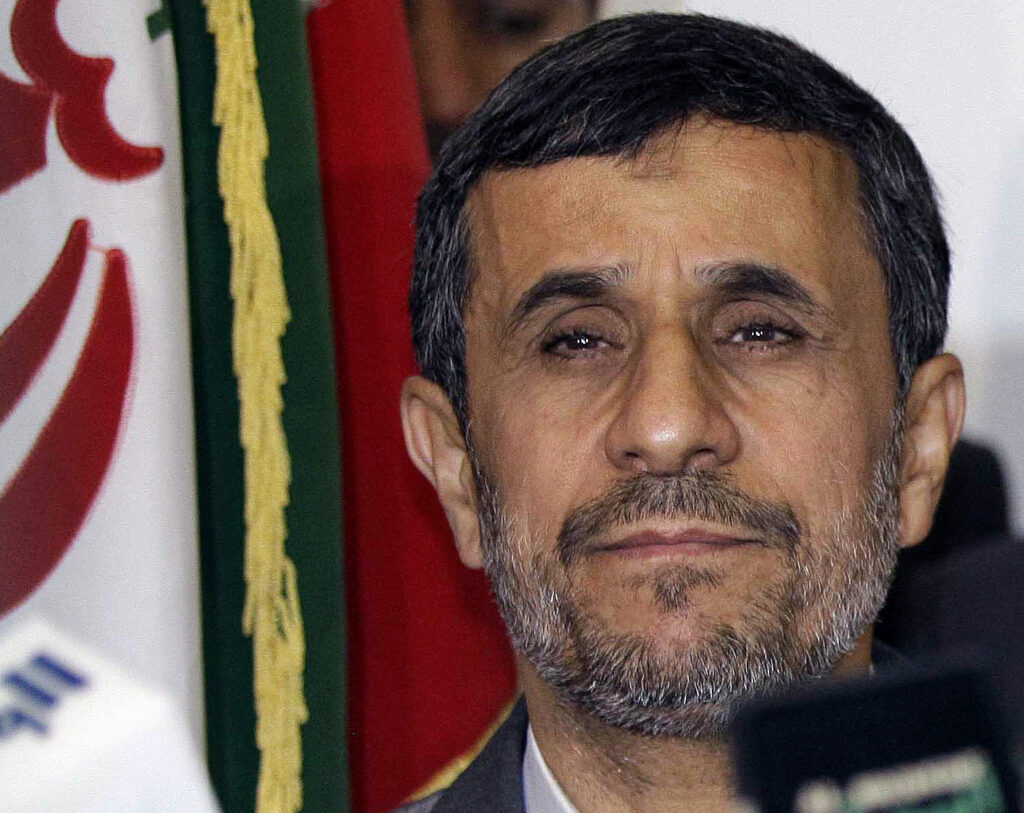
Israel’s Mossad cultivated former Iranian President Mahmoud Ahmadinejad as a potential successor to Iran’s clerical leadership under an ambitious but ultimately unsuccessful regime-change operation, according to an investigation published by the Israeli newspaper Haaretz.
The operation, reportedly codenamed “Puss in Boots,” involved plans to assassinate senior Iranian leaders, encourage nationwide unrest, arm Kurdish militias and support a ground incursion into western Iran. Ahmadinejad, once one of Israel’s fiercest critics, was allegedly selected to assume power if the government in Tehran collapsed.
Haaretz said its investigation was based on interviews conducted in recent months with more than 30 senior political, security, diplomatic and foreign officials. Many of the newspaper’s assertions have not been independently verified.
According to the report, Mossad began paying closer attention to Ahmadinejad after receiving intelligence suggesting that his political views had changed significantly since he left office in 2013.
The former president, who had previously denied the Holocaust and repeatedly described Israel as an illegitimate and dangerous entity, had increasingly positioned himself as a critic of Iran’s ruling establishment.
Israeli intelligence was particularly interested in Ahmadinejad’s reported belief that Iran could not continue indefinitely under international sanctions and that the country’s nuclear programme had become more of a liability than a strategic asset.
Haaretz claimed that people involved in the covert relationship believed Ahmadinejad was so strongly opposed to the clerical leadership that he was prepared to cooperate with Mossad and entrust his future to the Israeli intelligence service.
Mossad chief David Barnea reportedly took personal control of the operation. In 2024, according to the newspaper, Barnea travelled to Budapest for a face-to-face meeting with Ahmadinejad.
By early 2026, Israeli officials allegedly considered the former president one of their most valuable assets inside Iran.
The plan was for Ahmadinejad to emerge after the fall of the existing leadership, abandon Iran’s pursuit of nuclear weapons and present the international community with what Israeli planners hoped would be a transformed Iran led by a familiar political figure.
The Ahmadinejad channel, however, represented only one component of a far broader regime-change strategy.
Other elements reportedly included efforts to influence Iranian public opinion, foment unrest among ethnic minorities, arm and train Kurdish forces based in northern Iraq and establish an aerial corridor through which militias could advance into western Iran.
Serious disagreements emerged within Israel’s political and security establishment over whether the operation had any realistic chance of succeeding.
Military Intelligence chief Major General Shlomi Binder reportedly submitted an assessment questioning the plan’s feasibility. Brigadier General Ofir Mizrahi-Rosen, head of the Military Intelligence research division, was also said to have prepared a detailed document challenging its assumptions.
Then-national security adviser Tzachi Hanegbi withdrew from the preparations after concluding that the plans amounted to little more than fantasy, according to Haaretz.
The disputes intensified shortly before the planned attack. Three days before the operation was due to begin, Israeli military chief Eyal Zamir reportedly ordered that preparations be halted. Prime Minister Benjamin Netanyahu nevertheless decided to proceed.
The structure created by Netanyahu and Barnea collapsed before the Kurdish forces fired a shot, the newspaper said.
A turning point after Raisi’s death
Haaretz traced the origins of the plan to May 2024, following the death of Iranian President Ebrahim Raisi in a helicopter crash near the country’s border with Azerbaijan.
Raisi, who was accused of playing a central role in the mass execution of political prisoners during the late 1980s, exercised far less authority than Supreme Leader Ali Khamenei. Nevertheless, Israeli intelligence reportedly viewed public celebrations of his death as evidence of deeper dissatisfaction with the government.
Mossad was already aware that Iran’s political system faced economic pressure, international sanctions and public anger following the death of Mahsa Amini in morality-police custody in 2022.
However, the celebrations following Raisi’s death convinced some officials that the system was weaker than previously assumed and potentially vulnerable to external pressure.
The period also coincided with what the report described as a change in Netanyahu’s approach to military force following the Hamas-led attacks of October 7, 2023.
Netanyahu had historically exercised caution over large-scale military operations, but Haaretz said his approach became increasingly aggressive during the Gaza war. He was reportedly concerned both about Iran’s nuclear programme and about securing a strategic achievement that could overshadow Israel’s failures surrounding the October 7 attack.
The prime minister subsequently instructed Barnea to redirect Mossad resources towards destabilising Iran.
The decision marked a dramatic shift from Israel’s long-standing policy.
Former Mossad directors had repeatedly opposed attempts to lead a regime-change operation inside Iran. Under previous governments, Israeli intelligence focused primarily on disrupting Iran’s nuclear programme, including through sabotage operations and the assassination of nuclear scientists.
Mossad initially began with more limited activities, including influence campaigns, efforts to exploit ethnic divisions and technological operations intended to encourage protests.
Even inside the agency, however, officials reportedly warned that such measures were unlikely to produce meaningful results and risked wasting substantial resources.
Syria’s collapse inspires Netanyahu
The fall of Syrian President Bashar al-Assad’s government in late 2024 reportedly transformed Netanyahu’s thinking.
Syrian opposition forces launched an offensive around Aleppo on November 27, rapidly advancing through Hama, Homs and Damascus as government soldiers abandoned their positions.
Within roughly a week and a half, the opposition had entered the capital and Assad’s government had collapsed.
Haaretz said Netanyahu became fascinated by the success of the insurgents led by Ahmed al-Sharaa, formerly known as Abu Mohammed al-Jolani.
A source who participated in Israeli security discussions said al-Sharaa’s campaign became a major source of inspiration for the prime minister.
Netanyahu concluded that toppling Iran’s leadership would require armed ground forces capable of exploiting instability created by air strikes and internal unrest.
The result was the Kurdish component of the plan.
Under the proposal, Israel would arm and train Kurdish militias in northern Iraq and provide air support for an invasion of western Iran.
Security officials reportedly warned that comparisons between Syria and Iran were deeply flawed. Syria had been economically devastated and fragmented by more than a decade of civil war, while Iran remained a far larger and more cohesive state with a population of about 90 million and deeply entrenched security institutions.
One security source compared the idea of dismantling Iran’s system using Kurdish militias to attempting to demolish a building with a pen.
Netanyahu nevertheless pressed ahead.
Mossad had maintained relations with Kurdish groups since the 1970s and conducted a review of organisations that could participate. Groups strongly opposed to Turkey were reportedly excluded to avoid provoking Ankara or encouraging Turkish intervention.
Influence operations in Tehran
In early 2025, Israeli officials discussed how long it might take to destabilise Iran. Mossad initially assessed that at least three years of sustained operations would be required to create a meaningful effect.
Those estimates were reportedly received with scepticism by officials who believed Israel possessed neither the influence nor the operational tools necessary to determine political developments inside Iran.
Despite the doubts, Mossad continued attempting to build influence in Tehran’s Grand Bazaar, historically a centre of economic and political protest.
Israeli planners believed that demonstrations beginning among merchants would be viewed as genuine economic unrest rather than an externally driven political campaign, giving them greater legitimacy with the public.
Throughout 2025, Mossad agents reportedly tried to cultivate influence among local figures and identify potential leaders who could assume control if the government became destabilised.
Following Israel’s June 2025 military campaign against Iran, the focus shifted from long-term influence operations towards assassinations, air strikes and militia incursions.
War creates confidence — and overconfidence
Israel’s air campaign, known as Operation Rising Lion, began on June 13, 2025, and lasted 12 days.
The destruction of Syrian air defences following Assad’s collapse had opened a more secure route for Israeli aircraft flying towards Iran.
Israeli officials considered the operation an overwhelming military success. According to Haaretz, Netanyahu became convinced that sustained pressure could eventually bring down Iran’s government.
The prime minister reportedly asked senior officers whether Israeli forces could “get Khamenei,” prompting discussions about both the feasibility and political consequences of assassinating the elderly supreme leader, who holds considerable religious importance among Shia Muslims.
Despite the confidence generated by the air campaign, subsequent intelligence assessments indicated that Iran was rebuilding damaged infrastructure, restoring military production and strengthening its ballistic-missile programme.
Iran’s ability to reconstruct its capabilities reportedly convinced Netanyahu that Israel needed to accelerate rather than abandon its plans.
The prime minister ordered security agencies to closely monitor Iran’s underground leadership complex in central Tehran, seeking precise information about which officials were inside individual bunkers and when Khamenei might be present.
Netanyahu also convened weekly Friday meetings attended by Barnea, senior Mossad officials, representatives of the Israeli military and intelligence officers to review progress towards weakening the government.
Many of those participating remained deeply sceptical.
Hanegbi reportedly stopped attending after several weeks, telling another official that the plans resembled science fiction and had little practical value.
Protests accelerate the timetable
Two events in late 2025 further accelerated Israeli planning.
Iran’s efforts to rebuild its ballistic-missile programme convinced Israeli officials that another military confrontation was likely by the following summer.
Then, on December 28, protests erupted in a Tehran market over inflation and the sharp decline in the value of the Iranian rial. Demonstrations quickly spread.
The government responded by shutting down the internet and deploying the Islamic Revolutionary Guard Corps. Haaretz alleged that thousands of protesters were killed during a two-day crackdown beginning on January 8.
US President Donald Trump publicly assured Iranians that assistance was coming and signalled his willingness to consider military action.
Netanyahu then asked Zamir to prepare the strongest possible short-term attack plan and instructed Barnea to produce the most effective regime-change proposal Mossad could assemble.
The Israeli security establishment reportedly recognised that it was not fully prepared, but believed the prospect of US involvement meant the operation could move forward regardless.
Kurdish invasion plan
In the weeks before the proposed campaign, Mossad officers worked alongside Kurdish militia commanders in northern Iraq.
Israel supplied weapons reportedly seized during its conflict with Hezbollah, while Mossad personnel trained Kurdish commanders in their use.
According to Israeli sources cited by Haaretz, the Kurdish groups maintained organised military bases, training areas, patrols, watchtowers and command structures.
The plan called for approximately 16,000 Kurdish fighters to cross into western Iran under Israeli air cover.
They were expected to seize two cities near the Iraqi border, including areas around Kermanshah and the Kurdish city of Marivan. Israeli planners believed local Kurdish populations and armed opposition groups would join the advancing force.
Other minority organisations cooperating with Mossad were expected to launch operations elsewhere, forcing Iranian security forces to redeploy away from Tehran.
At the same time, the United States and Israel would carry out joint strikes against Iran’s senior leadership and security institutions.
The combined effect of assassinations, border incursions, ethnic rebellions and nationwide protests was intended to create the impression that the government was under attack from every direction.
Mossad also mapped Iranian weapons depots that Kurdish fighters could seize as they advanced, allowing them to replenish their ammunition.
In the most optimistic scenario, Kurdish units would continue towards Tehran, with Israeli aircraft clearing routes into opposition-leaning neighbourhoods of the capital.
Ahmadinejad would then be promoted through a coordinated influence campaign as the figure best placed to take power.
Israeli officials reportedly believed Ahmadinejad still enjoyed substantial popularity inside Iran despite being viewed abroad as a politician from an earlier era. They also believed his popularity explained why Iranian authorities had not acted more aggressively against him, even as rumours of his contacts with Israel circulated.
As the operation approached, Mossad officers and Kurdish commanders reviewed invasion routes, air-support plans and operational maps. Barnea personally attended a final meeting with senior Kurdish representatives.
The participants were reportedly waiting only for approval from the White House.
That approval never produced the outcome anticipated by Israeli planners.
According to Haaretz, the elaborate project collapsed before the Kurdish offensive began, exposing the enormous gap between Mossad’s operational achievements and the political assumptions underpinning the broader regime-change strategy.
The newspaper concluded that the man presented as Israel’s “Puss in Boots” — a seemingly unlikely character capable of delivering an extraordinary victory — had instead been a “cat in the bag” from the beginning.