Iran said it would respond in kind if the United States returned to its commitments under a June agreement aimed at ending their conflict, as renewed military exchanges and attacks on oil tankers raised fears of a wider escalation.
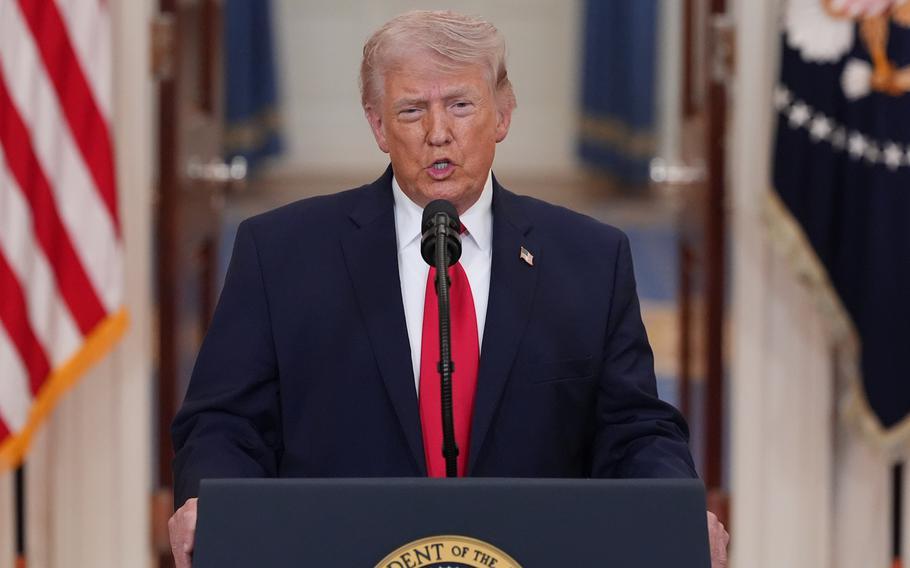
Iranian President Masoud Pezeshkian made the appeal on Tuesday, a day after US President Donald Trump threatened further strikes against Tehran.
“If the US returns to its commitments under the Memorandum of Understanding, the Islamic Republic of Iran will immediately reciprocate,” Pezeshkian said during a Shanghai Cooperation Organisation summit in Kyrgyzstan’s capital, Bishkek.
The statement came after the first direct exchange of attacks between Iran and the US since late July. Washington struck Iran’s Larak Island on Sunday, prompting Tehran to launch missiles at two American airbases in Jordan overnight.
Trump subsequently warned that the US would “hit them hard” and deliver a response, according to remarks reported by Fox News. He separately said the latest attacks did not indicate a return to full-scale war.
A senior Iranian source described the exchange as a “limited and contained confrontation” but warned that Tehran would respond forcefully to any further attack.
Neither side appears eager to resume an all-out war. However, their pledges to retaliate have underscored how quickly a confrontation increasingly driven by sanctions, blockades and economic pressure could return to direct military action.
Hormuz tanker attacks fuel oil concerns
Oil prices rose amid the renewed tensions and reports that two supertankers carrying Saudi crude were struck by unidentified projectiles while leaving the Strait of Hormuz late on Monday.
The vessels were hit within minutes of one another, according to shipping intelligence and tracking companies Marisks and Kpler.
Iran has effectively closed the strategic waterway to commercial shipping and says it will restore freedom of navigation only if Washington implements the terms of the June memorandum.
The agreement formally halted the fighting and established a 60-day period for negotiations on unresolved issues. That deadline passed without a broader settlement.
Pezeshkian said on Monday that war was not in anyone’s interest and that Iran remained open to negotiations. There has been no indication, however, that Washington and Tehran are close to a breakthrough.
Brent crude futures rose by a further 1.3% on Tuesday as markets assessed the risk of supply disruptions in one of the world’s most important oil-producing regions.
“The tit-for-tat missile exchanges between the US and Iran bring validation to those who believe that even if not a ‘forever war’, this conflict will run and run,” PVM analyst John Evans said.
Washington intensifies economic pressure
Thousands of people, primarily in Iran and Lebanon, have been killed since the conflict began with US and Israeli attacks on Iran on February 28.
Washington has increasingly turned to economic measures in an attempt to compel Tehran to lift its blockade of the Strait of Hormuz and end the conflict.
US Treasury Secretary Scott Bessent has warned that countries continuing to do business with Iran could face sanctions. He said Washington was likely to announce new secondary sanctions each week, initially targeting banks.
Iranian Central Bank Governor Abdolnaser Hemmati sought to reassure markets on Tuesday, saying the country possessed sufficient foreign currency reserves.
The central bank was prepared to inject as much as $2 billion into the foreign exchange market to contain recent volatility, the semi-official Tasnim news agency quoted him as saying.
“I am telling the president of the United States: Iran has foreign currency, and it has enough,” Hemmati said.
Iran’s economy nevertheless remains under severe pressure. The rial fell to a record low in August, crossing the threshold of 2 million to the US dollar, while annual inflation reached 66 percent in July.