Iran and the United States intensified attacks on each other on Thursday, deepening a week-long confrontation that has largely dismantled last month’s fragile truce. However, Tehran’s release of an American citizen offered a possible sign that both sides may still be searching for a way to avoid a return to full-scale war.
The latest escalation has brought renewed US airstrikes along Iran’s southern coast, Iranian missile and drone attacks on American military bases across the region and another major disruption to shipping through the Strait of Hormuz.
For the first time since a memorandum of understanding paused the fighting last month, US forces launched two large waves of airstrikes in a single day on Wednesday before carrying out further attacks on Thursday.
Iran responded by targeting US bases in neighbouring countries, including a recently expanded air base in Jordan.
Washington also resumed efforts to block Iranian ports after Tehran reimposed restrictions on commercial shipping through the Strait of Hormuz.
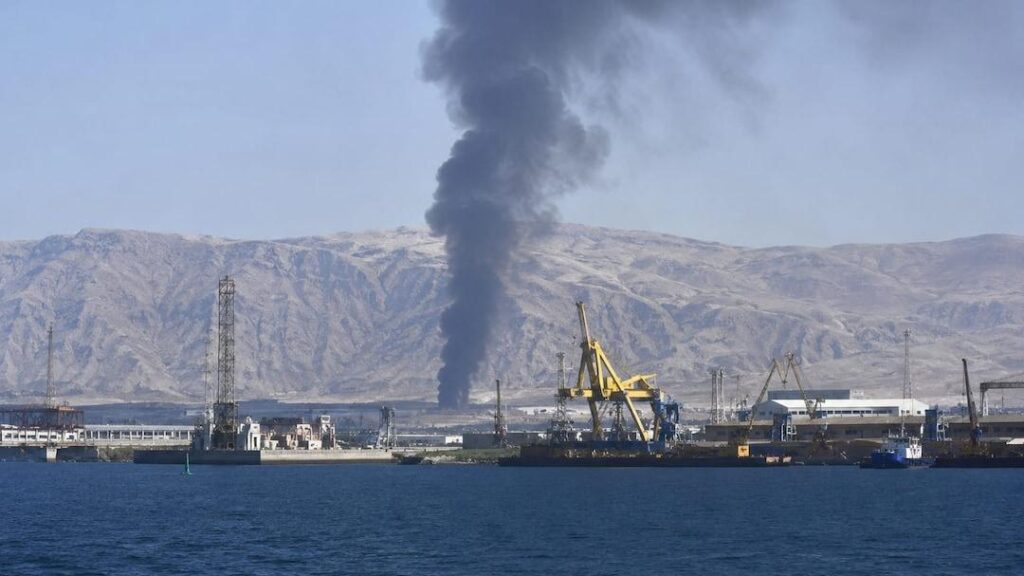
The US military said it attacked a tanker near Iran’s Kharg Island, with Hellfire missiles striking the vessel’s smokestack. Kharg Island is home to Iran’s principal oil export terminal and has emerged as a possible target in any broader US military campaign.
Iranian state media said US projectiles also struck Qeshm Island and areas near Bandar Abbas on Thursday evening. Both locations lie along the Strait of Hormuz and host important Iranian naval and Revolutionary Guards facilities.
Iran has additionally suggested that it could encourage the Houthis in Yemen to close the Bab al-Mandeb Strait, another critical global shipping route connecting the Red Sea with the Gulf of Aden.
Sources said Tehran had already instructed the group to act if Washington followed through on threats to attack major Iranian infrastructure.
Despite the expanding military confrontation, US President Donald Trump welcomed Iran’s release of an American citizen, describing it as a “gesture of goodwill”.
Human rights lawyer Jared Genser identified the released woman as Dena Karari. He said she had been prevented from leaving Iran since December 2024 after facing what he described as false charges and was now travelling safely back to the United States.
Iranian authorities did not immediately comment on the case.
Shipping through Hormuz disrupted
The renewed fighting has again brought much of the traffic through the Strait of Hormuz to a halt, placing further pressure on global oil and gas supplies and driving energy prices higher.
The strait is the world’s most important maritime route for energy exports, linking Gulf producers with international markets.
The latest escalation began after Iran attacked vessels travelling through a designated corridor in the strait last week. One strike caused a serious fire aboard a Qatari tanker carrying liquefied natural gas.
Iranian sources said Tehran’s objective was to reinforce its authority over Hormuz rather than trigger a broader war that could destroy the preliminary agreement reached with Washington in June.
Under the memorandum, Iran wants commercial vessels to use a shipping channel closer to its coastline and has said it plans to impose transit fees following a 60-day negotiation period.
The United States has instead encouraged vessels to travel through a more southerly route near Oman.
US officials say recent attacks on Iranian coastal military positions are intended to weaken Tehran’s ability to control the strait.
Iranian military spokesperson Brigadier General Mohammad Akraminia dismissed that strategy, arguing that Iran could strike shipping routes from positions across the country and would retain the ability to control access to Hormuz.
Three US officials said the strikes could also be intended to prepare the battlefield for a larger military operation by destroying Iranian capabilities that Washington would want eliminated before taking further action.
One official described the attacks as helping to “set the stage” should Trump decide to escalate.
Trump has not ruled out using ground forces, including a possible operation to seize Kharg Island. He has also threatened to strike Iranian power plants and bridges unless Tehran returns to negotiations.
Iran targets US-linked base in Jordan
Iran said it fired missiles at a Jordanian air base that the United States has expanded in recent years into a regional military headquarters.
Tehran claimed the base had been used to support an attack near a children’s cancer hospital in the Iranian city of Ahvaz on Wednesday night.
Hospital officials said patients and staff were evacuated after a missile landed about 200 metres from the main building.
Amin Goodarzi, spokesperson for the Ahvaz Jundishapur University of Medical Sciences, said some patients had returned because their treatment could not be interrupted, although most remained away from the hospital.
Inside Iran, the renewed bombing has increased public anxiety following large memorial ceremonies for slain Supreme Leader Ayatollah Ali Khamenei, which authorities portrayed as a demonstration of national unity and victory.
A 46-year-old government employee in Tehran said the constant possibility of another major war had become emotionally exhausting and expressed hope that diplomacy would prevail.
Limited war reaching its limits
Alex Vatanka, director of the Iran programme at the Middle East Institute in Washington, said both sides appeared to be approaching the limits of what they could achieve through a controlled military confrontation.
He said Washington and Tehran were effectively back where they started and would eventually have to decide whether to retreat or escalate further.
The United States, he added, could not continue limited airstrikes indefinitely because questions would eventually arise over what meaningful targets remained.
For now, Iran has largely confined its retaliatory attacks to US military installations in neighbouring countries, while Washington has focused on Iranian coastal defences, naval infrastructure and assets linked to Tehran’s control of the Strait of Hormuz.
The release of the American citizen has provided one of the few signs that diplomatic channels remain open, but the expanding range and intensity of attacks have left the region facing the growing risk of another full-scale war.