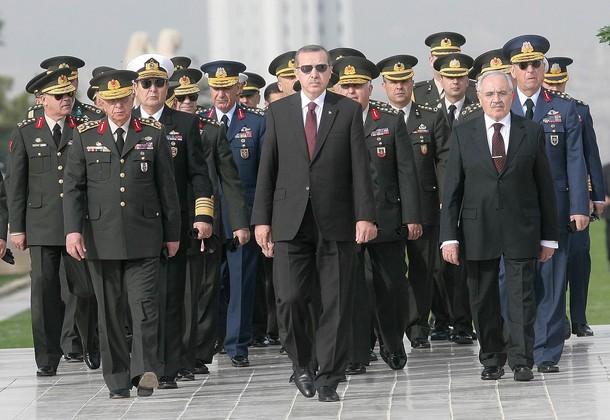
Türkiye is rapidly expanding its regional and international influence, capitalising on Iran’s weakened position to position itself as a leading Sunni power across the Middle East and beyond, according to an Israeli analysis.
The assessment, written by Tamir Hayman, argues that Türkiye represents a significant strategic challenge for Israel but warns that confronting Ankara militarily or formally designating it an enemy would be a serious mistake.
Instead, Israel should pursue a long-term strategy combining stronger regional partnerships, specialised intelligence capabilities, economic engagement and direct dialogue with Ankara, Hayman wrote.
Iran’s decline creates an opening for Türkiye
The outcome of the US-Israeli confrontation with Iran has presented Türkiye with an opportunity that Ankara is exploiting effectively, the analysis said.
Iran’s weakening and the decline of its regional allies have created space for powerful Sunni states to deepen their cooperation and potentially establish an independent security alliance.
At the same time, the damage inflicted by Iran on Gulf states has exposed their vulnerability and raised questions about whether Washington can provide a reliable, long-term security umbrella.
According to Hayman, these conditions have strengthened the case for a regional security structure in which Türkiye assumes a central leadership role.
Ankara’s ambitions are supported by an extensive military footprint. Türkiye reportedly maintains a military presence in 13 countries across the Middle East and Africa and operates more than 100 bases and facilities throughout the region.
Its growing involvement in the Red Sea, the Gulf, Lebanon, Syria and Gaza could appear from Israel’s perspective to be part of a strategy aimed at surrounding the country. However, Hayman argues that Ankara’s activities are better understood as an attempt to exploit changing regional conditions and build a broad sphere of influence sometimes described as “neo-Ottomanism.”
Türkiye has also strengthened its security relationships with Pakistan and Saudi Arabia. Washington has welcomed this cooperation, reflecting a preference within the Trump administration for regional states to assume greater responsibility for their own defence.
US President Donald Trump’s positive personal relationship with Turkish President Recep Tayyip Erdoğan has also helped Ankara strengthen its position within NATO and increase its leverage over Europe, particularly through the issue of migration.
Israel urged to avoid a self-fulfilling conflict
Israel’s security doctrine changed significantly after the October 7 attacks, with military power increasingly taking precedence over risk management and international agreements, the analysis said.
Within that environment, Türkiye is increasingly being viewed as a potential threat.
Hayman acknowledged that Ankara’s military capabilities, expanding regional presence and Erdoğan’s hostile rhetoric towards Israel provide legitimate reasons for concern. Nevertheless, he warned that formally treating Türkiye as an enemy could trigger an unnecessary cycle of escalation.
If Israel identifies Türkiye as a direct threat, the Israeli military would inevitably begin preparing offensive options. Ankara could then interpret those preparations as evidence of hostile Israeli intentions and respond with its own military planning.
Israeli intelligence would detect those Turkish preparations and cite them as confirmation that Ankara had become an enemy, creating a self-reinforcing confrontation between the two countries.
Türkiye remains a NATO member, maintains an embassy in Israel and is exposed to considerable political and economic influence from Western countries. For those reasons, Hayman argued, it should not be compared directly with the Iranian-led regional alliance.
Equating the two would underestimate the scale and nature of the threat historically posed by Tehran while potentially serving Iranian interests, he added.
Building deterrence without provoking Ankara
Israel should continue developing military and intelligence capabilities that could respond to a future Turkish threat, including stronger naval forces, improved intelligence collection and long-range strike capabilities.
However, Hayman argued that Türkiye should not be formally identified as the central threat guiding the Israeli military’s multi-year planning.
Although the distinction may appear semantic, such a designation would influence defence spending, military exercises and Ankara’s own perception of Israel’s intentions.
Israel should instead strengthen diplomatic and defence relations with Greece and Cyprus while expanding cooperation with India, which is closely monitoring Türkiye’s relationship with Pakistan.
These partnerships should form part of a broader Israeli strategy covering the eastern Mediterranean and Indo-Pacific regions, including energy, transport and infrastructure projects.
At the same time, Israel and Türkiye should maintain a direct mechanism for preventing escalation. Commercial relations should also be gradually restored, as significant economic potential remains despite Ankara’s boycott measures.
In Syria, Israel should avoid multiplying its red lines in ways that restrict its ability to respond flexibly. Turkish involvement should be assessed case by case rather than treated in the same way as Iran’s former military entrenchment in the country.
The analysis concluded that Türkiye’s rise cannot be ignored, but the challenge should primarily be addressed through diplomacy, intelligence and carefully constructed regional alliances—not through a military campaign.