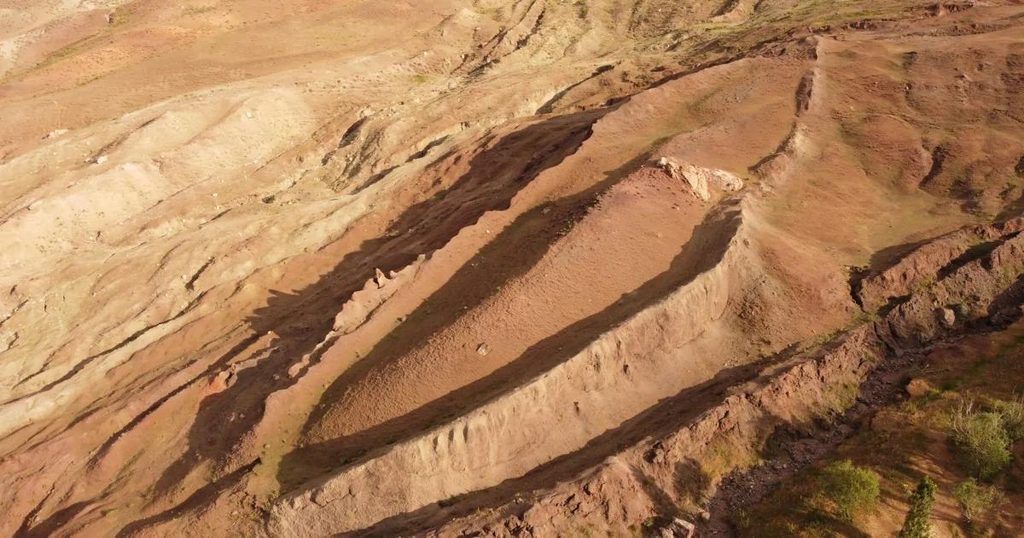
An international team searching for Noah’s Ark in eastern Turkey claims to have uncovered extraordinary new evidence beneath a mysterious boat-shaped formation, with underground radar detecting possible tunnels and drilling revealing organic material that researchers believe could be the remains of the biblical vessel.
The discoveries at the Durupınar Formation, near Mount Ararat, have prompted researchers to prepare a specially designed robotic drone to explore cavities buried deep inside the mountain.
The expedition, led by archaeologist Professor Cenker Atila of Sivas Cumhuriyet University in cooperation with Noah’s Ark Scans, says its latest findings challenge the long-standing explanation that the formation is simply a natural geological feature.
Researchers now claim they are 100% confident that the formation is a man-made structure, according to the Daily Mail, although its identification as Noah’s Ark has yet to be scientifically established.
The formation, approximately 157 metres long and located about 29 kilometres south of Mount Ararat, has attracted international attention for decades because of its striking resemblance to a giant ship.
Its dimensions have also fuelled speculation that it could correspond to the vessel described in the Book of Genesis, which recounts how Noah built an enormous ark to protect his family and animals from a catastrophic flood.
The latest investigation, however, has moved beyond the formation’s unusual appearance, with researchers deploying advanced radar technology, drilling into the ground and recovering physical samples for laboratory examination.
Radar reveals possible tunnels and three-deck structure
One of the most remarkable developments came from underground radar surveys, which researchers say revealed previously unseen features beneath the formation.
The scans identified straight lines, right-angle intersections, structural layers and large cavities at different depths.
Five prominent anomalies appeared to form a possible tunnel system stretching approximately 46 metres, while other underground features suggested the presence of chambers and interconnected passageways.
Researchers also identified a thick underground layer that appeared to divide into three sections.
The team believes the arrangement could resemble the biblical description of Noah’s Ark, which was constructed with three decks.
The investigation has been strengthened by advanced radar equipment deployed by US scientist Dr Khosrow Bakhtar, whose technology has allowed researchers to investigate deeper beneath the formation than previous surveys.
Robotic drone to enter mysterious underground chambers
The research team is now preparing to send a specially designed underground exploration drone into the formation to investigate the cavities and possible tunnels identified by radar.
Named GOPHER after the wood mentioned in the biblical account of Noah’s Ark, the robot has been developed for underground exploration and is equipped with a high-resolution camera.
Australian engineer Dr Robert Ross adapted the robot from technology originally designed for wildlife exploration.
Unlike conventional aerial drones, GOPHER is designed to enter narrow underground spaces through boreholes, allowing researchers to investigate areas that would otherwise require extensive excavation.
The team hopes the device will capture the first direct images of the suspected internal chambers and provide a closer look at the materials and structures hidden beneath the surface.
Aerial drones have already been used to document the formation from above, including earlier surveys that helped researchers map its distinctive outline.
The underground robot represents a further stage of the investigation, potentially allowing scientists to examine the formation from the inside for the first time.
According to the expedition’s September 23 announcement, GOPHER was being prepared for deployment into the underground cavities. The team has not yet published verified images from inside the suspected tunnels.
Drill bit shatters after striking mysterious hard layer
The investigation has also produced an unexpected discovery during physical drilling.
Researchers collecting samples from depths of up to 18 metres reported that their equipment encountered an unusually hard underground layer approximately four to five metres beneath the surface.
The material was so resistant that it broke the drill bit, forcing the team to halt drilling at that location.
Andrew Jones, founder of Noah’s Ark Scans, said petrified or highly mineralised wood was among the possible explanations for the material.
Laboratory testing will be needed to establish its composition.
Researchers also reported recovering layers of organic-rich material that they believe could contain the decayed remains of wood from the upper sections of an ancient vessel.
Other drilling locations revealed underground cavities, including one containing mud and water.
According to the team, the cavity repeatedly filled with water during drilling, raising further questions about the underground spaces identified by radar.
Jones said the drilling had not encountered continuous bedrock or solid limestone inside the formation, which he believes challenges previous geological explanations for its distinctive shape.
He has argued that the discoveries support the possibility that the formation conceals the remains of a large wooden structure, rather than simply being a naturally occurring geological feature.
The researchers are sending recovered material for laboratory analysis to determine whether it contains preserved wood or other evidence of ancient construction.
Ancient pottery discovered as scientists collect 1,000 samples
The latest discoveries come as the international team completes an extensive field investigation involving approximately 20 researchers from five countries.
During roughly 90 days of fieldwork, researchers collected around 1,000 soil samples from approximately 150 locations across the formation.
The investigation also uncovered pottery fragments, adding another potentially significant element to the search.
Some researchers believe the pottery could date to a period associated with the biblical flood, although laboratory testing has not yet established its age or any connection with Noah’s Ark.
The discoveries were reported by Turkish media following the completion of the 2026 field season.
Researchers have also extracted deeper core samples, which have been sent to Ankara for scientific examination.
The team hopes that comparisons between samples collected inside and outside the formation will help establish whether its unusual characteristics resulted from natural geological processes or ancient human activity.
Could Noah’s Ark have finally been found?
The Durupınar Formation was first identified in aerial photographs by Turkish military officer İlhan Durupınar in 1959.
Its enormous ship-like outline subsequently attracted explorers, archaeologists and religious researchers seeking evidence of the biblical Ark.
Previous geological investigations have interpreted the formation as a natural landform, with its distinctive shape attributed to geological processes rather than ancient construction.
But the latest team believes the combination of underground radar anomalies, organic-rich material and findings from physical drilling warrants a renewed examination of that explanation.
Jones has expressed confidence that the formation contains the remains of Noah’s Ark, although he acknowledges that the evidence collected so far has not definitively established its identity.
The researchers hope laboratory analysis will establish the composition and possible age of the material recovered during drilling.
If suitable organic samples are identified, further testing could help determine whether they contain ancient wood and establish when it originated.
The next phase will also involve further underground exploration, including the planned deployment of GOPHER into the suspected cavities.
Sivas Cumhuriyet University expects the broader investigation to continue into 2027, when researchers plan to publish the findings from their geological and archaeological work.
For now, the discoveries have renewed international interest in one of the Bible’s greatest mysteries, with researchers hoping that the next stage of underground exploration will finally reveal what lies beneath the mountains of eastern Turkey.