Pakistan, Saudi Arabia and Turkey signed the Makkah Joint Defence Agreement, with some calling it the new NATO, on August 7 with one of the clearest promises possible: an armed attack on one member would be treated as an attack on all three.
Pakistan then got to work.
On the music.
Within hours of the agreement being signed, Pakistan’s Ministry of Information and Broadcasting released a special anthem celebrating the pact, built around the refrain “One Allah, One Prophet, One Quran, One Kalima, One Qibla, One Identity.”
Two days later came another banger.
On August 9, state broadcaster Radio Pakistan announced “Hum Sab Aik Hain” — “We Are All One”, another song specifically marking the defence agreement between Pakistan, Saudi Arabia and Turkey.
Then came the final chart blazer at number three.
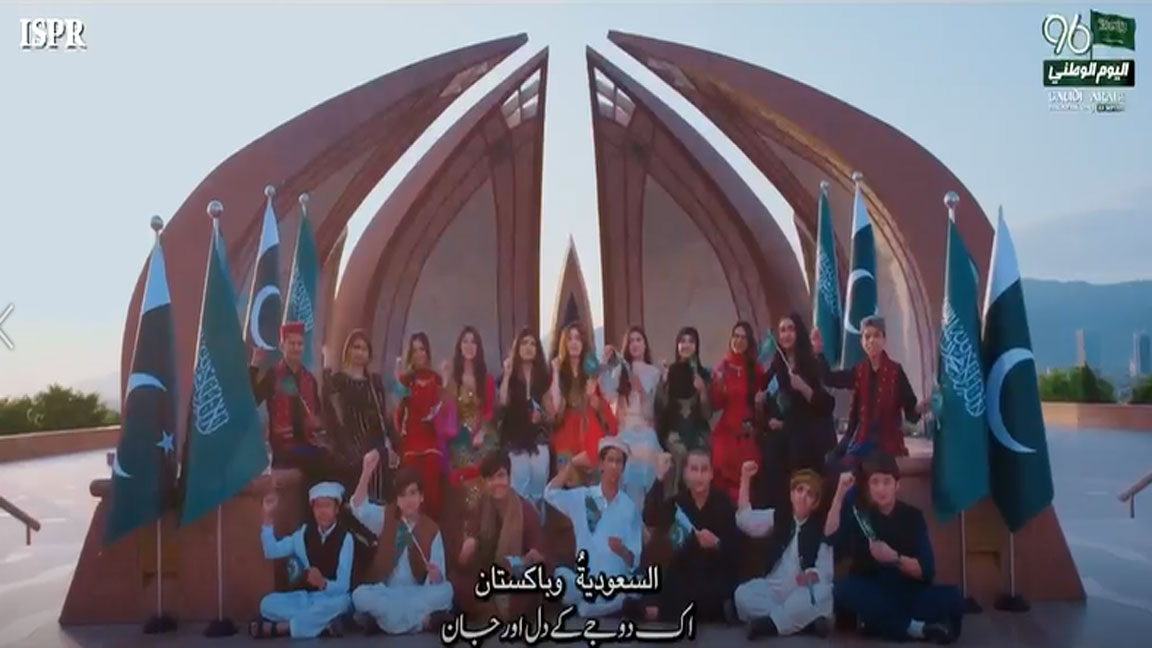
On September 23, Pakistan military’s Inter-Services Public Relations released “Ek Doojay Kay Dil-o-Jaan”, an Urdu-Arabic tribute for Saudi National Day celebrating Pakistan-Saudi friendship and once again highlighting the Makkah Joint Defence Agreement.
Three songs in seven weeks, God knows somewhere, probably in a pool, DJ Khaled is nodding approvingly.
The big problem is that the agreement soon faced a considerably less musical test.
Houthi forces began striking Saudi cities and infrastructure with missiles and drones — precisely the kind of armed attack the pact was supposedly created to address.
Yet on September 10, Pakistan’s Foreign Ministry said there had been no discussion of a military response under the agreement.
“There is no such thing under discussion right now,” spokesperson Sajjad Haider Khan said, adding: “When time comes we will act under the agreement.”
By then, the attacks had already happened.
That contrast is difficult to ignore.
Pakistan was able to produce three separate musical celebrations of collective defence before publicly confirming that the collective-defence mechanism itself had been activated.
This is not because Pakistan lacks forces in Saudi Arabia or would need months to deploy them. Islamabad already has a substantial military presence in the kingdom, including thousands of personnel and combat aircraft deployed under longstanding defence cooperation.
Nor has Pakistan abandoned Saudi Arabia politically. Defence Minister Khawaja Muhammad Asif said on September 30 that Pakistan would defend the kingdom using “whatever means are available.” He did not, however, confirm whether Pakistani forces had participated in strikes against the Houthis or whether Riyadh had formally requested such action.
The three countries are also holding military meetings. Their chiefs met in Riyadh on September 25 to discuss intelligence sharing, military coordination and integrating their capabilities.
All of that may eventually produce a meaningful collective-defence structure. But as of September 30, the publicly visible record presents an extraordinary picture.
The pact promised that an attack on Saudi Arabia would be treated as an attack on Pakistan and Turkey.
Saudi Arabia was attacked.
Pakistan publicly said no military response under the agreement was being discussed.
And somewhere along the way, Islamabad managed to release three songs about how united everybody is.
The Makkah agreement was promoted as part of a new regional security architecture at a moment when Gulf states are openly questioning the reliability of traditional Western protection.
That makes its first real test important.
Because replacing an unreliable security guarantee requires something more convincing than another unreliable security guarantee with better music, or worse depending on your taste.
For now, the Makkah Joint Defence Agreement has demonstrated at least one capability beyond doubt:
Its soundtrack is fully operational.