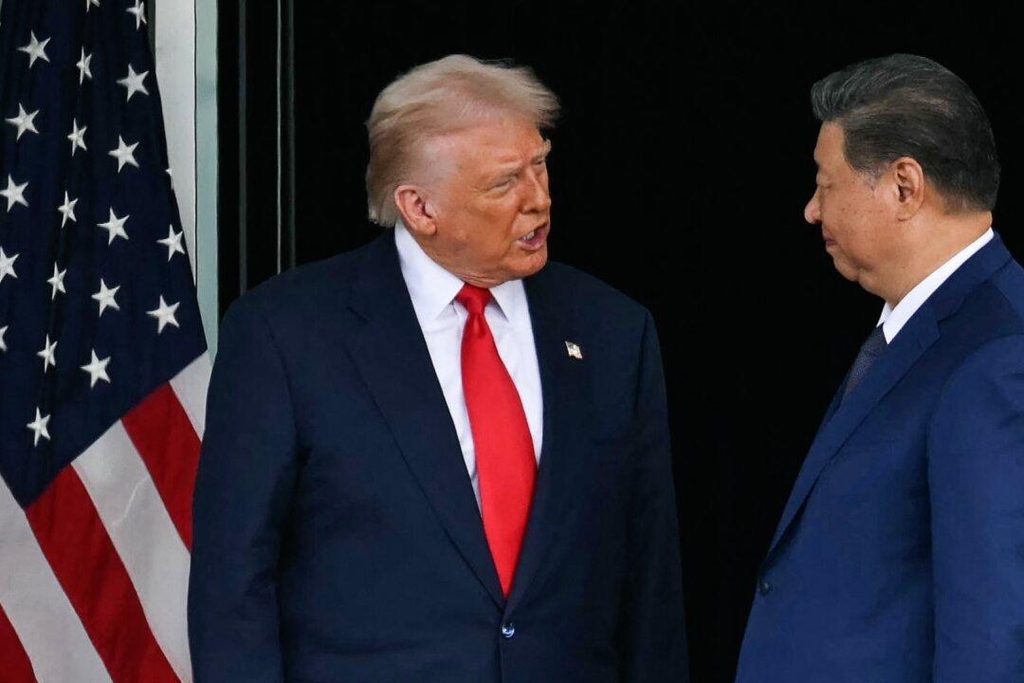
US President Donald Trump and Chinese President Xi Jinping were set for high-level talks at the White House on Thursday, with artificial intelligence emerging as a central issue alongside trade, Taiwan and the war in Iran.
The summit follows an agreement to extend a fragile US-China trade truce, giving the world’s two largest economies more time to negotiate a broader deal as they seek to manage tensions over technology, security and global influence.
Trump said ahead of the meeting that AI, which he has begun calling “superintelligence”, would feature prominently in his discussions with Xi, while indicating that he did not want new restrictions on the technology’s development.
In a post on Truth Social, Trump said he wanted to leave the technology’s existing arrangements unchanged, adding that China shared his position. He pointed to the US Department of Justice as Washington’s safeguard against potential abuses.
The president has also pushed for federal documents to use the term superintelligence instead of artificial intelligence, arguing that the word artificial makes the technology sound fake.
His comments come amid growing debate over the risks of increasingly powerful AI systems and whether governments should establish stronger safeguards without slowing technological development.
Trade truce gives summit an early result
The diplomatic preparations have already produced a limited economic agreement.
US Treasury Secretary Scott Bessent announced on Wednesday that Washington and Beijing had agreed to extend their trade truce by two months, moving its expiration from November 10 to January 10.
The extension followed negotiations with Chinese Vice Premier He Lifeng and is intended to give both sides additional time to explore a more comprehensive economic agreement.
Bessent said the discussions covered outstanding trade commitments, agricultural purchases and the possibility of reducing tariffs on certain goods.
The two sides also discussed AI safety. Bessent said officials had agreed to establish a communications channel for reporting AI-related incidents, although China’s state news agency Xinhua did not publicly confirm the hotline agreement.
Senior officials are expected to continue those discussions in Shenzhen within approximately two months.
Red carpet diplomacy meets strategic rivalry
Xi arrived in Washington on Wednesday for a three-day state visit, receiving an unusual personal welcome from Trump at Joint Base Andrews in Maryland.
The two leaders were joined by their wives for a ceremony featuring a military band, ceremonial cannon fire and a US B-1 bomber flyover.
In a statement issued upon his arrival, Xi called for a more stable relationship and said China and the United States should be partners rather than rivals.
Thursday’s White House programme includes private and expanded bilateral talks, military ceremonies and a state dinner hosted by Trump and First Lady Melania Trump.
Despite the ceremonial welcome, significant disagreements remain.
Taiwan is expected to feature in the discussions, with Beijing seeking to curb US military support for the island, which China claims as its territory. Washington is also seeking to address restrictions on technology and critical minerals.
The war in Iran presents another diplomatic challenge. Trump is expected to seek greater Chinese involvement in efforts to influence Tehran, although Beijing has given little indication that it is prepared to exert the pressure Washington wants.
The summit comes as both countries attempt to maintain economic cooperation while competing over advanced technologies, military influence and international trade.
For now, the clearest concrete result has come before the presidents’ formal talks: an additional two months for trade negotiations.
Whether the Washington meetings produce further agreements on AI, Taiwan or Iran remains unresolved.