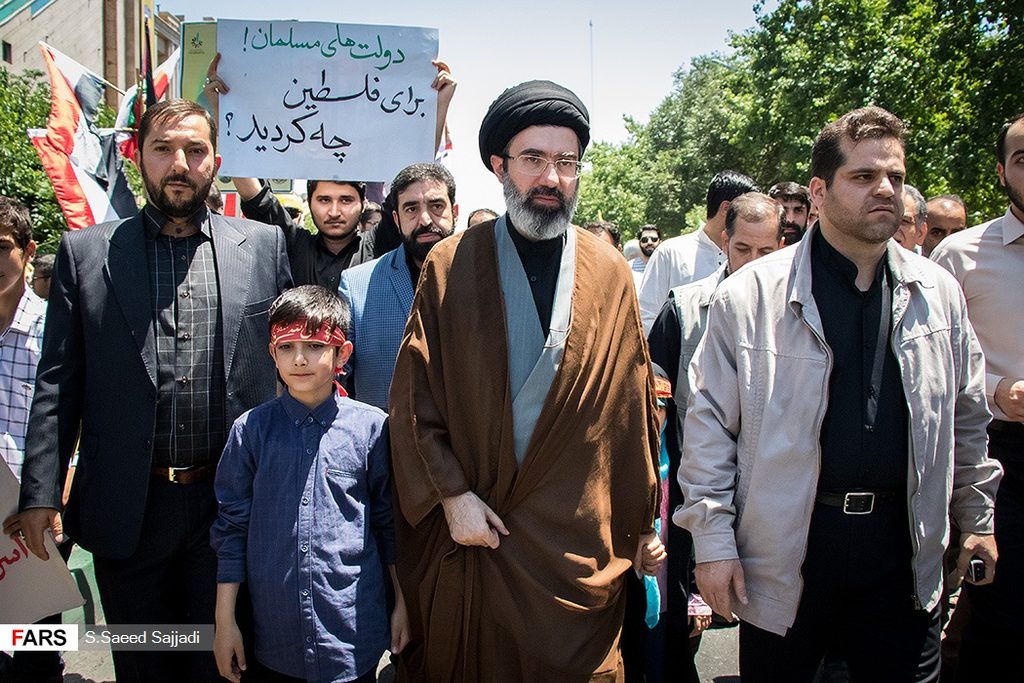
When Iran’s three most senior military commanders met Supreme Leader Mojtaba Khamenei on October 31, they briefed him on the readiness of their forces and received orders on how to respond to another US or Israeli attack, according to Iranian state media. Tehran released no photograph of the meeting. The public account of what Khamenei told his commanders came through the state news agency.
Since succeeding his father, Ali Khamenei, in March, the Iranian leader has issued written statements and, according to Tehran, held talks with the president, parliament speaker, security council secretary and judiciary chief. Yet no independently verified photograph, video or audio recording of him from that period has emerged, Erem News reported on Tuesday. He has also remained out of public view during major state and religious occasions.
That absence has practical consequences for a country at war. President Masoud Pezeshkian has described spending hours with Khamenei, but has also acknowledged how difficult it can be to reach him. Foreign Minister Abbas Araghchi has said the Supreme National Security Council has arrangements for making urgent decisions on negotiations when officials cannot contact the leader, according to Erem News.
The commanders who receive his orders
Iran identified the three men at the October 31 meeting as Revolutionary Guard commander Ahmad Vahidi, armed forces chief of staff Ali Abdollahi and army commander Amir Hatami. According to the official IRNA news agency, Khamenei told them that any new threat from the United States or Israel should draw an immediate response without geographic limits.
Vahidi had already emerged as one of the few officials reported to have a direct line to Khamenei. Erem News cited a US study published in April that described the Guard commander relaying instructions to military and security institutions at a time when other senior figures struggled to reach the leader.
The October announcements put several civilians among those Tehran says have spoken to him. On October 21, Iranian institutions said Parliament Speaker Mohammad Baqer Qalibaf had discussed the war, the economy and relations with Iran’s strategic partners with Khamenei. Qalibaf later spoke publicly about the meeting. Tehran also announced talks that month between Khamenei and judiciary chief Gholamhossein Mohseni Ejei on corruption cases and compensation for wartime losses.
A message to Moscow
Mohsen Rezaei, secretary of the Supreme National Security Council, has taken on a visible role in diplomacy conducted in Khamenei’s name. On October 27, Tehran announced that Rezaei had met the leader a day after talks with representatives of Saudi Arabia, Turkey and Pakistan. The official account said the discussion covered the council’s role in coordinating political, military and economic decisions.
On November 5, Russian President Vladimir Putin received Rezaei at the Kremlin. Iranian state media said Rezaei delivered a message from Khamenei. Rezaei said afterwards that his talks with Putin had covered regional security and what arrangements might follow the war.
Photographs documented the Kremlin meeting. How Khamenei conveyed the message to Rezaei remains unclear.
Rezaei took over the council secretariat in August from Mohammad Baqer Zolqadr, who became a political adviser to Khamenei. Erem News cited reports of disagreements within the leadership over negotiations with Washington, with some figures close to the supreme leader favouring a larger role for Rezaei at Qalibaf’s expense. Tehran’s accounts place both men in contact with Khamenei but give little indication of whose advice he follows when they disagree.
Conflicting accounts of the president’s access
Pezeshkian gave one of the earliest public accounts of meeting the new leader. In May, he said the two had spoken candidly for two and a half hours. He did not say where or when the conversation took place.
Iran International published a different account on August 4. Citing unnamed sources familiar with the episode, it reported that Pezeshkian had been driven to an undisclosed location in Tehran and seated in a car with tinted windows beside a man introduced to him as Khamenei. The sources said the encounter lasted only minutes.
Their account has not been independently verified.
Pezeshkian’s own descriptions of access have varied over time. On July 21, he said his contacts with Khamenei were becoming more frequent. By early August, he was saying communication was very difficult. On August 9, state media disclosed another meeting, said to have taken place in late July, on military and economic affairs. Erem News also cited later reports of a lengthy discussion in August.
The officials around the leader’s office
Beyond those named in the official announcements are figures whose influence predates the succession. They include Hossein Taeb, the former Revolutionary Guard intelligence chief who has longstanding ties to Mojtaba Khamenei, and Mohammad Ali Jafari, a former Guard commander who retains extensive contacts in the armed forces. Gholam Ali Haddad-Adel, Khamenei’s father-in-law, has long been associated with political circles around the family.
Little public information establishes whether any of them has seen Khamenei in recent weeks or decides who can speak to him, Erem News reported. The same uncertainty surrounds Zolqadr, despite his formal appointment as an adviser.
Mohamed Youssef al-Nour, a researcher on Iranian affairs, told Erem News that public appearances by the supreme leader traditionally served two purposes in Iran. They reinforced his authority and allowed Iranians to see senior officials gathered around him. Written statements give the public little basis for judging whether Khamenei can exercise his powers in person. Al-Nour raised the possibility of serious injury or death while acknowledging there was no conclusive evidence for either.
For officials handling the war and negotiations with Washington, the immediate question is who can obtain a decision when one is needed. Araghchi’s account offers a partial answer for urgent negotiating matters. The security council can act when Khamenei is unreachable.
What Tehran has yet to explain is who decides which matters must wait for him, what information reaches him and who has the authority to issue instructions in his name.