Saudi Arabia spends more than almost any country on defence and possesses some of the world’s most advanced weapons. Yet repeated missile and drone attacks have exposed a persistent gap between what the kingdom owns and what it can reliably defend.
Saudi Arabia has spent decades building one of the most expensive military establishments in the world. It operates advanced American combat aircraft, sophisticated missile-defence systems and a sprawling network of military and security forces.
Yet in September, air raid warnings again sounded across the kingdom as Yemen’s Houthis launched missiles and drones at Saudi targets, including Riyadh and the Khamis Mushait airbase. Saudi forces intercepted some incoming weapons, but attacks have continued to threaten airports, military installations and critical energy infrastructure.
That raises an uncomfortable question for Riyadh: why does one of the world’s biggest military spenders remain so vulnerable?
The answer is not simply that Saudi Arabia lacks weapons. It has plenty.
According to the Stockholm International Peace Research Institute, Saudi military expenditure reached $83.2 billion in 2025, making it the world’s eighth-largest military spender. Pakistan, by comparison, spent about $11.9 billion.
Saudi Arabia was also the third-largest importer of major arms worldwide between 2021 and 2025, accounting for 6.8 percent of global imports. It was the single largest recipient of American arms during that period, receiving 12 percent of all US weapons exports.
The Saudi government itself allocated 272 billion riyals — roughly $72.5 billion — to the military sector in its 2025 state budget. Differences between that figure and SIPRI’s estimate reflect differing definitions of military expenditure.
In other words, Saudi Arabia’s problem is not a shortage of money.
Expensive weapons, persistent vulnerability
The warning signs are not new.
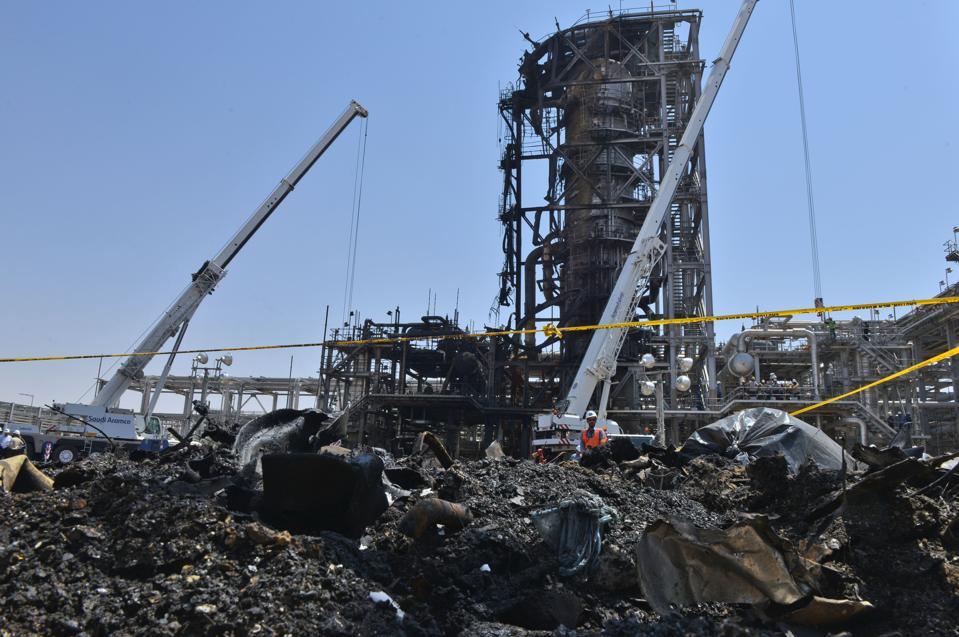
In September 2019, attacks on the Abqaiq and Khurais oil facilities temporarily knocked out around 5.7 million barrels per day of Saudi production, more than half of the kingdom’s output at the time and roughly 5 percent of global oil supply.
Seven years later, the vulnerability remains.
During the regional war in 2026, drone and missile attacks again affected Saudi energy facilities. In March, operations at the Ras Tanura refinery were halted as a precaution after drone attacks. In September, strikes damaged pumping stations on the East-West Pipeline, temporarily disrupting a route that had become even more important because of instability around the Strait of Hormuz.
No air-defence network can guarantee that every missile or drone will be intercepted. Saudi systems have successfully destroyed many incoming weapons.
But the frequency with which relatively inexpensive drones and missiles can threaten infrastructure worth billions of dollars illustrates a deeper imbalance: possessing advanced weapons is not the same thing as creating an integrated defence system capable of protecting a vast country, its cities, oilfields, ports, pipelines and military bases simultaneously.
An army designed with the palace in mind
There is also a political explanation.
For decades, scholars of Saudi civil-military relations have examined what is known as “coup-proofing” — organising armed institutions in ways that prevent any single military organisation from accumulating enough power to threaten the ruling system.
Saudi Arabia became one of the classic examples studied by political scientists.
James Quinlivan, in an influential study of Middle Eastern militaries, identified the use of parallel armed forces, competing security institutions and carefully cultivated loyalties as mechanisms used by governments including Saudi Arabia to reduce coup risks. The trade-off, he argued, can be reduced overall military effectiveness.
Saudi Arabia historically maintained not simply a conventional military but powerful security institutions outside it, most notably the Saudi Arabian National Guard, which developed separately from the regular armed forces.
Political scientist Zoltan Barany has similarly argued that Gulf monarchies cultivated privileged military units and institutional rivalries partly to ensure political loyalty, while highly concentrated decision-making could hinder military effectiveness.
That does not mean today’s Saudi military is unchanged. Crown Prince Mohammed bin Salman has pursued extensive military restructuring, localisation of defence production and attempts to professionalise the armed forces.
Nor should every Saudi military weakness be explained through coup prevention. Recent scholarship has cautioned against simplistic claims that Gulf forces are inherently ineffective, noting that several have developed substantially more sophisticated capabilities and operational experience.
But the historical structure still matters.
A military designed partly around political reliability can face different incentives from one built from the ground up around decentralised command, battlefield initiative and cooperation between services.
Yemen exposed the limits
The Yemen war provided the most prolonged test.
When Saudi Arabia intervened militarily in 2015, it possessed overwhelming advantages in aircraft, precision weapons, surveillance systems and funding.
Yet technological superiority did not produce a decisive political or military victory over the Houthis.
Researchers studying the campaign have repeatedly pointed to shortcomings in coordination, training, command structures and the difficulty of translating air superiority into control on the ground. The war also demonstrated that military performance cannot be measured simply by counting aircraft, tanks or defence spending.
More than a decade after the intervention began, the Houthis have not disappeared. In September 2026 they were again launching missiles and drones deep into Saudi territory while making significant territorial gains inside Yemen.
That is perhaps the starkest measure of the problem.
Dependence has a cost
Saudi Arabia also remains heavily dependent on foreign suppliers.
SIPRI found that the United States supplied 74 percent of Saudi major-arms imports in 2020–24, followed by Spain with 10 percent and France with 6.2 percent. Riyadh is trying to develop its domestic defence industry under Vision 2030, but SIPRI says dependence on imported weapons is unlikely to disappear soon.
Foreign dependence does not make a military weak by itself. Many highly capable armed forces rely on imported equipment.
But advanced aircraft and missile systems require maintenance, ammunition, software support, spare parts, intelligence and extensive training. Purchasing the platform is only the beginning.
Saudi Arabia therefore faces an unusual paradox.
It has enormous financial resources, some of the world’s most sophisticated weaponry and longstanding security relationships with major military powers.
Yet the threats confronting it have evolved faster than the security model built to contain them.
Cheap drones can target billion-dollar installations. Mobile missile launchers can threaten cities hundreds of kilometres away. Pipelines, refineries, airports and desalination plants create an enormous number of potential targets. And groups such as the Houthis do not need to defeat the Saudi military conventionally — they only need enough weapons to penetrate its defences occasionally.
So the question is not whether Saudi Arabia possesses a powerful military.
On paper, it unquestionably does.
The more difficult question is whether decades of extraordinary military spending have produced a defence system capable of converting that wealth into resilient national security.
The repeated attacks on Saudi territory suggest that the answer remains far less certain than the size of the kingdom’s defence budget would imply.