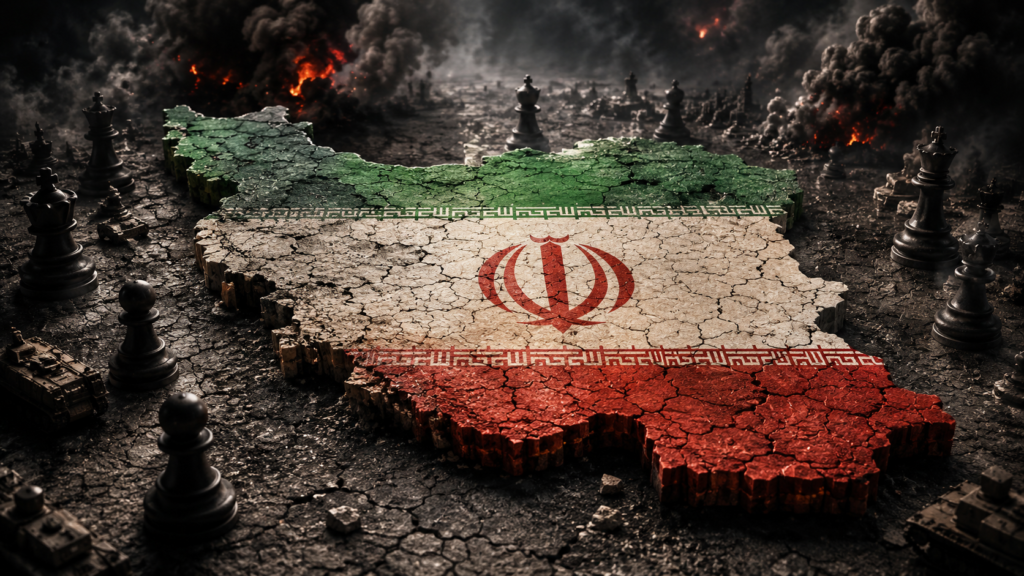
The war spreading across the Middle East is not spiralling out of control.
It is moving in the direction the American deep state appears to want.
Iran has been bombed, penetrated and decapitated at the highest levels, but it has not been destroyed. Senior commanders have been located and killed. Iranian airspace has repeatedly been breached. Military sites once presented as untouchable have been struck with ease.
Yet enough of the regime remains standing to retaliate. Enough of its missile capability survives to threaten the region. Enough of its leadership is still alive to keep the conflict moving into its next phase.
From the opening days of the war, the United States and its allies showed that they possessed extraordinary intelligence on Iran’s military command.
Tier-one, tier-two and tier-three figures were removed with astonishing speed. Washington and its partners seemed to know where Iran’s most important men were, how they communicated and when they were vulnerable.
A coalition capable of doing that could have wrapped this up ten times already.
It has chosen not to.
Instead, Iran has been left in exactly the condition needed to prolong the war: badly wounded, deeply humiliated and still capable of striking back.
Every Iranian retaliation then becomes the justification for another American or allied attack. Every missile fired at a base, every drone launched at an energy facility and every strike on a tanker expands the battlefield.
The reported drone attack against a US-owned gas storage vessel at Egypt’s Mediterranean port is only the latest step.
What began around Iran and Israel is now drawing in Iraq, Jordan, Saudi Arabia, Yemen, the Red Sea and potentially Egypt’s Mediterranean coastline.
Sunni Arab states are no longer watching from the sidelines. They are being pushed towards open involvement.
Shipping lanes are turning into military corridors. Energy infrastructure is becoming part of the battlefield. American bases are being targeted, while Iranian-backed groups are being struck across several borders.
This regional war is rapidly becoming something much larger.
Iran is being preserved, not spared
The standard explanation is that the United States is showing restraint.
That explanation is becoming harder to accept.
Real restraint would involve building a credible route out of the conflict. It would mean reducing Iran’s incentive to retaliate, keeping meaningful diplomatic channels open and preventing new countries from being dragged into the fighting.
We are watching the opposite.
Iran is being hit hard enough to force a response, but not hard enough to remove its ability to respond.
Its military command has been damaged but not erased. Its armed forces have been degraded but not neutralised. Its political system has been shaken but not dismantled.
The result is a country trapped in a cycle of retaliation.
Iran cannot simply absorb repeated attacks without responding. Any government in Tehran must prove that it can still impose costs, or it risks losing deterrence abroad and authority at home.
Washington understands that.
Israel understands it.
The permanent American security establishment understands it better than anyone.
Iran is being left with enough power to ensure that another retaliation will come. That retaliation will then be presented as the reason the next escalation had no alternative.
The sequence is now familiar.
A commander is killed. Iran responds.
A base is attacked. Washington retaliates.
A tanker burns. Shipping routes are militarised.
A pipeline is struck. Another government joins the conflict.
Each step is presented as an isolated response to the one before it. No one, we are told, is directing the wider process.
Yet the process always leads to war growing.
Trump and Netanyahu are playing good cop and bad cop
A central part of the performance is the idea that Donald Trump and Benjamin Netanyahu represent two competing approaches.
Netanyahu plays the bad cop. He threatens destruction, demands escalation and pushes the boundaries of what the region will tolerate.
Trump plays the good cop. He talks about negotiations, claims to be holding Netanyahu back and presents himself as the only man standing between the region and something worse.
Netanyahu bombs.
Trump pauses.
The pause ends.
The bombing resumes.
This routine worked more effectively during the Gaza war.
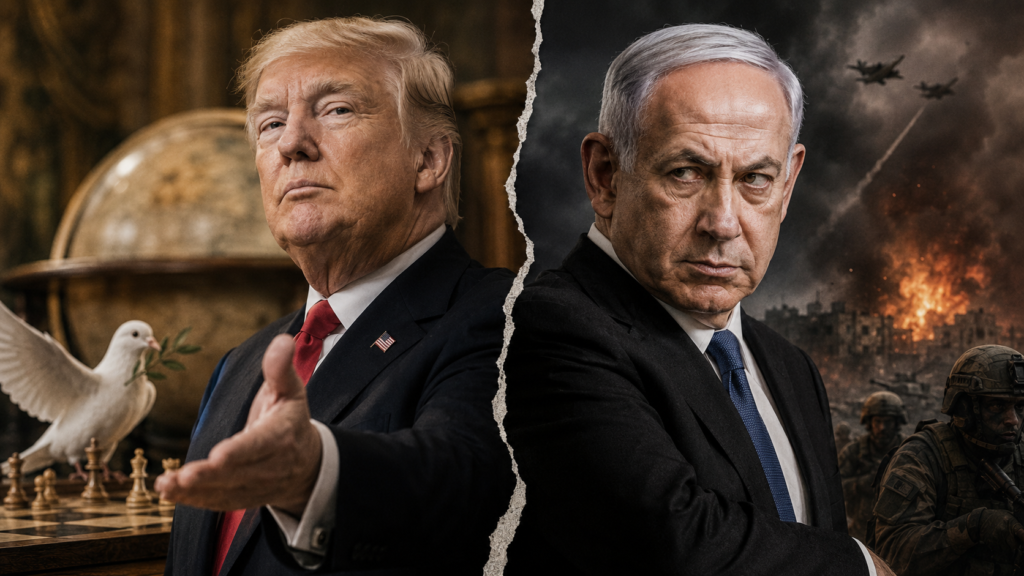
Trump could present himself as the man pressuring Netanyahu, demanding concessions and seeking pauses, while Israel’s prime minister absorbed most of the international anger.
Washington preserved the fiction that it was an outside mediator rather than the essential political, military and financial sponsor of the entire operation.
The performance gave the United States distance without forcing it to change the policy underneath.
But the routine has not transferred well to the Iran-US-Israel war.
The stakes are far higher. American involvement is much more direct. The coordination is too visible, and the division of labour is becoming too obvious.
Trump cannot convincingly claim to be restraining Netanyahu while American aircraft, intelligence systems, bases, air defences and regional allies are all operating inside the same war.
They should have rewritten the script.
Instead, they carried the Gaza version into a much larger conflict and expected everyone to keep believing it.
Arab and Muslim media have played along. Every report that Trump has rebuked Netanyahu, shouted at him, warned him or supposedly lost patience with him is treated as proof of a serious rupture.
The public is encouraged to follow the argument rather than the policy.
This show has been running since Hamas’ October 7, 2023 attack.
Remember that day?
Thousands of Hamas-led fighters and other armed men crossed into southern Israel, attacked communities and military positions, killed around 1,200 people and abducted roughly 250 hostages.
And somehow, we were expected to believe that no one across Mossad, Shin Bet, Israeli military intelligence or Israel’s vast surveillance apparatus saw anything significant coming.
A country capable of monitoring phones, borders, tunnels, financial transfers and individual militant commanders somehow missed preparations for the largest attack in its history.
Whatever.
Israel does not control the United States
The most absurd explanation for this relationship is the popular claim that Israel controls American foreign policy.
It does not.
Israel is the vassal state.
The United States is the empire.
Israel possesses influence in Washington. Its supporters exert pressure through lobbying organisations, campaign finance, media networks, intelligence relationships and political alliances.
Israeli leaders can exploit divisions inside the American system. They can push aggressively for policies that benefit Israel. They can embarrass presidents, provoke crises and attempt to shape the timing of American decisions.
But influence is not control.
A country dependent on American weapons, diplomatic protection, intelligence support, financial assistance and strategic cover is not the master of the country providing all of those things.
Israel cannot sustain its regional military dominance without the United States.
The United States can survive without Israel.
That fact alone reveals the real hierarchy.
Washington does not support Israel because Netanyahu commands Washington.
Washington supports Israel because Israel performs a strategic function for American power.
It is a heavily armed forward base positioned at the centre of the Middle East.
It provides intelligence, military reach, technological cooperation and a permanent mechanism for pressuring governments that resist the Western regional order.
Israel acts aggressively because aggression is part of its assigned value.
It absorbs regional hostility that might otherwise be directed more openly at Washington. It attacks targets that the United States may prefer not to strike under its own flag. It creates facts on the ground, destroys emerging threats and keeps the region divided, militarised and dependent on American protection.
Israel is dangerous precisely because it is protected.
But protection should not be confused with control over the protector.
The relationship extends far beyond Trump and Netanyahu.
It is embedded across the American deep state: the Pentagon, intelligence agencies, defence industry, congressional leadership, diplomatic establishment, donor networks and permanent national-security bureaucracy.
That is why arguments centred entirely on the personal relationship between Trump and Netanyahu miss the point.
Their chemistry may affect tone, timing and presentation, but it does not determine the strategic foundation of the alliance.
Neither man created the system.
Both operate within it.
The Abraham Accords are becoming a wartime loyalty test
This is where the Abraham Accords enter the picture.
They were never merely a collection of diplomatic agreements between Israel and individual Arab governments.
They were the beginning of a regional sorting mechanism.
The next phase will be far more aggressive.
Every government that once considered relations with Israel politically impossible will be placed under extraordinary pressure to sign.
States will be offered security guarantees, weapons, investment, debt relief, intelligence cooperation and access to Washington.
Those that still resist will face isolation, sanctions, destabilisation, economic pressure or abandonment..
The Abraham Accords are being transformed into a loyalty oath for the coming global confrontation.
The choice presented to Gulf and Muslim governments will not simply be whether to recognise Israel.
It will be whether they belong to the Western-Israeli security order or to the rival system emerging around China, Russia and the wider Global South.
That is why the war must expand before the final diplomatic architecture is imposed.
Governments that would never voluntarily sign an agreement with Israel may do so after their shipping lanes are attacked, their energy facilities are threatened, their airspace becomes militarised and their ruling systems are made to feel exposed.
Fear will achieve what diplomacy could not.
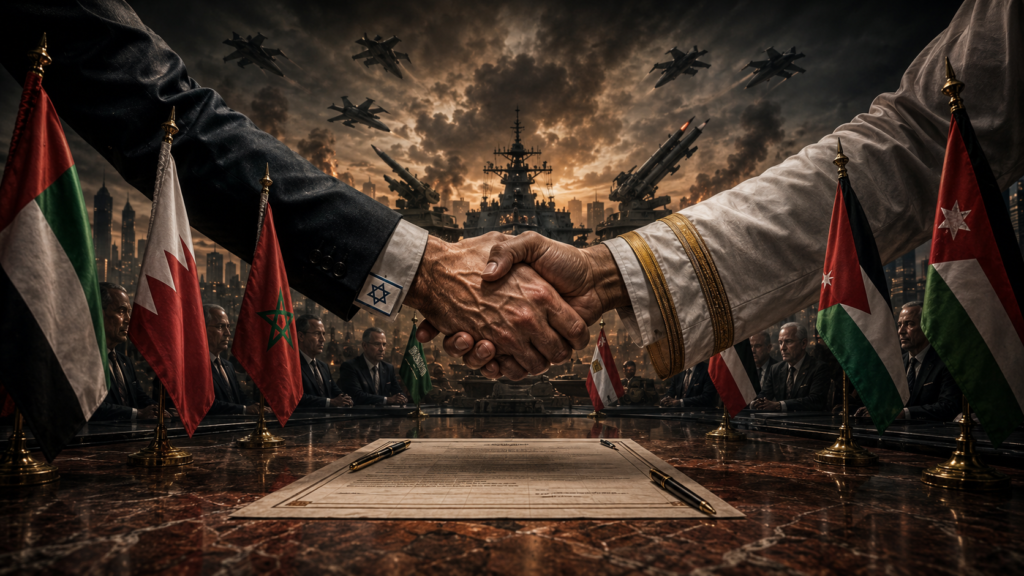
Iran’s survival serves this purpose too.
A permanently threatening Iran gives Washington the instrument it needs to discipline the Gulf.
Every drone attack, missile launch and maritime incident strengthens the argument that Arab governments cannot defend themselves without American intelligence, Western air-defence systems and security coordination with Israel.
The deeper the crisis becomes, the easier it is to sell Israel not as the region’s enemy, but as its necessary military partner.
Israel is gradually being repositioned from an isolated occupying state into the armed centre of a Western-sponsored regional alliance.
The Gulf monarchies will be expected to join.
Egypt and Jordan are already locked into the architecture.
Saudi Arabia will face relentless pressure.
The smaller Gulf states will follow because their security depends on systems Washington controls.
North African governments will be targeted next.
And eventually, almost every major Muslim state will be confronted with the same choice.
Sign, integrate and accept the Western-Israeli regional order—or risk being classified as part of the enemy camp.
The coming battle is about picking sides
The larger confrontation is not simply between Israel and Iran.
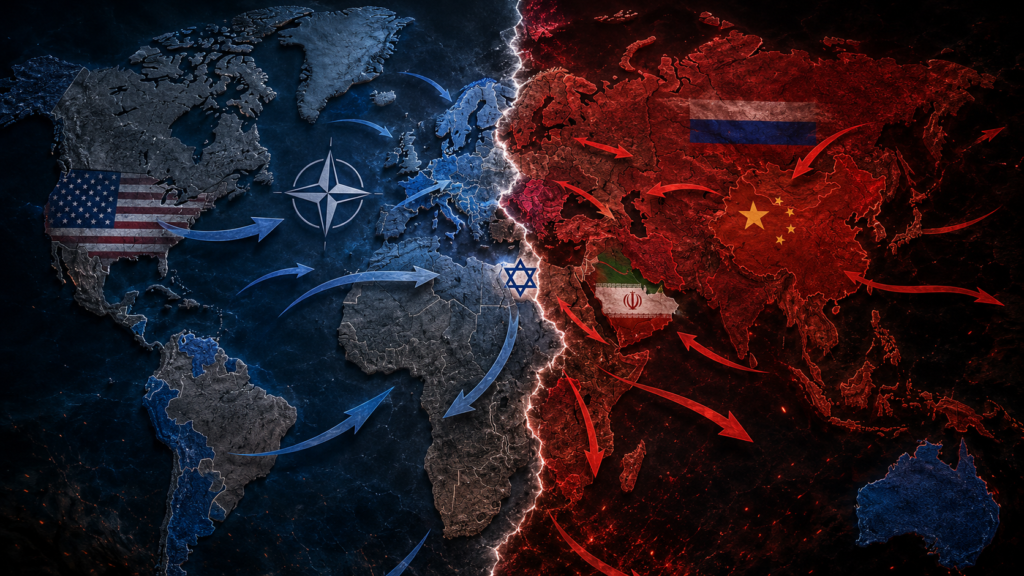
It is between competing global systems.
On one side stands the United States, NATO, Israel and the governments being absorbed into their military, technological and financial networks.
On the other stands China, Russia, Iran and a less organised collection of states attempting to escape Western control.
The Global South may talk about neutrality, multipolarity and strategic autonomy, but the space for genuine neutrality is being deliberately eliminated.
Governments will be forced to choose through arms contracts, sanctions, energy routes, banking access, intelligence partnerships and security agreements.
The Abraham Accords will become one of the principal tools for identifying who stands where.
Signing will mean more than opening an embassy or establishing commercial flights.
It will mean integrating air-defence systems, sharing intelligence, coordinating maritime security and placing national military infrastructure inside a Western-led command structure.
It will mean choosing the United States and Israel over China, Russia and the emerging alternative order.
That is why the eventual inclusion of nearly every Gulf state is not difficult to imagine.
They are already dependent on Western weapons, American bases, dollar-based finance and external security guarantees.
The war will simply provide the pressure required to formalise what already exists.
Even governments that condemn Israel publicly may conclude that regime survival requires private or open alignment.
The contradiction will be explained away as necessity.
The real targets are Russia and China
The ultimate targets are not merely Tehran and its armed allies.
The larger confrontation is with Russia and China.
Washington understands that neither Moscow nor Beijing can indefinitely remain outside a conflict that threatens the global energy system, shipping lanes, military alliances and the balance of power across Eurasia.
China depends heavily on energy flows from the Middle East.
A prolonged war around the Gulf, the Strait of Hormuz and the Red Sea places direct pressure on Chinese economic security.
The longer the war continues, the harder it becomes for Beijing to remain politically, economically and militarily detached.
But if energy routes, commercial shipping and allied governments are placed under sustained pressure, Beijing will eventually be forced to act.
Russia faces a similar trap.
It is already tied down in Ukraine, under sanctions and locked in confrontation with NATO.
A wider Middle East war forces Moscow to choose between abandoning partners, diverting resources or expanding its confrontation with the West.
That is the strategic objective.
Stretch both powers.
Force them to commit.
Merge separate conflicts into one global contest.
Ukraine, Iran, the Gulf, the Red Sea and eventually the Indo-Pacific are not isolated crises.
They are fronts in the same emerging war.
The missile-shortage story looks like bait
The US and NATO missile-shortage narrative should also be treated with deep suspicion.
NATO officials and Western governments repeatedly announce that they are short of missiles, interceptors and ammunition.
Their own media amplifies the message.
Officials speak publicly about depleted inventories, limited production and the inability to sustain multiple wars.
We are expected to believe that the world’s most powerful military alliance is advertising its most dangerous weakness to every potential enemy on Earth.
Military powers do not repeatedly broadcast genuine strategic vulnerability without a purpose.
If the shortages were as catastrophic as claimed, NATO would not be advertising them through speeches, briefings, reports and friendly media channels.
It would conceal exact weaknesses, accelerate production quietly and avoid encouraging adversaries to test the limits.
Instead, the message is repeated constantly.
The West is running out.
That message may be bait.
It invites Iran to escalate.
It encourages Russia to believe NATO can be exhausted.
It tempts China to conclude that the United States is overstretched.
It creates the impression of a vulnerable empire running out of weapons while simultaneously justifying unprecedented rearmament, larger defence budgets and emergency industrial expansion.
The deep state wants its adversaries to believe that this is the moment to move.
That is how traps work.
At some point, stupidity stops being convincing
The public is encouraged to interpret every escalation as another accident, miscalculation or irrational act.
But this explanation requires us to believe that every major actor has suddenly become incompetent at the same time.
It requires us to believe that the United States can locate and eliminate Iran’s most protected commanders but cannot anticipate Iranian retaliation.
It requires us to believe that Washington wants de-escalation while repeatedly creating conditions that make de-escalation impossible.
It requires us to believe that Trump is restraining Netanyahu while the United States supplies the machinery that makes Netanyahu’s wars possible.
It requires us to believe that Israel controls the superpower upon which its own military survival depends.
It requires us to believe that NATO is desperately vulnerable while loudly advertising that vulnerability to Russia, China and Iran.
It requires us to believe that every new front is an unfortunate surprise, even as the same pattern repeats across the region.
At some point, stupidity becomes a less convincing explanation than design.
The American deep state does not need to control every missile, drone or political decision.
It does not need to script every attack.
It only needs to shape the environment, preserve the principal enemy and ensure that each actor responds predictably.
Washington then presents itself as the indispensable power managing a crisis that its own strategic system helped construct.
Iran could have been destroyed quickly, or at least struck so decisively that its capacity for regional escalation was broken.
Instead, it has been kept alive as a wounded predator.
Its continued existence serves a purpose.
It keeps Israel mobilised.
It pushes Sunni states towards Washington.
It threatens Chinese energy security.
It burdens Russia.
It justifies the largest Western military expansion in decades.
And it creates the conditions required to force the Muslim world into a new security architecture built around Washington and Israel.