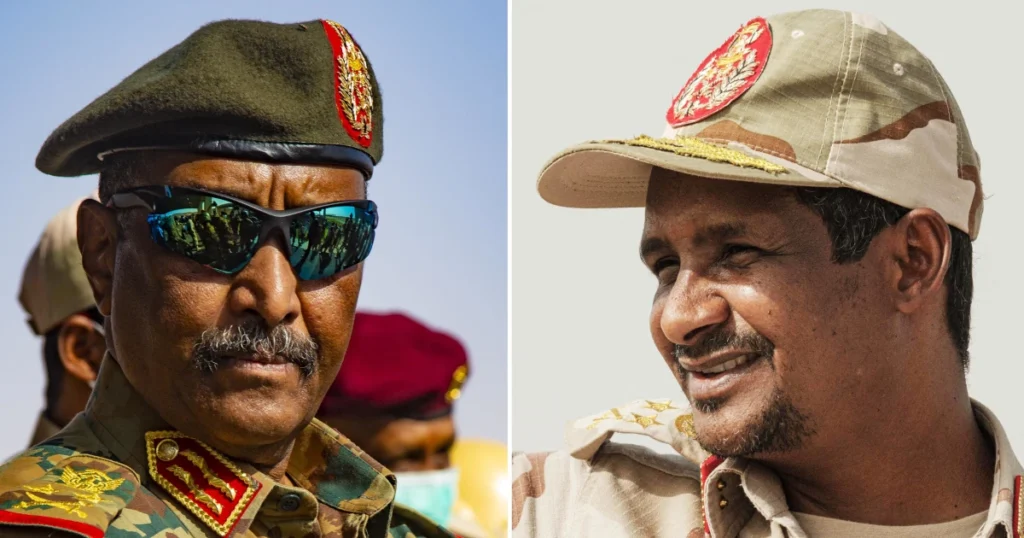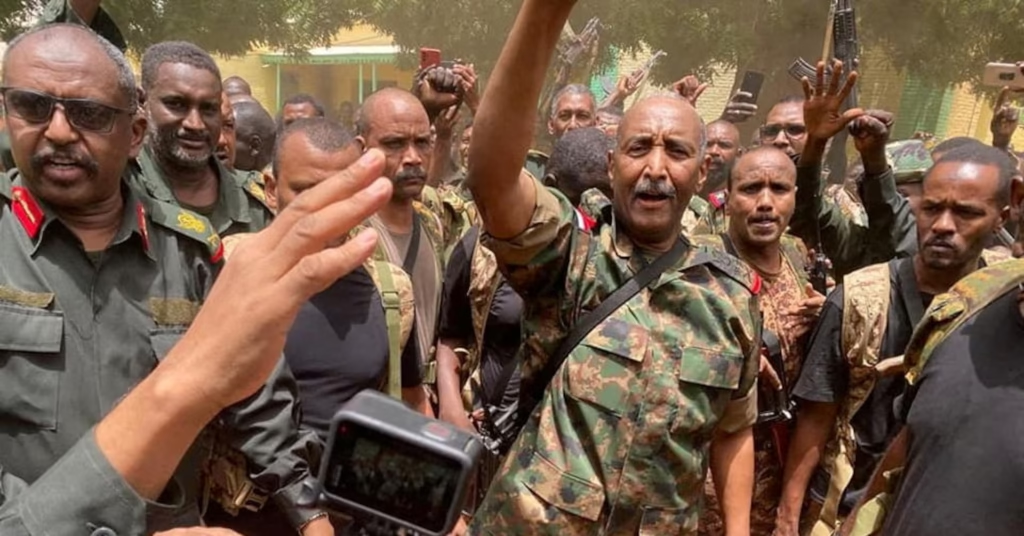
Sudan’s SAF chief and head of the Transitional Sovereignty Council, Abdel Fattah al-Burhan, is pinning his hopes on a major Pakistani weapons deal as part of a strategy aimed at achieving a decisive military victory and consolidating his grip on power, despite mounting international pressure to halt the war.
Pakistan is preparing to supply General al-Burhan’s army (SAF) with weapons and aircraft under a deal valued at around $1.5 billion, according to informed sources. The move provides fresh evidence of Burhan’s determination to prolong the conflict with the Rapid Support Forces (RSF), even as international and UN-led efforts push for an immediate ceasefire in a war that has displaced millions and triggered what is widely described as the world’s worst humanitarian crisis.
The development underscores Burhan’s clear preference for a “military solution,” dismissing growing international calls for an unconditional ceasefire. The deal with Pakistan—tacitly backed by China—also signals a notable shift toward the “Eastern and Asian camp,” as Sudan’s military leadership seeks to bypass US and European pressure that conditions military support on ending hostilities and returning to a civilian democratic transition.
Rather than entering negotiations as an equal party, the SAF appears intent on returning to the table from what it hopes will be a position of victory, in order to impose what critics describe as maximalist demands, chief among them the complete dismantling of the RSF. In this context, Burhan has rejected multiple international initiatives, including the Quad mechanism and proposals for a long-term truce, arguing they would merely “freeze the conflict” rather than resolve it. The RSF, by contrast, has repeatedly stated its readiness to engage seriously in a comprehensive and fair political settlement.
Sources familiar with the deal say it includes 10 Karakoram-8 light attack aircraft, more than 200 reconnaissance and combat drones, and advanced air-defense systems.
Retired Pakistani Air Force Air Marshal Amir Masood confirmed that “the deal is effectively sealed,” adding that it also covers Super Mushshak training aircraft, with the potential inclusion of JF-17 fighter jets jointly developed by Pakistan and China.
This qualitative military support—particularly drones and fighter aircraft—could help SAF attempt to regain air superiority, which it has gradually lost as the RSF expanded its use of drones, enabling it to seize control of large and strategically important territories.
The $1.5 billion price tag rivals budgets that could have been used to rehabilitate Sudan’s collapsed public services. Allocating such a sum to arms procurement sends a clear signal that the Port Sudan-based authorities have fully embraced a “war economy,” diverting national resources—most notably gold revenues—to sustain a military arsenal capable of prolonging the conflict for years.
By diversifying arms suppliers and commercial partners, Burhan also appears intent on shielding his rule from potential international sanctions. As the SAF’s traditional airpower advantage erodes due to ground-based air defenses and loitering munitions, Pakistani drones and air-defense systems such as the HQ-9 and HQ-6 are being positioned as tools to restore balance and secure Port Sudan, now functioning as Sudan’s de facto capital.
Ultimately, the deal represents far more than a routine arms purchase. It is a political decision to continue the war to its bitter end. Burhan is betting on hard power to settle the conflict, even if that choice comes at the cost of deepening and prolonging Sudan’s humanitarian catastrophe.